SEP Trends in Green Transport Patents
Intellectual Property Management
May 29, 2026
Rising SEP activity in EV charging, batteries and V2G; top filers, geographic shifts, and licensing cost risks explained.

Green transport is driving a surge in patent activity, with standard-essential patents (SEPs) playing a vital role in advancing technologies like EV charging, battery systems, and vehicle-to-grid (V2G) communication. These SEPs ensure interoperability across systems while balancing fair licensing practices.
Key highlights from the article:
Patent Growth: Green transport patents have grown exponentially, with filings for batteries jumping from 3,000 in 2000 to 41,000 in 2023.
Key Standards:ISO 15118 (plug-and-charge) and IEC standards dominate the EV landscape, shaping how SEPs are used.
Top Players: Toyota, CATL, BYD, and Tesla are leading SEP contributors, with strategies ranging from licensing to open-source approaches.
Geographic Trends: China, Japan, the U.S., South Korea, and Germany account for 90% of global mobility patents.
Challenges for Implementers: Licensing SEPs can lead to high costs, with cumulative royalty fees for 5G-connected EVs reaching $40–$47 per vehicle.
The article emphasizes how SEPs are shaping the future of green mobility, outlining opportunities for patent holders and challenges for companies navigating licensing complexities.
Research Methodology for SEP Analysis
Data Collection and Filtering
The process of identifying SEPs in green transportation begins with a focused filtering approach. Researchers typically rely on a combination of keyword searches, patent classification codes, and technology taxonomy filters to sift through global patent databases. For instance, one major study examining the EV ecosystem reviewed around 170,000 patent families to uncover meaningful trends.
To maintain relevance, patents unrelated to green transportation - such as those for medical transport equipment, toys, or robots - are excluded early in the process. Instead, the analysis zeroes in on core technology areas like EV Charging, Charging Infrastructure, Battery Management Systems (BMS), EV Components, and Charging Management.
Essentiality is evaluated at the claim level rather than for the entire patent. A claim may be deemed technically essential (where compliance with a standard inherently leads to infringement) or commercially essential (where alternatives are economically unfeasible). The connection between a claim and a standard can take various forms: literal, equivalent, implied, or tied to optional features.
After narrowing down the relevant patents, researchers cross-reference them with SEP declarations to ensure alignment with green transportation standards.
Standards and SEP Declarations
Once candidate patents are identified, they are mapped to specific green transport standards by cross-referencing official SEP declarations filed with standards organizations. The table below highlights key organizations and the standards they oversee, which serve as reference points in this analysis:
Organization | Key Standards | Technology Focus |
|---|---|---|
ISO | ISO 15118, ISO 26262, ISO 5474-3 | V2G Communication, Functional Safety, DC Charging |
IEC | IEC 61851, IEC 62660, IEC 62840 | Charging Modes, Battery Testing, Battery Swapping |
SAE | SAE J3400, SAE J3068 | NACS Charging, Three-Phase AC Power Transfer |
ETSI | ITS-G5, C-V2X | Intelligent Transport Systems |
Among these, ISO 15118 plays a critical role, as it governs plug-and-charge capabilities and vehicle-to-grid (V2G) data exchange, making it a particularly patent-intensive standard. It’s also worth noting that different organizations use distinct timelines for SEP evaluation - while IEEE compares patents at the time of standard approval, ETSI bases its evaluations on the SEP declaration date, which can influence qualification outcomes.
These standards provide a structured framework for deeper analysis using advanced tools.
Tools and Platforms Used
Conducting precise SEP analysis requires powerful analytical tools. Platforms like the WIPO Patent Momentum Indicator and swimy are utilized to track trends effectively. Additionally, Patently offers advanced SEP analytics, including semantic search tools that help uncover relevant patent families and visualize trends across extensive datasets. These platforms empower patent professionals, OEMs, and technology developers to make well-informed, strategic decisions in the green transportation sector.
"The companies that proactively map their SEP exposure, participate in standards development to shape the IP landscape, and negotiate licensing positions before disputes arise will be far better positioned." - Patent Detectives Editorial Board
Key Trends in Green Transport SEPs
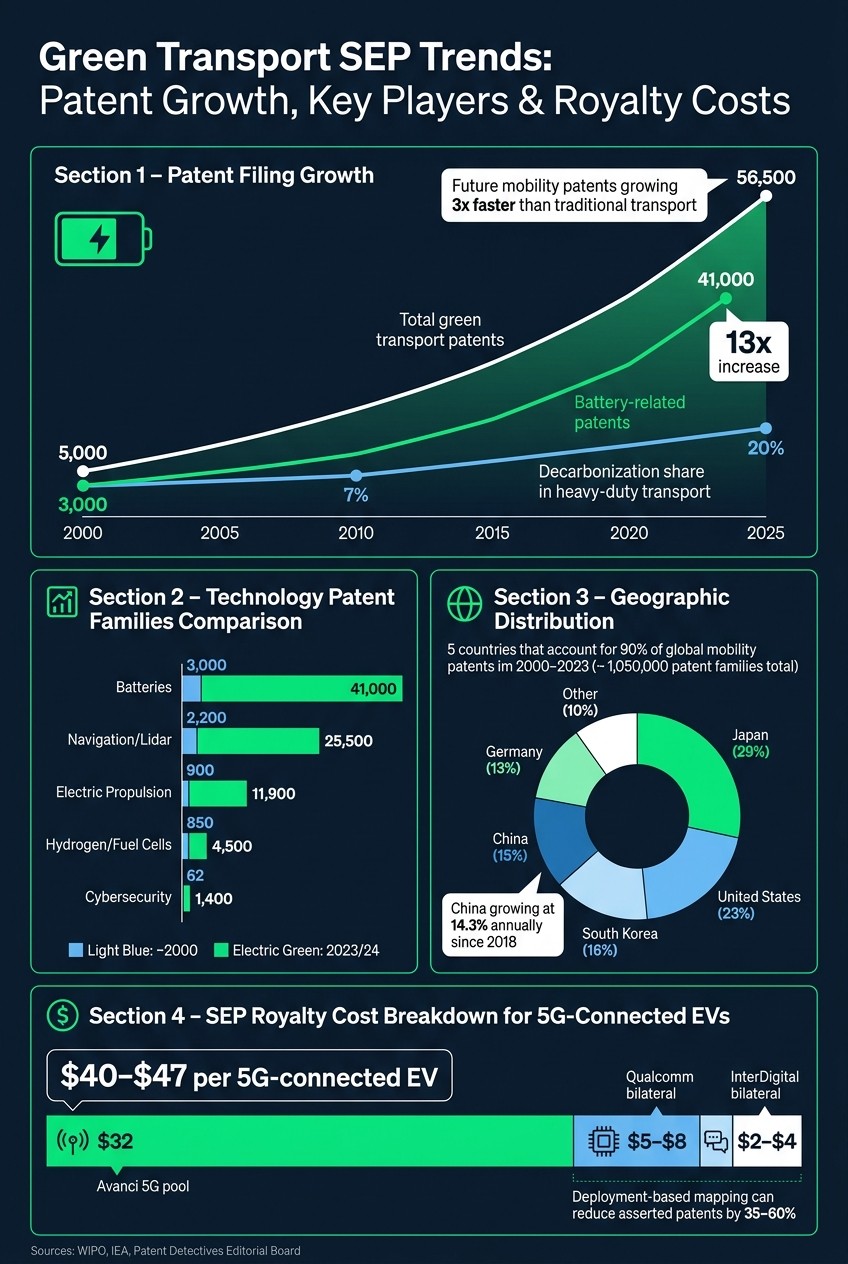
Green Transport SEP Trends: Patent Growth, Key Players & Royalty Costs
Patent Filing Growth Over Time
The number of green transport patent filings skyrocketed from 5,000 in 2000 to an impressive 56,500 in 2025, while filings for fossil-fuel technologies have remained stagnant. Patents related to future mobility are growing at nearly three times the pace of those for traditional transportation. Battery-related patents in mobility have seen a dramatic increase, jumping from 3,000 in 2000 to 41,000 in 2023 - a staggering 13-fold rise. In heavy-duty road transport, the share of patents focused on decarbonization climbed from 7% in 2000 to around 20% in 2024, highlighting the growing emphasis on electrification within commercial fleets.
Technology-Specific Insights
The surge in patent filings reflects a clear shift in innovation priorities, with battery-electric solutions leading the charge. However, other technologies are also gaining traction.
Technology Area | Patent Families (~2000) | Patent Families (2023/24) | Key Trend |
|---|---|---|---|
Batteries | ~3,000 | ~41,000 | Dominating research efforts |
Navigation/Lidar | ~2,200 | ~25,500 | Crucial for autonomous systems |
Electric Propulsion | ~900 | ~11,900 | Growth has slowed recently |
Hydrogen/Fuel Cells | ~850 | ~4,500 | Accelerating since 2019 |
Cybersecurity | ~62 | ~1,400 | Critical for connected vehicles |
Fast-charging standards like CCS, NACS, and CHAdeMO are considered key areas for SEPs within the EV ecosystem. Similarly, Battery Management Systems (BMS) are emerging as a hotbed of intellectual property, with safety and interoperability standards such as ISO 26262 and IEC 62660 becoming focal points.
Hydrogen-related patents, covering both fuel cells and infrastructure, have nearly doubled between 2019 and 2024. This growth is driven by the need for long-haul heavy-duty solutions, where battery weight and range limitations are significant challenges. On the other hand, hybrid vehicle patenting has leveled off as the industry shifts its focus to fully electric designs.
"In the EV industry, the invisible toll road of SEP royalties runs beneath every charger, every battery pack, and every connected vehicle on the road." - Patent Detectives Editorial Board
These developments illustrate the rapidly evolving landscape of innovation shaping sustainable transportation.
Geographic Distribution of SEPs
Shifting the focus to geography, five countries - China, Japan, the United States, South Korea, and Germany - dominate the global SEP landscape, accounting for 90% of future mobility patents. Between 2000 and 2023, these nations collectively generated about 1,050,000 patent families.
China has emerged as the main driver of growth since 2018, with a 14.3% annual increase in future transport-related patents. In the land transport sector, Japan holds the largest share of International Patent Families (IPFs) at 29%, followed by the United States at 23%, South Korea at 16%, China at 15%, and Germany at 13%. Regional specializations are also evident: Germany and Sweden focus heavily on land transport, while Norway and Finland are leaders in sea transport innovation.
China’s strategic approach to SEP accumulation has been particularly noteworthy. Companies like CATL and BYD are actively contributing to international standards organizations such as ISO and IEC, aiming to strengthen their intellectual property positions relative to Western automakers. As one analysis explains:
"China's leading battery manufacturers have observed the telecommunications industry's SEP playbook - most notably Huawei's strategy of contributing heavily to 5G standardization to accumulate SEPs - and are applying similar logic to EV battery standards." - Patent Detectives
For businesses in the U.S., this geographic concentration has practical implications. Keeping a close eye on IP filings from Asian battery manufacturers and tech companies like Huawei and Tencent, which are entering the automotive space, is becoming increasingly important to manage SEP risks.
Leading Innovators in Green Transport SEPs
Top SEP Filers and Assignees
The green transport SEP landscape brings together a mix of traditional automakers, battery experts, and telecom companies, each excelling in specific areas of technology.
Toyota Motor leads the pack with over 37,000 patent family publications in land transport technologies between 2000 and 2023. Its portfolio covers a wide range, including sustainable propulsion systems, fuel cell electric vehicles (FCEVs), and batteries, making it one of the most extensive in the automotive industry. Following Toyota, Denso holds around 18,000 families, focusing on communication, security, and human-machine interfaces. Honda and Panasonic Holdings complete the top four with approximately 15,000 and 12,000 families, respectively.
Hyundai Motor Group stands out with over 100 SEPs in V2X and M2M communication, an impressive number for an original equipment manufacturer (OEM). On the other hand, Ford and General Motors distinguish themselves by patent quality rather than volume, leading the automotive sector in "Competitive Impact", a measure of the average quality of their patent families.
In the battery and charging sector, CATL and BYD are aggressively building their SEP portfolios by contributing technical proposals to IEC and ISO standards committees. This ensures their intellectual property becomes integral to global battery management and charging standards. Among automakers, BYD has shown the fastest growth in patents for sustainable innovation, surpassing both Volkswagen and Hyundai in growth rate between 2017 and 2022.
Tesla has taken a unique approach by transforming its proprietary North American Charging Standard (NACS) into SAE J3400, making it a broadly applicable SEP. The company also embraced an open-source patent pledge. As Elon Musk explained:
"We believe that applying the opensource philosophy to our patents will strengthen rather than diminish Tesla's position in this regard." - Elon Musk, CEO, Tesla
Tesla's strategy of opening up proprietary standards reflects how companies can use such moves to strengthen their position within the green transport ecosystem. This variety of approaches naturally leads to a deeper look at how collaboration across industries is shaping SEP portfolios.
Portfolio Concentration and Collaboration
The value of SEP portfolios today goes beyond just numbers. Analyzing these portfolios often requires using the top patent tools available to IP professionals. Strategic partnerships between industries are increasingly important. For instance, modern electric vehicles depend on connectivity, which brings telecom companies like Qualcomm and Huawei into the fold. These companies own foundational SEPs for 4G/5G and Intelligent Transport Systems (ITS), technologies essential for connected vehicles. This creates a layered licensing environment, where automakers must work with both traditional automotive IP holders and telecom firms.
In June 2024, major European automakers formed the Automotive Licensing Negotiation Group (ALNG) to collectively negotiate FRAND (fair, reasonable, and non-discriminatory) terms for 4G/5G SEPs, streamlining the process and cutting transaction costs. The group includes BMW, Mercedes-Benz, Thyssenkrupp, and Volkswagen, with support from Germany's Bundeskartellamt. Andreas Mundt, President of the Bundeskartellamt, commented:
"Competition law acknowledges that licensors can bundle the patents required for implementing a specific standard to form a package which they offer at fair conditions. Our examination focuses for the first time on a cooperation on the licensees' side." - Andreas Mundt, President, Bundeskartellamt
By July 2025, the European Commission provided informal guidance indicating that the ALNG posed no issues under EU competition law. This was partly due to the group’s combined market share in the SEP demand market being under 15%, and because licensing costs made up less than 1% of a vehicle's total production cost.
Comparison of Leading Assignees
Here’s a summary of the key players, their SEP strategies, and what sets them apart:
Organization | Primary SEP/Patent Focus | Portfolio Size (Families) | Distinguishing Characteristic |
|---|---|---|---|
Toyota Motor | Sustainable propulsion, FCEVs, batteries | 37,000+ | Largest overall portfolio in land transport |
Denso | Communication, security, HMI | ~18,000 | - |
Sustainable propulsion, automation | ~15,000 | - | |
Panasonic Holdings | Battery technology | ~12,000 | - |
Automation, circularity, propulsion | ~11,000 | Key contributor to ISO 15118 | |
Volkswagen | Sustainable propulsion, HMI | ~9,000 | Active in ALNG collective licensing |
Hyundai Motor Group | V2X and M2M communication | Not ranked by family count | 100+ communication SEPs - rare for an OEM |
Qualcomm / Huawei | 4G/5G and ITS standards | Not ranked by family count | Foundational connectivity SEPs for connected vehicles |
CATL / BYD | Battery management and charging | Not ranked by family count | Strong focus on IEC/ISO standardization |
Ford / GM | High-quality sustainable tech | Smaller than Toyota | Highest average patent quality (Competitive Impact) |
Tesla | Charging (NACS/SAE J3400) | 347 | Converted proprietary tech into open industry standard |
What stands out is that the most influential players aren't just filing patents - they’re shaping the standards that make these patents indispensable. Whether through standards committees, collective licensing efforts, or open-source initiatives, these strategies are reshaping the competitive environment in green transportation.
What SEP Trends Mean for Sustainable Mobility
Let’s dive into what these SEP (Standard-Essential Patent) trends mean for the broader sustainable mobility landscape, focusing on both opportunities and challenges for stakeholders in this space.
Opportunities for Patent Owners
The expanding SEP landscape in green transportation opens up lucrative opportunities for patent owners. Companies with SEPs in areas like EV charging, battery management, and V2X (vehicle-to-everything) communication stand to gain long-term licensing revenue from automakers, charging network operators, and energy grid providers.
A strong example of this dynamic is Nokia’s enforcement campaign against Geely in July 2024. By initiating four simultaneous legal proceedings in the UPC Munich, UPC Mannheim, and Munich I Regional Court, Nokia showcased how SEP holders can actively monetize their portfolios as Chinese manufacturers push into European markets. This highlights a key takeaway: getting involved early in standardization efforts can pay off in a big way. A strategically built SEP portfolio can become a major source of revenue as the green transport sector continues to expand globally.
Challenges for Implementers
For companies needing to license SEPs, the situation is far from simple. The biggest headache? Cumulative royalty burdens. Settling with one licensor doesn’t shield companies from demands by others. Take BYD’s experience in 2025 as an example: After being sued by Sol IP in February 2025, they faced additional litigation from IP Bridge in March. Even after settling with IP Bridge in May, the Sol IP lawsuit was still ongoing. Each settlement adds separate costs, which can quickly pile up.
To put this into perspective, royalty fees for a 5G-connected EV can total $40–$47 per vehicle. This includes Avanci’s $32 5G rate, along with bilateral agreements from companies like Qualcomm ($5–$8) and InterDigital ($2–$4). For manufacturers producing at scale, these costs become a significant financial burden. Adding to the complexity, German courts require companies to respond to licensing demands with a substantive counteroffer within 2–3 months. Failing to do so can be seen as "unwillingness", potentially leading to an injunction.
One effective strategy gaining traction is deployment-based mapping. This approach focuses on analyzing SEP exposure based on the specific features activated in a region, rather than the full capabilities of the chipset. By narrowing the scope of asserted portfolios, companies can reduce the patents in question by 35–60% during negotiations. This method offers a practical way to manage costs while navigating SEP demands.
Despite these hurdles, the role of SEPs in green transport remains pivotal, driving innovation and shaping the future of sustainable mobility.
Future Outlook for Green Transport SEPs
The path forward is clear: SEP activity in green transport will continue to grow, mirroring the surge in patents related to sustainability and transportation digitalization discussed earlier. This evolving IP landscape will be something every stakeholder in green transport will need to navigate.
However, there are still gaps to address. Key areas requiring standardization include heavy-duty wireless charging, error code reporting, and end-to-end encryption for EV charging systems. Companies that secure foundational patents in these areas and actively participate in standards committees will be well-positioned to influence future licensing dynamics.
Hyun Jin (HJ) In, Principal at Fish & Richardson, summed it up well:
"If there's a takeaway here for companies and countries, it would be not to neglect your IP efforts, because it many times ends up being the most valuable thing that you have."
Conclusion
Key Takeaways
Standard Essential Patents (SEPs) have become a driving force in advancing green mobility, evolving into a critical element for all players in the sustainable transport sector. Since 2000, patent filings have grown exponentially, with a few leading nations spearheading global advancements. The race to influence and define global standards is becoming more competitive than ever.
Electrification remains the focal point of patent activity, especially in areas like batteries, charging infrastructure, and smart-grid integration. The automotive sector is also undergoing a transformation where understanding SEPs is now as crucial as engineering know-how. To stay ahead, stakeholders need to engage early with standards organizations, map their SEP exposure thoughtfully, and embrace collaborative licensing strategies. These efforts are essential for shaping the future of green transport standards rather than merely reacting to them.
Next Steps for Stakeholders
Given these trends, stakeholders must take deliberate, forward-thinking actions. Patent professionals, innovators, and policymakers should focus on being proactive to avoid risks instead of responding to disputes after they arise. Mapping exposure to key standards like ISO 15118 (Plug & Charge) and V2X protocols is no longer optional - it’s a competitive requirement. Smaller companies and startups, in particular, should consider joining patent pools to gain access to crucial standards while also leveraging their own contributions for revenue.
Tools like Patently can play a pivotal role in this process by providing SEP analytics and semantic search capabilities. These tools help professionals identify relevant patent families, monitor portfolio trends, and anticipate licensing challenges in areas like EV charging and vehicle-to-grid (V2G) communication.
In the EV sector, SEPs act like an "invisible toll road", impacting every charger, battery pack, and connected vehicle. Having access to the right data - and crafting a strategy built on proactive standards engagement - can lead to tangible advantages in this rapidly evolving landscape.
FAQs
What makes a patent “standard-essential” in EV charging?
A patent is considered standard-essential in the context of EV charging when it covers technology necessary to comply with established industry standards such as CCS, ISO 15118, or SAE J3400. These standards are critical for ensuring interoperability and safety, meaning the patented technology becomes a must-have for developing compliant products or infrastructure. Tools from Patently assist professionals in analyzing these standard-essential patents (SEPs), helping them identify potential licensing requirements early in the development process.
How can automakers reduce SEP royalty costs for connected EVs?
Automakers can save on SEP royalty costs by opting into licensing platforms that use fixed-rate models. These platforms make negotiations simpler and help cut down on the risk of legal battles. Joining efforts like the Automotive Licensing Negotiation Group (ALNG) can also encourage more open and clear licensing practices. To keep royalty fees reasonable, automakers should push for rates tied to the technical value of the patented feature, rather than the overall vehicle price. Additionally, starting SEP mapping early and working proactively with licensors can prevent expensive conflicts down the road.
Which EV standards create the most SEP risk (ISO, IEC, SAE, ETSI)?
In the electric vehicle (EV) industry, Standard Essential Patent (SEP) risk is particularly pronounced in areas like DC fast charging and battery management standards. A notable example is the Combined Charging System (CCS), which integrates IEC 61851 and ISO 15118 standards. ISO 15118, in particular, carries a high patent load due to its advanced features, such as plug-and-charge and vehicle-to-grid capabilities. Similarly, standards like ISO 26262, ISO 6469, and IEC 62660, which govern battery management systems, are becoming increasingly critical areas to watch.