Green Patent Valuation: Key Trends 2026
Intellectual Property Management
May 30, 2026
Green patents are now financial assets shaping valuation, licensing, and AI-driven portfolio strategies amid soaring filings.

Green patents are no longer just legal tools; they’re financial assets driving company valuation and investment strategies in 2026. Here’s what you need to know:
Surge in Green Patents: Global filings grew by 20% in 2025, with Asia leading (60% of patents), while the U.S. saw a 9% decline.
Financial Impact: Companies with 10% green revenue see a 4% valuation boost, rising to 13% at 60%. First-time green financing lowers capital costs by 40–60 basis points.
Patent Trends: Rapid growth in green hydrogen, battery recycling (42% annual increase), and solar energy patents (60% of renewables).
Litigation & Licensing: Patent enforcement is rising. Licensing deals, like Aiko Solar’s $231M agreement, are reshaping green tech monetization.
Valuation Models: Advanced methods like Real Options Analysis and ESG-focused metrics are redefining how green patents are assessed.
Green patents are shaping financial decisions, but challenges like undervaluation by banks (60–90%) remain. Companies must focus on high-impact patents, leverage top patent tools for analysis, and align portfolios with market needs.
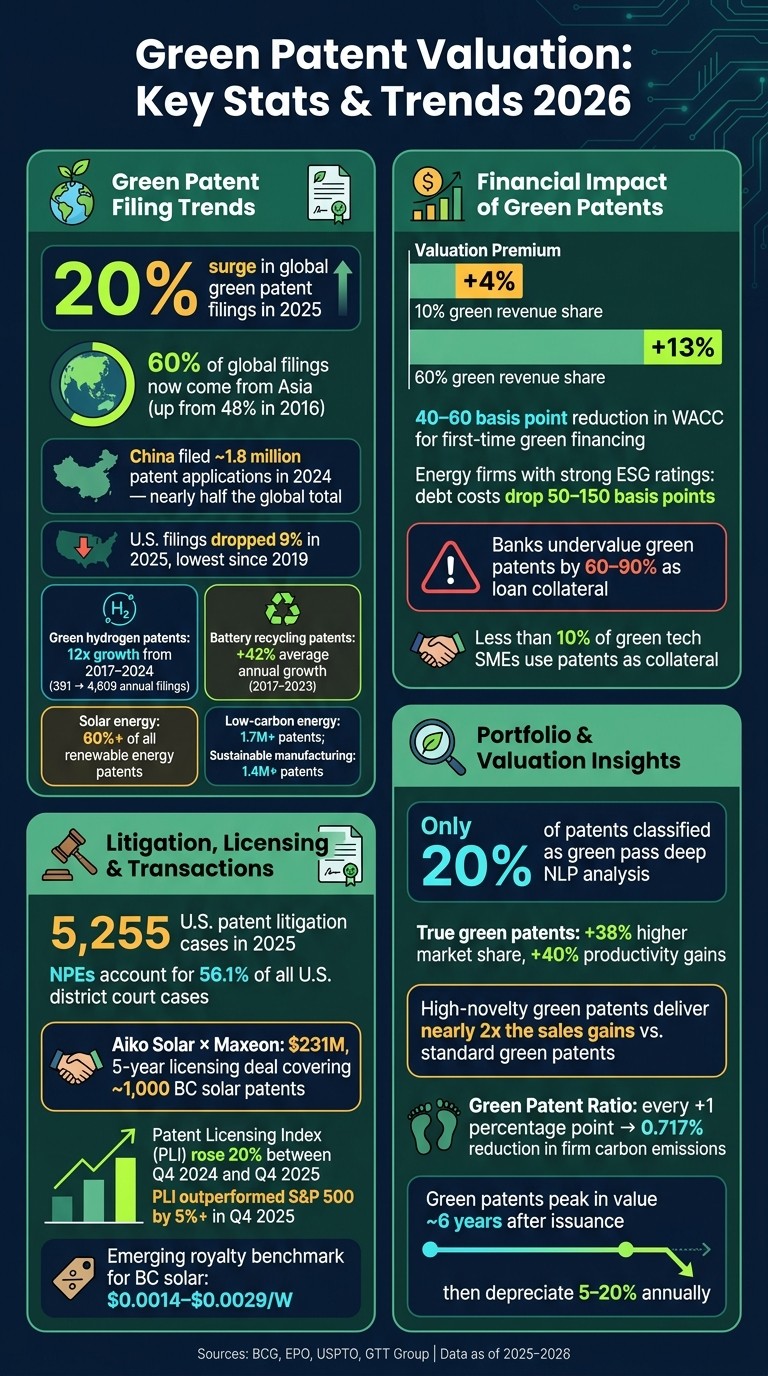
Green Patent Valuation: Key Stats & Trends 2026
Key Data Trends in Green Technology Patenting
Growth and Composition of Green Patent Filings
Green patent filings are picking up speed. Following a 20% surge in 2025, fueled by global policy changes and a 106% spike in industrial R&D in a single year, two major areas are now leading the innovation landscape: artificial intelligence and energy transition technologies. Low-carbon energy alone boasts over 1.7 million patents, with sustainable manufacturing trailing close behind at 1.4 million.
The types of patents being filed are evolving just as rapidly as their volume. Green hydrogen is a standout example: patents for water electrolysis increased 12 times between 2017 and 2024, climbing from 391 to 4,609 annual filings. Battery circularity, covering reuse and recycling, is another area of rapid growth, with patents increasing at an average annual rate of 42% between 2017 and 2023. Solar energy remains dominant in renewable energy, making up over 60% of all renewable energy patents.
Geographically, the focus is shifting toward Asia. The region now accounts for 60% of global patent filings, a significant jump from 48% in 2016. China alone filed around 1.8 million patent applications in 2024, nearly half of the global total. However, 96% of these are domestic-only. Meanwhile, U.S. patent filings dropped 9% in 2025, hitting their lowest level since 2019. Despite this decline, U.S. patents maintain a quality edge: American AI patents are cited nearly seven times more than the global average.
These shifts in patent trends and geographic focus are reshaping the financial landscape of green innovation.
Financial Value of Green Innovation
Data highlights a clear connection between green revenue and company valuation. Companies reaching a 10% green-revenue share see a 4% valuation premium, which rises to 13% at a 60% green-revenue share. For example, SKC, a South Korean materials company, grew its green-revenue share from 4% in 2017 to 20% in 2024 by investing in thin-film technology and biodegradable plastics. During this period, its EV/R multiple climbed from 1.2 to 4.6.
"As the share of green revenue increases, so does the valuation uplift - from an average premium of 4% at a 10% green-revenue share to a 13% premium at a 60% share." - BCG
Green patents also reduce capital costs. Companies securing first-time green financing benefit from a 40–60 basis point reduction in their Weighted Average Cost of Capital (WACC), while energy firms with strong ESG ratings see debt costs drop by 50–150 basis points. However, there’s a gap: less than 10% of green tech SMEs use patents as collateral, with banks often undervaluing their worth by 60% to 90%.
These financial metrics are shaping how companies approach litigation, licensing, and transactions in the green tech space.
Litigation, Licensing, and Transaction Data
Patent enforcement is on the rise. In the U.S., patent litigation cases reached 5,255 in 2025, with Non-Practicing Entities (NPEs) accounting for 56.1% of all district court cases. In the green sector, established players are defending their positions, while newcomers are challenging older patents granted under less stringent scrutiny.
The solar industry offers a clear example of how licensing strategies are evolving. In February 2026, Aiko Solar signed a $231 million, five-year licensing deal with Maxeon, covering around 1,000 patents for Back-Contact (BC) solar technology. Aiko adjusted its product prices by $0.0029/W to offset licensing costs, but with projected shipments exceeding 165 GW, the average internal patent cost dropped below $0.0014/W. In April of the same year, Trina Solar, JA Solar, and JinkoSolar launched China’s first TOPCon solar cell patent pool in Beijing, initially covering 54 patents. This move reflects a shift toward collaborative licensing rather than adversarial litigation.
These transactions are crucial for valuation experts. For instance, the emerging royalty range of $0.0014–$0.0029/W for BC solar technology provides solid benchmarks for relief-from-royalty calculations. The Patent Licensing Index (PLI) also highlights this momentum, rising 20% between Q4 2024 and Q4 2025 and outperforming the S&P 500 by over 5% in the same quarter.
"Despite economic and political uncertainty, we are forecasting positive market momentum for the first half of 2026." - Michael Lubitz, Managing Director and Founder, GTT Group
These developments set the stage for more advanced valuation models, which will be explored in the next section.
Valuation Frameworks for Green Patents
Adapting Income, Market, and Cost Methods for Green Assets
Traditional valuation methods are still central to assessing green patents, but they've been fine-tuned to handle the unique challenges of clean-tech markets.
On the income front, standard Discounted Cash Flow (DCF) models are now paired with Real Options Analysis (ROA), utilizing binomial models and Monte Carlo simulations. This combination helps account for the flexibility managers need when navigating volatile markets. On the market side, Natural Language Processing (NLP) plays a key role in distinguishing genuinely "green" patents from those that are only labeled as such. Interestingly, only 20% of patents traditionally classified as green by major patent offices pass this deeper NLP analysis. On the cost side, valuation models incorporate non-linear curves that reflect the lifecycle of green patents, from early adoption to eventual obsolescence. Typically, these patents reach their peak value about 6 years after issuance and then depreciate annually at rates between 5% and 20%, depending on the specific technology.
"Patent assessment has progressed beyond conventional financial indicators, integrating sophisticated methodologies such as real options analysis, SWOT framework, ESG considerations, and binomial models." - Roberto Moro-Visconti, Professor, Catholic University of the Sacred Heart
It's also worth noting that while strong legal protections can enhance a patent's value, they may limit its transferability in highly competitive markets.
These updated methods pave the way for incorporating ESG factors and transition risks into valuation processes.
ESG and Transition-Risk Valuation Models
The role of ESG (Environmental, Social, and Governance) factors in green patent valuation has grown significantly. Analysts now factor ESG variables into key areas like discount rates, royalty benchmarks, revenue projections, and useful life estimates. A patent's value can fluctuate depending on its vulnerability to regulatory shifts or changes in carbon pricing.
To provide a more complete picture, researchers have developed climate-specific valuation metrics. These include:
Climate Patent Portfolio Size (CPPS): Tracks the number of climate-related patents held by an organization.
Climate Technology Contribution Index (CTCI): Measures the technological impact of these patents by analyzing forward citations.
Climate Specialization Index (CSI): Evaluates whether a company's green innovations are widely distributed or concentrated in a specific niche.
Efforts to standardize these valuation practices are gaining momentum. Organizations like the International Valuation Standards Council (IVSC), the Royal Institution of Chartered Surveyors (RICS), and the International Sustainability Standards Board (ISSB) are working toward unified guidelines for integrating ESG factors into intangible asset valuation. This push for consistency is crucial, especially given that banks currently discount green patents by 60% to 90% when assessing them as loan collateral.
"The integration of Environmental, Social, and Governance (ESG) considerations into mainstream financial analysis has created a structural demand for more sophisticated treatment of intangible assets, and intellectual property (IP) in particular." - Olalekan O. Akinwumi, Founder and Principal Partner, Lekan Akinwumi & Co
Valuing Standards-Essential Green Technologies
When a green patent becomes part of an industry standard - think smart grid communication protocols or EV charging technologies - its valuation takes on a new dimension. System-level essentiality ensures enduring financial value, as the patented technology becomes a mandatory market component rather than an optional feature.
"When an entity secures a patent for a high-efficiency energy storage system or a carbon-capture methodology, they are essentially holding a legal monopoly over a solution that the market is mandated to adopt." - Sanaullah Ashrafi, Patent Monetize
Regulatory requirements further enhance this dynamic. When environmental compliance rules narrow the field to a single technical solution, the patent covering that solution effectively guarantees a steady revenue stream. Non-exclusive licensing models are also becoming more common for green standards-essential patents, offering a way to scale income while minimizing litigation risks. Tools like Patently provide valuable insights into SEP (Standards-Essential Patent) analytics, helping professionals evaluate portfolio essentiality and compare licensing strategies using real transaction data. This is particularly useful as green patent pools become more prevalent in the energy and infrastructure sectors.
These advanced valuation frameworks are shaping how organizations manage and strategize their green patent portfolios in an increasingly dynamic market landscape.
Managing Green Patent Portfolios
Effective management of green patent portfolios ensures that the most impactful inventions drive both competitive advantage and financial success.
Metrics for Identifying High-Value Green Patents
The valuation methods outlined earlier can be translated into clear, actionable metrics for managing patent portfolios. One such metric is the Green Patent Ratio - the proportion of green patents within a portfolio. Research shows that a 1 percentage point increase in this ratio correlates with a 0.717% reduction in a firm's total carbon emissions. This makes it a key indicator of both environmental impact and innovation priorities.
Portfolio quality is just as important as scale. The Climate Technology Contribution Index (CTCI) combines forward citations with the growth rate of green patent filings to measure technological influence. Forward citations, in particular, highlight how often other innovators build upon a patent, making it a strong indicator of relevance. Another useful tool is the Climate Specialization Index (CSI), which uses a Herfindahl-Hirschmann-based approach to evaluate whether a portfolio is concentrated in one green technology or diversified across multiple Y02 categories.
"The climate contribution value is the contributions of an organisation towards the development of technologies for mitigation and adaptation against climate change." - Scientometrics
By assessing technical, economic, and legal strengths, managers can uncover opportunities for competitive defense or technology transfer.
With these metrics in place, firms can refine their portfolios to focus on meaningful green innovation.
Portfolio Rebalancing Approaches
Rebalancing a portfolio starts with removing patents that only superficially meet green criteria. Classification systems like the OECD ENV-TECH list or the EPO's Y02 tags tend to be broad, but studies suggest that only about 20% of patents in these categories represent genuinely impactful green inventions. Eliminating the rest allows companies to focus their resources more strategically.
The financial benefits of this approach are clear. Companies with verified "true" green patents enjoy a 38% higher market share and 40% productivity gains. High-novelty patents - those introducing entirely new technical language combinations - deliver even greater returns, with nearly double the sales gains compared to standard green patents. During rebalancing, prioritizing these high-value assets ensures resources are directed where they matter most. Additionally, the CSI metric can help identify overreliance on a single technology area. Adjusting the portfolio to balance Y02 categories based on market trends and policy developments reduces this risk.
How AI Supports Green Patent Valuation
Generative AI patent tools are transforming how green patent portfolios are evaluated, bringing greater precision and efficiency to the process. For example, neural network-powered natural language processing (NLP) tools can analyze large patent datasets to distinguish genuinely impactful green inventions from misclassified ones. This level of accuracy is difficult to achieve manually, especially as the number of green patent filings continues to grow.
Platforms like Patently enhance this process with tools such as Vector AI semantic search, which goes beyond simple keyword matching to identify patents based on conceptual similarities. This feature is particularly useful for aligning portfolios with emerging green technology standards or regulatory requirements. Patently’s Forward and Backward Citation Browser simplifies tracking citation networks, aiding in the calculation of metrics like the CTCI and helping to identify trending patents. For portfolios that include standards-essential green technologies, Patently’s SEP analytics provide detailed data on essentiality and licensing activity, enabling informed decisions about whether to retain, license, or divest specific assets.
Conclusion: Green Patent Valuation After 2026
Green patents have evolved far beyond being just legal shields; they now play a central role in shaping financial strategies and ensuring market stability. Experts emphasize this transformation, and the data presented here backs it up: green patents are becoming key financial tools, influencing how companies secure funding, draw in investors, and maintain competitive positions.
This shift is particularly impactful for U.S. patent professionals, as it reshapes investment approaches and market strategies. With institutional investors increasingly prioritizing ESG metrics, a strong green patent portfolio signals long-term stability and adaptability. As global climate deadlines draw closer, these patents are expected to grow in value - a trend that sets them apart from most other IP assets. For clean energy startups, building a strategic patent portfolio early is crucial, as patents often serve as the most reliable indicator of future potential before revenue streams are established.
However, challenges persist. One major hurdle is the undervaluation of collateral, which restricts green tech SMEs from accessing patent-backed financing. Addressing this issue demands moving beyond broad IPC/CPC classifications. Instead, leveraging NLP-based analysis can help pinpoint high-value assets - those linked to more than double the sales growth and a 40% boost in productivity.
Advanced technologies are key to tackling these challenges. AI-driven tools are enabling patent professionals to move from general portfolio evaluations to detailed, data-centric insights. These tools help identify valuable patents that were previously too costly to analyze. Platforms like Patently demonstrate how this technology is making a difference. As green patent filings continue to rise and valuation methods grow more complex, this level of precision will become even more critical.
FAQs
How do green patents increase company valuation?
Green patents can significantly enhance a company's valuation by showcasing its commitment to eco-friendly practices. They signal environmental credibility, reduce potential regulatory risks, and appeal to institutional investors who prioritize sustainability. Beyond reputation, these patents offer tangible business benefits like increased sales, expanded market share, and higher productivity.
Although green patents are not commonly used as direct collateral for financing, they are increasingly linked to reduced capital costs and stronger stock performance. Tools such as Patently’s advanced semantic search and SEP analytics empower professionals to efficiently manage and highlight these valuable assets, ensuring they maximize their potential impact.
What’s the best way to value a green patent in 2026?
In 2026, the income-based approach continues to lead as the most effective method for valuing green patents. Instead of focusing on past development costs, this approach zeroes in on future cash flows or cost savings that the patent could generate. A popular technique within this method is the relief-from-royalty approach, which helps translate innovative ideas into clear financial terms.
To ensure accurate valuations, it’s essential to evaluate key aspects of the patent, such as the breadth of its claims, the size of its potential market, and how enforceable it is. Advanced AI tools, like Patently, can further refine this process by offering real-time scoring and risk analysis, making it easier to gauge a patent’s true potential.
How can SMEs use green patents to get cheaper financing?
SMEs can tap into green patents to access more affordable financing by using them as collateral for specialized loans, such as green patent pledge financing. A strong focus on patents related to climate mitigation not only signals a commitment to environmental goals but also reduces transition risks, which can result in lower borrowing costs. Beyond this, SMEs might consider strategies like securitizing royalty streams or pursuing milestone-based funding linked to their patent portfolios. These approaches demonstrate innovation and can make the business more appealing to potential lenders.