How NLP Powers NER in Patent Search
Intellectual Property Management
May 31, 2026
NLP-powered NER extracts inventors, technical terms, and claim elements to speed and improve patent and prior-art search.
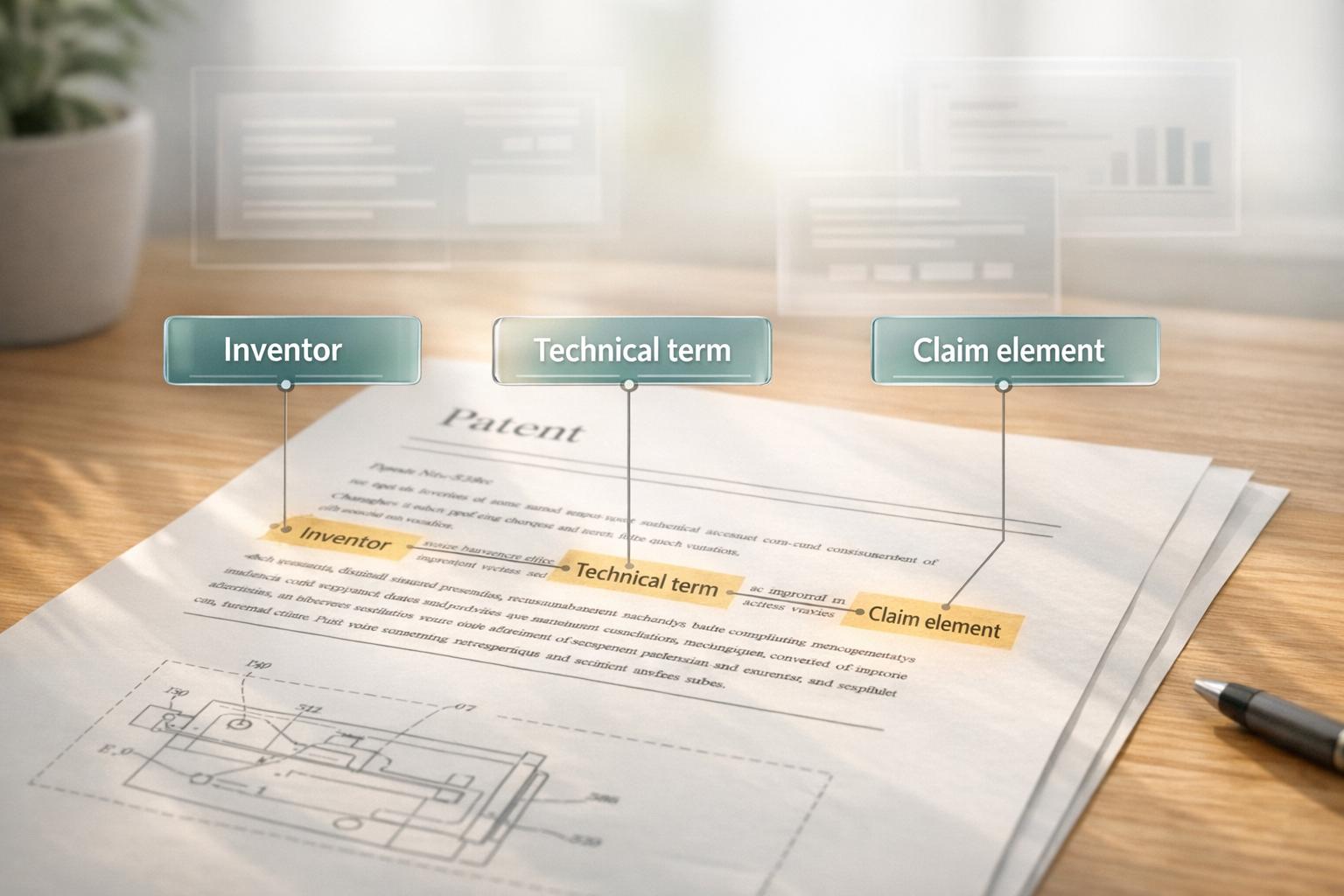
Patent search is complex. Traditional keyword searches often fail to capture the nuanced and technical language of patents. That’s where Natural Language Processing (NLP) and Named Entity Recognition (NER) come in.
NER identifies and categorizes key elements in patent text - like inventors, assignees, technical terms, and dates - turning dense legal and technical language into structured, searchable data. This makes searching across millions of patents faster and more precise. This precision is vital for novelty and FTO analysis.
Key takeaways:
NER extracts entities like names, dates, and technical terms, making patent text easier to search.
Challenges include multilingual patents, legal references, and domain-specific jargon.
Advanced NLP models like BERT and ELMo improve accuracy by understanding context.
Applications include prior art search, refining queries, and analyzing standard-essential patents (SEPs).
How Does Named Entity Recognition (NER) Power Search Engines? - AI and Machine Learning Explained
What Is Named Entity Recognition in Patent Search?
Named Entity Recognition (NER) processes patent text by identifying and categorizing elements like names, dates, technical terms, and organizations into predefined groups. This transforms complex legal and technical language into structured, searchable data that patent search systems can easily handle.
Defining NER and Its Role for Patent Professionals
NER tackles a straightforward but crucial task: identifying the "important things" in a text and determining what each one represents. For patent professionals, these "things" could include an inventor's name, an assignee company, a chemical compound, or a specific claim limitation.
Given the sheer volume of patents - 17.3 million valid patents worldwide as of 2022 - manual extraction is an impossible task, often requiring AI patent drafting tools to manage the workload. NER enables efficient, scalable analysis by breaking down claims into their core components, such as the preamble, transition phrases, and body limitations. This allows professionals to determine if a product feature aligns with a specific claim and retrieve relevant data points on demand. This capability is a hallmark of the top patent tools currently used by IP professionals.
To appreciate NER's importance, it’s essential to understand why patent text is uniquely challenging.
Why Patent Text Makes NER Difficult
Patent documents are unlike typical technical writing. They adhere to strict legal frameworks, use broad language, and frequently rely on internal referencing - phrases like "the aforementioned motor" or "said device." This referencing system, called antecedent basis, is particularly challenging for NER models. If a system fails to resolve these references, it can misinterpret what a claim is describing.
Additionally, patents cover multiple languages and technical fields. For instance, the term "substrate" means different things in materials science versus biology. Generic NLP models often struggle with this specialized language, leading to errors in identifying entity boundaries or missing critical terms altogether.
This linguistic complexity highlights the need for clearly defined categories tailored to both bibliographic and technical data.
Key Entities in Patent Search
The challenges of patent text shape the types of entities that matter most in searches. These entities generally fall into two categories: bibliographic and technical.
Bibliographic entities include inventors, assignees, filing dates, patent numbers, and prior art citations. Even structured data can be inconsistent. For instance, "Nokia" appears in 89 different variations in USPTO records, such as "Nokia Technologies Oy" and "Nokia US Holdings Inc." Without careful handling, searches might miss relevant filings.
Technical entities are more intricate, encompassing components, materials, process steps, parameters, and claim-specific elements like transition phrases ("comprising", "consisting of") and functional relationships between parts. Accurate identification of these entities - especially as multi-word phrases like "data processing unit" - enables NER to go beyond basic document matching and support detailed feature-level analysis.
NLP Techniques That Power NER for Patent Search
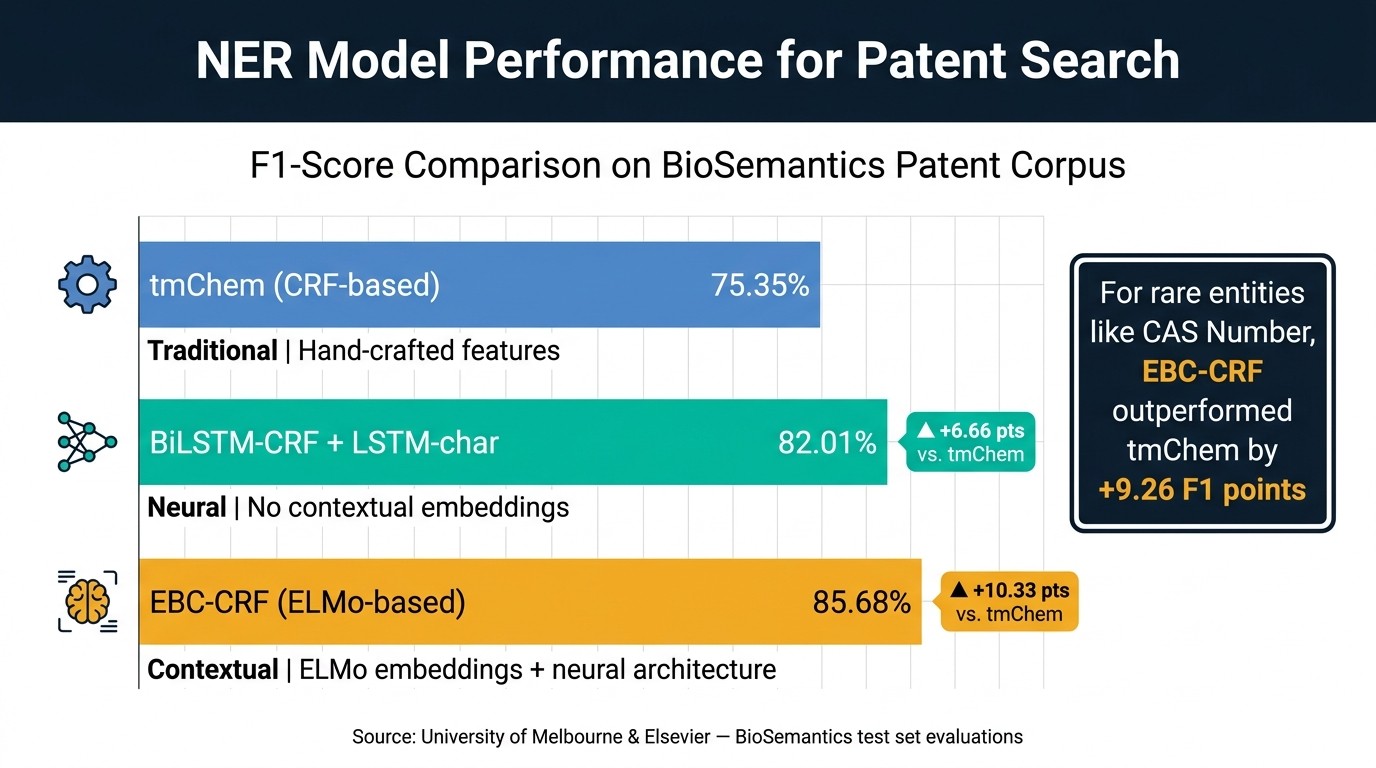
NER Model Performance in Patent Search: Traditional vs. Neural vs. Contextual
When it comes to patent search, advanced NLP techniques help transform dense and complex patent language into actionable insights. Identifying entities is just the starting point - making NLP systems reliably detect them in intricate patent text requires multiple layers of processing. Each step builds upon the previous one, converting raw legal and technical jargon into structured data that NER models can effectively work with.
Preprocessing Patent Text
Before an NER model can begin identifying entities, the raw patent text needs to be cleaned and structured. This process starts with format conversion, which ensures that semi-structured patent documents are standardized into a consistent text format for seamless processing across NLP pipelines.
Next, tools like SpaCy are used for tokenization and sentence segmentation, breaking down lengthy and complex patent claims into smaller, more manageable units. Accurate segmentation is crucial, as it ensures the text is processed in a way that retains its meaning. Additionally, domain-specific stop-word lists are employed, as generic lists might mistakenly remove terms that are critical in legal or technical contexts.
For multilingual patents, text normalization is another essential step. For instance, regular expressions can be used to encode English proper nouns found in non-English documents into length-coded formats. This prevents semantic confusion while preserving the original context. Together, these preprocessing steps lay the groundwork for effective NER in patent search workflows.
Linguistic and Semantic Analysis
After preprocessing, linguistic analysis helps models understand the function of each word in the text. Part-of-speech (POS) tagging annotates tokens as nouns, verbs, or modifiers, making it easier to distinguish between technical component names and functional descriptions. For handling complex chemical names or newly introduced terms, character-level features derived from CNNs or LSTMs come into play.
The difference in performance between traditional and neural approaches is striking. A study conducted by the University of Melbourne and Elsevier compared the EBC-CRF model - a combination of ELMo embeddings and a BiLSTM-CNN-CRF architecture - against the traditional tmChem system using the BioSemantics patent corpus. The results showed a significant improvement, with the EBC-CRF model achieving an F1-score of 85.68%, compared to 75.35% for tmChem. Notably, for rare entities like "CAS Number", the contextual model outperformed by 9.26 points in F1-score.
Model Type | F1-Score | Notes |
|---|---|---|
tmChem (CRF-based) | 75.35% | Traditional, hand-crafted features |
BiLSTM-CRF + LSTM-char | 82.01% | Neural, no contextual embeddings |
EBC-CRF (ELMo-based) | 85.68% | Contextual embeddings + neural architecture |
Data from BioSemantics test set evaluations.
These linguistic insights are further refined with the help of modern models that leverage contextual embeddings, ensuring accurate entity detection even in highly specialized patent texts.
Using Contextual Embeddings for Patent Language
Contextual embeddings take entity detection to the next level by addressing the limitations of static word embeddings. Unlike fixed vectors, contextual embeddings like ELMo and BERT generate word representations based on their surrounding text. This is especially valuable in patent documents, where the same term can have varying meanings depending on the context.
Pre-training on domain-specific data has proven to significantly improve performance. For example, in March 2026, researchers at Fudan University applied a BERT-refined keyphrase extraction (BRKE) method to 13,199 USPTO patents focused on robotics and automation. Their fine-tuned BERT model achieved an F1-score of 52.97% for top-10 extracted keyphrases, outperforming KeyBERT by 9.52%, YAKE by 6.1%, and RAKE by 2.35%. Similarly, an ensemble of contextualized models applied to chemical patents achieved an exact F1-score of 92.30%, showcasing the potential of domain-tuned models at scale.
"Contextualized word representation can help to improve performance in various NLP tasks by incorporating contextual information, essentially allowing for the same word to have distinct context-dependent meanings." - Zenan Zhai et al., University of Melbourne
Models like RoBERTa and PatentSBERTa further refine entity detection by offering high-dimensional feature spaces. When paired with attention mechanisms, these models can zero in on the most relevant sections of lengthy patent claims. Together, these advancements enhance NER workflows for patent searches, making complex data more accessible and actionable.
Building NER Models for Patent Data
Creating a Named Entity Recognition (NER) model for patent data involves adapting to the unique language, structure, and legal intricacies of patents. Success hinges on decisions made throughout the process - like defining the entities to extract, annotating data correctly, and fine-tuning model evaluation.
Defining an Entity Schema for Patents
The first step is deciding what your model should identify. This involves creating an entity schema, a structured list of entity types tailored to your specific goals.
For instance, if you're working on bibliographic mapping, your focus might be on entities like inventors, assignees, filing dates, and classifications. On the other hand, technical intelligence efforts might prioritize identifying components, functions, or technical fields. Chemical patent analysis often requires even more detailed schemas. A great example of this is the ChEMU (Cheminformatics Elsevier Melbourne University) lab's 2020 work. They developed a schema for extracting chemical reactions from 1,500 patent snippets from the EPO and USPTO. Instead of a generic "Chemical" label, they used 10 specific entity types, such as REACTION_PRODUCT, STARTING_MATERIAL, SOLVENT, REAGENT_CATALYST, TEMPERATURE, TIME, and YIELD_PERCENT.
Patent-specific elements, like prophetic compounds (chemicals claimed but not synthesized) and Markush structures (broad chemical descriptions with multiple variants), also need dedicated labels to avoid misclassification. As Camilo Thorne and colleagues from Elsevier noted:
"Patent authors often seek to protect their knowledge from being fully disclosed... patents typically contain more details and are more exhaustive than scientific papers." - Camilo Thorne et al., Elsevier
Some schemas for patent abstracts may include up to 17 entity types and 15 relation types, though most projects use a more focused subset. Once your schema is set, the next step is gathering quality training data.
Annotating and Preparing Training Data
With your schema defined, the next challenge is creating labeled examples. Patent text is dense, technical, and filled with domain-specific terminology, making accurate annotation difficult for general annotators. This is where domain experts come in, though their availability is often limited.
To tackle this, large patent texts are typically divided into smaller, manageable chunks - usually 100–200 words, similar to the length of a patent abstract. Using specialized tools can also improve annotation consistency and boost F1 scores.
For larger datasets, weak supervision can streamline the process. This involves programmatic labeling methods like regex patterns, curated term lists, or even spatial coordinates in PDF documents. For example, the ChEMU corpus used a 70/10/20 split for training, development, and testing across its 1,500 annotated snippets, serving as a benchmark for similar projects and showing measurable performance improvements. Another study involving 33,000 patents demonstrated how improving training data with BERT-based models led to recall scores of around 97% during cross-validation and increased extracted references by 50% - resulting in a total of 735,000 references.
Once your annotated dataset is ready, you can move on to training and evaluating the model.
Training and Evaluating NER Models
Training a patent NER model follows a standard pipeline, but evaluation requires extra care. Metrics like precision, recall, and F1-score are essential, but patent NER benefits from using both strict and relaxed span matching. Strict matching requires exact entity boundaries, while relaxed matching gives partial credit if the concept is correctly identified, even if the boundaries are slightly off. This dual approach helps pinpoint whether errors are due to boundary detection or entity classification.
Domain-specific pre-training consistently delivers better results than general models. For example, "ChemPatent" word embeddings, trained on 84,076 full patent documents (about 1 billion tokens), improved chemical NER F1-scores by an average of 1.46 points compared to general biomedical embeddings. Similarly, a fine-tuned XLM-RoBERTa-large model trained on OCR'd front pages from 300 years of British Patent Office records (1617–1899) achieved a micro-average F1-score of 92.5% for exact entity matches across six entity classes, including inventor names, addresses, and filing dates. These improvements lead to faster and more accurate patent searches, enabling better prior art discovery and precise entity-level retrieval across vast patent collections.
The key takeaway? The closer your training data matches the patents you're analyzing, the better your model will perform.
How NER Is Used in Patent Search Workflows
Natural Language Processing (NLP) tools powered by Named Entity Recognition (NER) are transforming patent workflows, from prior art searches to evaluating standard-essential patents (SEPs). These tools are reshaping how professionals navigate massive patent databases.
Using NER for Prior Art Search
Prior art searches often face a major hurdle: the terminology gap. Two patents might describe the same invention using entirely different terms. For instance, "flexible substrate" and "bendable carrier layer" refer to the same concept, but keyword searches might fail to connect them. By employing NER alongside semantic NLP techniques, this gap is bridged, focusing on the concepts rather than just matching strings of text.
The time savings are striking. Traditional Boolean keyword searches can take 7–13 hours and still miss 20–40% of relevant patents. In contrast, NLP/NER-powered searches cut review time to 4–6 hours while improving recall. For example, innovation teams using advanced NLP tools have reported workflows that are 75% faster overall.
NER also automates the interpretation of complex claim language, helping distinguish between independent and dependent claims while extracting technical details. This reduces the manual effort needed to dissect claim structures, allowing examiners and attorneys to focus more on in-depth analysis. Additionally, these tools enhance the precision of search queries, as explained below.
Refining Search Queries with Entity Data
NER plays a critical role in extracting and normalizing key data - such as assignee names, inventor details, technical terms, and classifications - for more accurate indexing and queries.
Take claim decomposition as an example. NER breaks down claims into structural elements like the preamble, transition phrases, and specific limitations, labeling the technical entities within each part. This process also resolves references in claims, ensuring accurate scoping. Such refined entity data significantly improves the precision of analyses, especially in specialized tasks like SEP evaluation.
Applying NER to Standard-Essential Patent (SEP) Analysis
NER's impact is particularly evident in SEP analysis. Evaluating a standard-essential patent involves comparing its claims to technical specifications, such as 3GPP standards for 4G/5G. Each claim limitation must align with a specific feature of the standard.
NER extracts technical entities and resolves dependent claim chains, offering a complete view of a patent’s legal scope. This structured data feeds directly into Telecom SEP Claim Charts, mapping claim limitations to standard features. Tools like Patently integrate this data to enhance SEP analytics, which plays a key role in licensing negotiations and litigation strategies.
Limitations of NER in Patent Search
NER plays a meaningful role in patent workflows, but it's not without its challenges. Practitioners need to be aware of these limitations to avoid over-reliance.
Domain-Specific and Multilingual Challenges
The language of patents is complex - legally precise, domain-specific, and filled with technical terms that often go beyond the capabilities of general NLP models. Researchers Zenan Zhai et al. from the University of Melbourne describe it well:
"The lexicon used in patents usually includes domain-specific and novel terms that are difficult to understand."
One hurdle is handling antecedent references, such as "the motor", which refers back to a previously mentioned entity. Misinterpreting these references can lead to flawed analysis. Another challenge is distinguishing between the non-limiting preamble and the claim body, which contains the actual limitations of a patent. Confusing these sections can skew results.
Multilingual filings add another layer of complexity. Patents from international authorities are often digitized using OCR, which introduces errors that reduce NER accuracy. For patents heavy on chemistry, systematic names like IUPAC identifiers can exceed the maximum sequence length of standard transformer models. To tackle this, specialized tokenization methods - such as character-level representations or tools like OSCAR4 and ChemTok - are often required.
These linguistic and technical challenges are further complicated by the high computational demands of NER in practice.
Performance and Resource Demands
While transformer-based models are known for their accuracy, they require significant computational resources to process patent documents. This is particularly challenging because the average patent document is about 24 times longer than a typical news article.
Additionally, patent terminology evolves with new technologies, requiring regular updates to the models. A practical way to manage costs is a two-stage approach: start with a faster BM25 keyword search to narrow down candidates, then use an NER-powered neural model as a re-ranker. This strategy balances precision with resource efficiency.
Measuring NER Effectiveness
Evaluating the effectiveness of NER tools requires a mix of standard NLP metrics and task-specific outcomes. The real measure of success is whether NER improves key tasks, like retrieving relevant prior art or reducing missed results.
Metric Category | Method | What It Measures |
|---|---|---|
NLP Performance | Precision, Recall, F1-score | Basic extraction accuracy and completeness |
Error Analysis | Confusion Matrix | Differentiates boundary detection from classification errors |
Search Impact | Search Precision/Recall | Effectiveness in retrieving relevant prior art |
Semantic Quality | Cosine Similarity | Relevance of expanded query terms in retrieval workflows |
In March 2026, researcher Yaojia Mu and his team at Fudan University applied this combined evaluation approach to 13,199 USPTO patents in robotics and automation. Their BERT-refined keyphrase extraction (BRKE) method achieved an F1-score of 52.97%, outperforming KeyBERT by 9.52% and YAKE by 6.1%. Confusion matrices were particularly helpful in identifying whether the model struggled more with boundary detection or entity classification - two distinct issues requiring tailored solutions. This analysis also revealed difficulties with multi-word technical concepts, providing clear direction for future improvements.
Recognizing these limitations is essential for developing more precise and reliable NER tools in patent search workflows.
Conclusion: Using NLP-Powered NER to Improve Patent Search
NLP-powered Named Entity Recognition (NER) is reshaping patent search by moving professionals beyond basic keyword matching. Instead, it introduces structured, feature-level analysis, allowing individual claim limitations to be directly compared to prior art or product specifications. Considering that over 70% of technical information in patent documents is unique to these documents, precise data extraction becomes essential for comprehensive research.
This precision has a tangible impact on workflows. NER simplifies query refinement, improves the accuracy of prior art retrieval, and provides detailed data for Standard Essential Patent (SEP) analysis. Together, these features redefine how intellectual property professionals navigate vast patent databases.
Platforms like Patently demonstrate the potential of this technology. Its Vector AI engine supports context-aware semantic search, while Onardo, an AI drafting assistant, identifies prior art in real time during the preparation of patent specifications. Jerome Spaargaren, Founder and Director of Patently, highlighted its significance:
"This powerful addition [Vector AI] has positioned Patently as one of the most innovative platforms for semantic patent search and is core to our technology stack."
Additionally, Patently leverages the Elastic Search AI Platform for real-time data processing, eliminating slower batch cycles and ensuring immediate access to the latest patent filings.
FAQs
How is patent NER different from regular NER?
Patent Named Entity Recognition (NER) is designed to tackle the highly technical, scientific, and legal language unique to patents. It pinpoints key elements such as inventors, assignees, and intricate entities, while also addressing challenges like OCR errors, lengthy sentences, and the distinct drafting styles found in patents. Standard models often fall short in handling these complexities, which is why training specifically for this domain is crucial for precise patent analysis.
What patent entities matter most for better search results?
Named Entity Recognition (NER) enhances patent searches by identifying and categorizing important elements in the text, rather than treating everything equally. Key entities include inventors, assignees, technical terms, dates, and locations. For niche areas like chemical patents, NER can pinpoint specific entities such as reaction products, reagents, solvents, and process parameters (like temperature or time). This approach helps clear up ambiguities, leading to more accurate search results and fewer irrelevant matches.
How do you evaluate NER accuracy for patent search?
Evaluating Named Entity Recognition (NER) accuracy for patent search relies on labeled datasets and metrics such as precision, recall, and F1-score. Advanced deep learning models, including BiLSTM-CRF and fine-tuned transformer-based models like BERT, are frequently employed for this task.
To boost performance, techniques like contextualized embeddings (e.g., ELMo) and domain-specific tokenizers are utilized. These methods are often tested on extensive datasets, such as the USPTO collection, which provides a robust basis for validation. For patent text - known for its complexity - comparisons often involve both exact and relaxed F1-scores to ensure a comprehensive evaluation of model performance.