Fast Track Green Patents by Jurisdiction
Intellectual Property Management
Jun 1, 2026
Compare global fast-track patent programs for green tech—eligibility, timelines, fees, and PPH strategies to speed protection.

Fast-tracking green patents can save up to 75% of the standard patent process time. Countries like the U.S., U.K., Canada, China, and Japan offer expedited programs, helping clean-tech innovators protect their ideas faster and secure funding or market position. Here's what you need to know:
Eligibility: Covers inventions in renewable energy, energy efficiency, pollution control, and more. Requirements vary by country.
Key Programs:
U.S.: Track One (12 months) with fees; free petitions also available.
U.K.: Green Channel (no fees, faster processing).
China: Prioritized Examination (45 days for first review).
Canada: Advanced Examination (3 months for first action).
Japan: Accelerated Examination (~2.3 months, prior art search required).
Documentation: Clear statements or technical explanations of the invention’s benefits are often needed.
Global Strategy: Combine fast-track approvals in countries like Canada or the U.K. with the Patent Prosecution Highway (PPH) to speed up filings elsewhere.
AI Tools: Use AI-enabled patent analysis for drafting, aligning with jurisdiction-specific rules, and tracking deadlines.
Fast-track programs are a game-changer for green technology patents, offering quicker protection without extra fees in many regions. Plan filings carefully to avoid delays and maximize benefits.
Green Innovation through Intellectual Property
Green Patent Eligibility: What You Need to Know
A fast-track program requires your invention to meet specific eligibility criteria. Most jurisdictions group eligible inventions into key categories, but the exact requirements and necessary documentation differ depending on the country.
What Counts as a Green Invention
If you're aiming to take advantage of fast-track programs, it's crucial to understand what qualifies as a green invention. Generally, these programs cover innovations in areas like renewable energy (solar, wind, biofuels), energy efficiency, pollution control, sustainable agriculture, and low-carbon transportation. However, each jurisdiction has its own specific guidelines.
For example, in the United States, the Climate Change Mitigation Pilot Program granted special status to 898 applications (as of January 7, 2025). To qualify, at least one claim in the invention must align with the Y02 subclass, which focuses on reducing greenhouse gas emissions. Other countries have their own approaches:
Japan and Taiwan emphasize energy-saving technologies and carbon reduction.
South Korea ties eligibility to its Framework Act on Carbon Neutrality and Green Growth.
Brazil narrows its focus to areas like biofuels, hybrid vehicles, and sustainable agriculture.
The United Kingdom takes a more adaptable stance. According to Dan Hanna of Swindell & Pearson:
"The UKIPO's definition as to what constitutes an 'environmental benefit' is intentionally broad. If an invention makes a product, process, or system cleaner, more efficient, or less wasteful in any meaningful way, it is likely to qualify."
This flexibility has practical advantages. For instance, a rocket engine patented as GB2624129B in December 2024 qualified for the UK's Green Channel because it used hydrolox fuel and a reduced-mass design to minimize CO₂ emissions. It was granted in just 313 days, despite not being a conventional clean-tech product.
How to Document Environmental Benefits
Once you confirm your invention qualifies, the next step is to clearly document its environmental benefits. Depending on the invention, this can range from a straightforward statement to a more detailed technical explanation. The UK Intellectual Property Office provides this guidance:
"If, for example, the invention is a solar panel or a wind turbine then a simple statement is likely to be enough. However a more efficient manufacturing process which uses less energy is likely to need more explanation."
In jurisdictions like the UK, Canada, and Australia, a brief written statement outlining the environmental benefits is usually sufficient and doesn't require additional fees. However, for inventions with less obvious benefits, a detailed explanation may be necessary. Nathaniel Taylor, an IP Attorney at Keltie LLP, advises:
"It is often reasonably straightforward to demonstrate an 'environmental benefit' and our attorneys would typically mention any such benefits when drafting your patent application, such that the benefits are readily apparent or derivable."
Here are some practical points to keep in mind:
United States: Applicants must file a specific petition (PTO/SB/457) and certify that expediting the application will positively impact the climate.
Thailand: Fast-track applications are limited to 10 claims and require a supporting document no longer than four A4 pages.
Response Timelines: Delays, such as requesting an extension to respond to an office action, can push your application back into the standard queue. Plan your responses carefully.
With the right documentation and strategy, you can maximize your chances of benefiting from these fast-track programs.
Green Fast-Track Programs by Jurisdiction
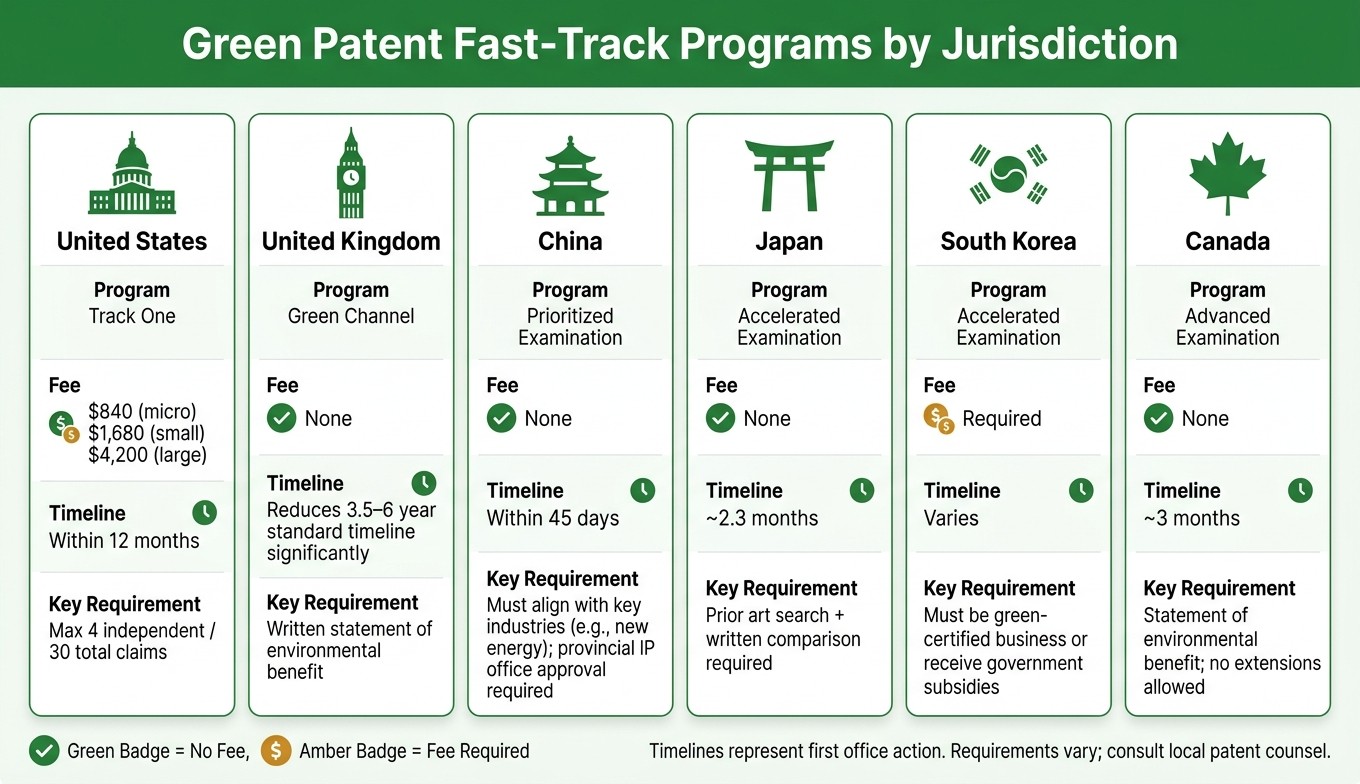
Green Patent Fast-Track Programs by Jurisdiction
Different patent offices around the world approach green fast-tracking in unique ways, with varying fees, eligibility criteria, and timelines. Here's a breakdown of the key jurisdictions and their processes.
United States: Track One and Petitions to Make Special
After the Climate Change Mitigation Pilot Program ended on April 18, 2025, applicants in the U.S. now rely primarily on Track One for expedited patent examination. This program aims for a final decision within 12 months.
The cost for Track One is $4,200 for large entities, $1,680 for small entities, and $840 for micro entities. To qualify, the request must be submitted with the original utility or plant application, and the application is limited to 4 independent claims and 30 total claims. However, keep in mind that requesting a time extension to respond to an Office Action will disqualify your application from the prioritized queue.
For a no-cost alternative, applicants can consider Petitions to Make Special under standard USPTO guidelines. However, Track One remains the preferred option due to its predictable timeline.
"Fast innovation is America's competitive edge." - USPTO
In Europe, acceleration options like PACE and national green channels offer a different approach.
Europe: PACE and National Green Channels
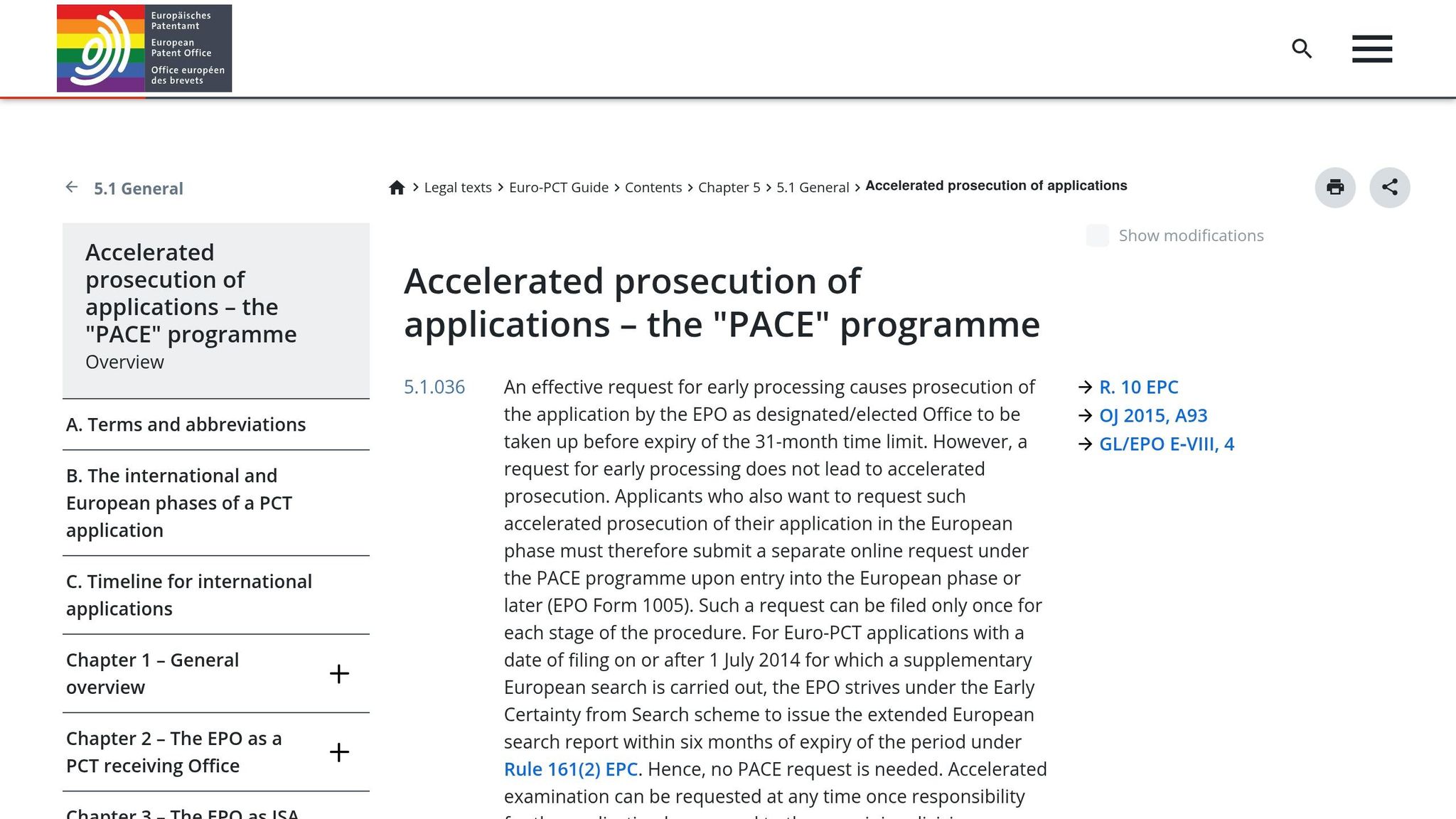
The European Patent Office (EPO) does not have a specific green fast-track program but offers the PACE program, which accelerates examination for any technology without additional fees.
On a national level, the UK Green Channel, available since 2009, provides a no-fee pathway for expedited processing. Applicants must submit a written statement explaining the environmental benefits of their invention. This program can significantly reduce the typical 3.5–6 year timeline for granting patents.
"The Green Channel for patent applications... allows applicants to request accelerated processing of their patent application if the invention has an environmental benefit." - UKIPO
Including clearly defined environmental benefits in your application can help streamline the review process for UK examiners.
In Asia, countries like China, Japan, and South Korea offer their own tailored fast-track options for green technologies.
Asia: China, Japan, and Korea
Asian jurisdictions also have programs to accelerate green patent applications, each with its own structure and requirements:
Jurisdiction | Program | Fee | First Action Timeline | Key Requirement |
|---|---|---|---|---|
China | Prioritized Examination | None | Within 45 days | Must align with "key industries" (e.g., new energy); provincial IP office approval required |
Japan | Accelerated Examination | None | ~2.3 months | Must demonstrate energy-saving effects or CO₂ reduction; prior art search required |
South Korea | Accelerated Examination | Required | Varies | Must be a green-certified business or receive government subsidies under the Framework Act |
China: To stay on the fast track, applicants must respond to the first Office Action within two months for invention patents or 15 days for utility models. Cases are typically resolved within a year. Non-Chinese applicants should work with local counsel early due to the need for provincial IP office approval.
Japan: Applicants must perform a prior art search and submit a written comparison of their invention against existing literature. Non-resident applicants must engage a Japanese patent attorney. As Michael Gamble from Harness IP puts it:
"PPH (Patent Prosecution Highway) is suitable for applicants who prioritize patent grant probability... while expedited examination is suitable for applicants who can complete responses in a short period of time." - Michael Gamble, Harness IP
South Korea: The process is more restrictive. Applicants typically need to be a green-certified business or have received government subsidies under the Framework Act on Carbon Neutrality and Green Growth. Ari Rollason from HLK notes:
"Eligibility for accelerated processing at KIPO is substantially more restricted than at other IP offices." - Ari Rollason, HLK
Building a Global Green Patent Portfolio
If you're looking to speed up the approval process for green patents, a smart mix of jurisdiction selection and careful timeline management is essential.
Choosing Jurisdictions and Filing Paths
Start by focusing on jurisdictions that offer free fast-track programs. These can help you gain early traction and pave the way for quicker approvals in other regions. For instance, Canada and the UK stand out - they both provide no-cost accelerated examination options that can significantly reduce wait times compared to the standard process. Once you secure a favorable outcome from either of these offices, you can leverage it to access the Patent Prosecution Highway (PPH) at the USPTO. This approach can cut down on U.S. patent pendency without requiring you to pay the Track One fee.
"Applicants wishing to speed up examination of their US applications without paying the prioritized examination fee may benefit from Canada's Advanced Examination process by filing a corresponding application in Canada." - Colleen N. Shovlin, Harness IP
For technologies tied to physical supply chains - like battery materials - consider filing in regions critical to resource extraction. Take cobalt as an example: the Democratic Republic of Congo (DRC) supplies about 70–75% of the world's cobalt, making it a key location for battery technology patents. However, keep in mind that while the DRC is a Paris Convention signatory, it’s not a PCT member. This means you’ll need to file directly in the DRC within the 12-month priority window.
Once you’ve chosen your jurisdictions and filing paths, the next step is to ensure all documentation and deadlines are perfectly aligned.
Coordinating Timelines and Documentation
After mapping out your jurisdiction strategy, precise timeline and document management becomes critical. Utilizing top patent tools can help streamline this process. Start by establishing a single priority date - this can be achieved by filing first in a low-cost jurisdiction. From there, expand your filings to other countries within 12 months or extend the timeline to 30–31 months using the PCT route.
To keep your applications moving through fast-track programs, make sure all required documentation is submitted on time. Each jurisdiction has its own set of rules, and missing even a small step could derail your application from the accelerated process. Additionally, don’t overlook jurisdiction-specific maintenance fees, as these can vary widely and must be factored into your overall plan. Proper coordination is key to staying on track and avoiding unnecessary delays.
Using AI Tools to Manage Green Patent Filings
Coordinating timelines is just the beginning. AI tools take filing management to the next level by ensuring accuracy and compliance across different jurisdictions. For green patents, combining AI tools with a well-planned filing strategy can help accelerate the process.
AI-Assisted Patent Drafting
Generative AI patent drafting tools simplify the complexities of filing patents across jurisdictions by aligning deadlines, eligibility criteria, and required documentation. Since requirements vary from one patent office to another, these tools automatically adjust language to fit the specific rules of each jurisdiction. This precision matters - mistakes can jeopardize your fast-track status.
Colleen N. Shovlin of Harness IP highlights this point:
"The CIPO has taken the position that it will not question the veracity or appropriateness of the required statement... the applicant need only repeat the statement verbatim."
Additionally, AI tools can evaluate your claims against green technology classifications. For instance, they can ensure alignment with Brazil's five categories (Alternative Energy, Transportation, Energy Conservation, Waste Management, and Sustainable Agriculture) or South Korea's "Framework Act on Carbon Neutrality." These tools can flag potential issues before you file, saving both time and effort.
Beyond drafting, AI portfolio analytics can help track deadlines and identify the best opportunities for filing.
Portfolio Analytics and Timeline Tracking
Fast-track programs offer significant time savings, with first office actions arriving in as little as 4 to 8 weeks in Australia, 45 days in China, or around 3 months in Canada. AI-powered portfolio analytics keep an eye on these milestones in real time, alerting you to potential risks. For example, in Canada, requesting an extension could remove an application from the advanced examination queue.
These analytics tools go beyond deadline management. They can also identify which jurisdiction is likely to grant an allowance first. This insight can help you strategically time a Patent Prosecution Highway (PPH) request in slower jurisdictions, such as the US, potentially avoiding the $4,515 Track One fee. Platforms like Patently offer features like project management and SEP analytics, helping teams stay on top of filing milestones and coordinate documentation across multiple cases efficiently.
Conclusion: Moving Green Patents Forward
Green fast-track programs offer a clear advantage by speeding up patent examination processes, which can make a big difference in market timing and boosting investor confidence. The best part? Many key jurisdictions - like the UK, Canada, Australia, China, and Japan - offer these expedited services without adding extra official fees. Faster protection doesn’t have to come with a higher price tag.
But success requires smart planning. It’s crucial to understand which jurisdictions have broader eligibility criteria, which ones enforce the strictest response deadlines, and how to coordinate filings to leverage Patent Prosecution Highway requests in slower markets. These strategies are essential for building a strong global green patent portfolio. Combining expedited filings with a well-thought-out global approach is key to staying ahead in the competitive green tech industry.
AI tools like Patently can make this process smoother. From drafting claims tailored to specific jurisdictional requirements to tracking multiple cases in real time, these tools help patent professionals stay on top of everything. For those managing large-scale green portfolios, having this level of oversight isn’t just helpful - it’s essential.
FAQs
How do I prove my invention has an environmental benefit?
To apply for fast-track programs, you'll usually need to provide a formal request explaining how your invention contributes to reducing environmental impact. The exact requirements depend on where you're applying:
United States: Submit Form PTO/SB/457, which certifies that your invention helps lower greenhouse gas emissions.
Canada: Provide a statement detailing the environmental benefits or how your invention conserves resources.
Other regions: You may need to outline specific ways your invention conserves energy or reduces CO2 emissions in writing.
Each jurisdiction has its own criteria, so be sure to check the specific guidelines for your application.
Can I use a fast-track grant in one country to speed up others via PPH?
Yes, you can take advantage of the Patent Prosecution Highway (PPH) to speed up patent applications in multiple countries. If one patent office finds your claims patentable, you can request faster processing in another participating office. Tools like Patently's AI-powered platform can assist in managing international filings and simplifying PPH requests across different jurisdictions.
What mistakes can kick my application out of a fast-track program?
To maintain your place in a fast-track program, steer clear of these frequent pitfalls:
Missed deadlines: Failing to meet deadlines for office actions or time extension requests can result in losing fast-track status for your application.
Procedural mistakes: Submitting false materials, incomplete requests, or using the wrong forms can lead to dismissal from the program.
Jurisdiction-specific issues: In some regions, voluntary amendments or exceeding claim limits (like more than 10 claims in Thailand) can disqualify your application.