5 Challenges in Harmonizing IP Sustainability Rules
Intellectual Property Management
Jun 2, 2026
Five hurdles—definitions, ESG rules, incentives, policy clashes, and data silos—and practical steps to align IP with sustainability.

Inconsistent rules for intellectual property (IP) and sustainability create challenges for companies managing global patent portfolios. Different regions define sustainability, ESG reporting, and green patent incentives in conflicting ways, increasing costs and complexity. Here's a quick breakdown:
Conflicting Definitions: What qualifies as "sustainable" varies by region, complicating patent filings.
Divergent ESG Rules: Reporting IP assets under different ESG frameworks is inconsistent and time-intensive.
Fragmented Incentives: Green patent programs differ by country, with varying costs and benefits.
Policy Conflicts: IP laws often clash with environmental goals, requiring flexible strategies.
Data Silos: Disconnected systems make sustainability reporting for IP inefficient and error-prone.
To address these, companies are centralizing IP data, leveraging top patent tools, and aligning internal processes with evolving global standards. These steps reduce risks and improve compliance in a fragmented regulatory landscape.
Global Digital Encounters (10): Fostering a Dynamic IP System Based on Sustainable Development Goals
Challenge 1: Conflicting Definitions of What Counts as Sustainable Innovation
What’s considered a sustainable invention in Brussels might not pass the test in Washington or Tokyo. This inconsistency creates a major hurdle for patent professionals trying to develop effective cross-border strategies for green intellectual property (IP).
The Problem with Varying Sustainability Taxonomies
Different jurisdictions have their own methods for defining sustainable innovation, and these methods can vary widely. For instance, the EU employs Technical Screening Criteria (TSC) - a detailed, threshold-based system tied to six environmental goals: climate change mitigation, adaptation, water protection, circular economy transition, pollution prevention, and biodiversity restoration. In contrast, many Asian countries use whitelist-based systems, which only recognize pre-approved technologies. Meanwhile, other regions rely on principle-based guidelines that lack strict thresholds.
This lack of alignment can create real headaches. Take a patent for a novel carbon capture process: it might qualify for green benefits under the EU Taxonomy but fail to meet the criteria in a whitelist-based system that hasn’t yet recognized that technology. The same invention can be evaluated differently depending on where it’s filed, complicating both patent strategies and ESG (Environmental, Social, Governance) reporting.
The EU adds another layer of complexity with its "Do No Significant Harm" (DNSH) requirement. Under the EU Taxonomy, an activity must support one environmental goal without negatively impacting the others. Many non-EU systems don’t include such safeguards, increasing the risk of greenwashing when companies report sustainability metrics across jurisdictions. As Springer Nature highlighted:
"The EU Taxonomy's rigorous TSC approach, including substantial contribution (SC) and do-no-significant-harm (DNSH) criteria, serves as a model for others."
Even patent offices have differing standards. For example, the European Patent Office (EPO) requires more than just claims of environmental benefits. Applicants must provide experimental evidence of an unexpected technical effect to meet inventive step requirements. These inconsistencies make it clear that companies need to take proactive steps to navigate these challenges.
Solution: Build Internal IP Sustainability Frameworks
Rather than waiting for global standards to align, many IP teams are creating internal systems to handle these differences. A good first step is updating invention disclosure processes to include key ESG data at the outset. This ensures that assets can be classified correctly when filing in jurisdictions with varying taxonomies.
With over 150 million patent documents in existence, manually tagging and classifying portfolios for sustainability is nearly impossible. That’s where AI-powered tools, like the semantic search features offered by Patently, come in. These tools help patent professionals quickly identify which assets meet sustainability criteria across different classification systems. This type of portfolio mapping becomes critical during ESG reporting periods, as teams must account for green IP holdings under frameworks that define "green" in very different ways.
Challenge 2: Inconsistent ESG Disclosure Rules for IP Assets
Even when companies manage to classify their patents under various sustainability taxonomies, reporting these assets consistently presents a whole new set of challenges. ESG disclosure rules differ widely across jurisdictions, leaving IP teams stuck navigating a maze of conflicting requirements.
The Problem of Disparate ESG Reporting Standards
Patent professionals operating internationally face a fragmented landscape of ESG frameworks that don’t align. For example:
The EU’s Corporate Sustainability Reporting Directive (CSRD) demands detailed, digital disclosures.
California’s SB-253 and SB-261 require large companies to report on greenhouse gas emissions and climate-related financial risks.
The SEC’s climate disclosure rule remains in flux, following its voluntary stay and the withdrawal of its legal defense in March 2025.
The International Sustainability Standards Board (ISSB) promotes globally comparable disclosures through IFRS S1 and S2, but adoption has been uneven.
The real issue isn’t just the differences between these rules - it’s that compliance with one framework doesn’t satisfy another. For IP teams, this means the same set of patents might need to be described, categorized, and valued differently depending on the reporting framework in play.
Adding to the complexity, the rules themselves keep changing. The EU’s "Omnibus" legislative package (Omnibus I and II) recently delayed and scaled back CSRD requirements, throwing companies that had already invested in compliance systems into uncertainty. This kind of legislative instability makes ESG reporting a constantly shifting target - especially for IP assets, which require consistent tracking over many years.
On top of this, organizational silos between Legal, ESG, and R&D teams further fragment reporting efforts. Without collaboration across these groups, sustainability disclosures become inconsistent and unreliable. Addressing these challenges calls for a unified strategy to manage ESG reporting for IP assets.
Solution: Use Centralized IP Data for ESG Reporting
To tackle the chaos of managing diverse sustainability taxonomies, centralizing IP data is essential for consistent ESG compliance. The key is to stop treating IP data and ESG data as separate entities. By consolidating patent portfolios in a single platform, teams can apply standardized ESG criteria across all jurisdictions instead of redoing the work for each framework.
For instance, AI-powered tools like Patently leverage Vector AI for semantic search, making it easier to identify sustainability-linked patents that traditional keyword methods might overlook. This includes technologies like carbon sequestration methods or circular economy innovations that aren’t explicitly labeled as “green.” Once identified, these patents can be tagged and tracked continuously, ensuring Legal, R&D, and ESG teams all work from the same data set.
Centralizing data also enhances audit readiness. Instead of scrambling to compile IP information before a reporting deadline, teams can maintain real-time dashboards that reflect the current portfolio’s alignment with multiple sustainability frameworks. This is especially useful as frameworks like CSRD become more prescriptive about how sustainability data must be structured and shared.
A proactive step to streamline this process is embedding ESG criteria directly into invention evaluation. By asking questions like, “Does this invention reduce environmental harm or contribute to a measurable social benefit?” during the patent disclosure phase, companies ensure the necessary data is already in place when reporting time comes. This approach eliminates the need to reconstruct ESG data after the fact, saving time and reducing errors.
Challenge 3: Fragmented Incentives for Green Patents Across Jurisdictions
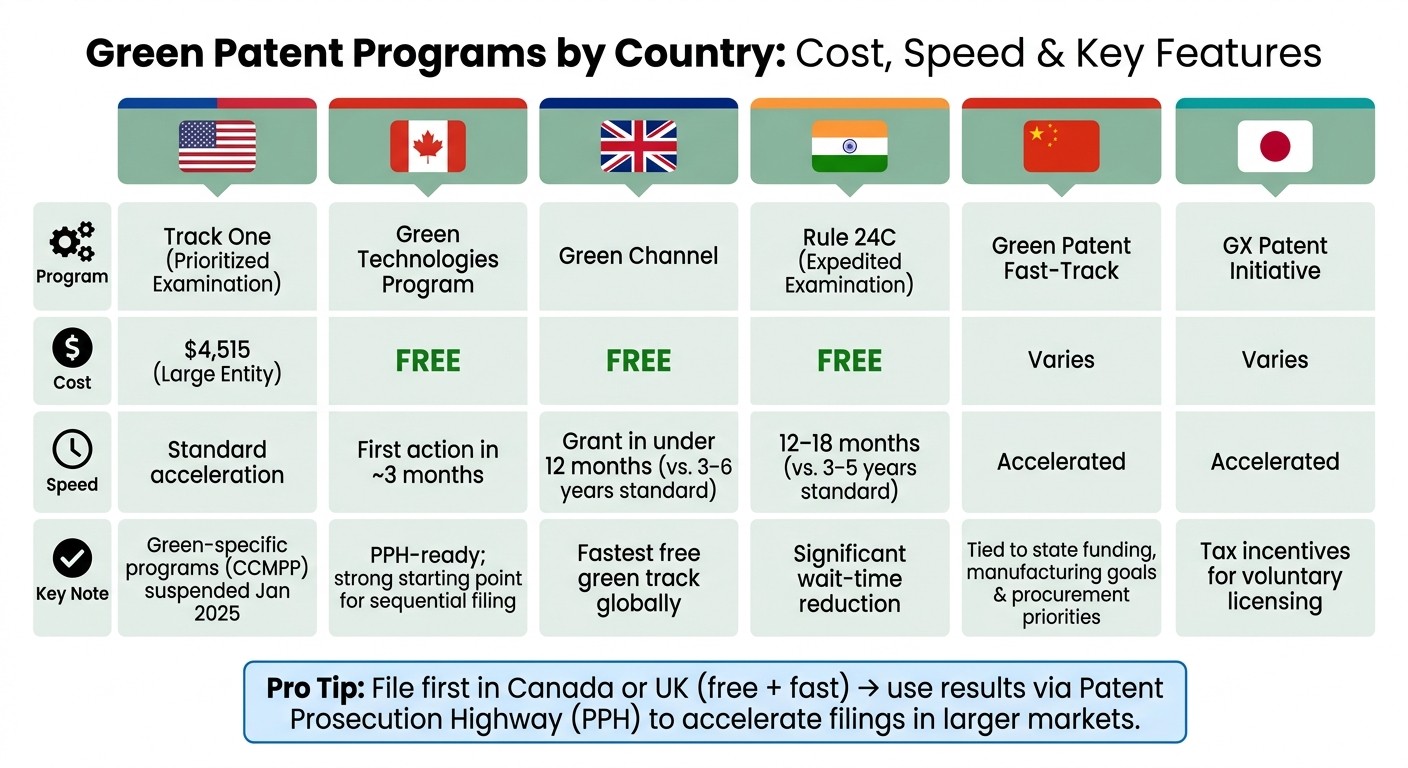
Green Patent Programs by Country: Cost, Speed & Key Features
After grappling with the challenges of defining sustainable innovation and dealing with inconsistent ESG rules, fragmented incentives for green patents present yet another obstacle. While green patent programs aim to encourage environmentally beneficial innovation, their stark differences across countries make it tough for companies to navigate the global landscape.
The Problem of Inconsistent Green Patent Incentives
There’s no universal agreement on what constitutes a "green" patent or how it should be expedited. Each country has its own rules, fees, and criteria, making it nearly impossible to craft a seamless global patent prosecution strategy. This lack of standardization complicates compliance across jurisdictions.
Take the United States as an example. The USPTO suspended its Climate Change Mitigation Pilot Program (CCMPP) on January 28, 2025, followed by the suspension of its environmental "petition to make special" program on July 10, 2025. Before its termination, the program had granted special status to just 898 applications. Companies relying on these programs faced unexpected delays. The alternative, the "Track One" prioritized examination, costs large entities $4,515 with no discounts for green technologies.
In contrast, other countries offer more accessible and affordable options. Canada and the UK, for instance, provide free expedited examination for green technologies. The UK's Green Channel can reduce patent grant times from the usual 3–6 years to under 12 months. Similarly, India’s Rule 24C slashes wait times from 3–5 years to just 12–18 months. Meanwhile, China ties green patent approvals to state funding, manufacturing goals, and procurement priorities, intertwining intellectual property strategy with industrial policy.
Here’s how these differences stack up:
Jurisdiction | Program | Cost | Key Feature |
|---|---|---|---|
United States | Track One (Prioritized) | $4,515 (Large Entity) | General acceleration; green-specific programs suspended |
Canada | Green Technologies Program | Free | First action in ~3 months; PPH-ready |
United Kingdom | Green Channel | Free | Grant in under 12 months |
India | Rule 24C (Expedited) | Free | Cuts wait times to 12–18 months |
China | Green Patent Fast-Track | Varies | Tied to state funding and procurement |
Japan | GX Patent Initiative | Varies | Tax incentives for voluntary licensing |
For companies managing multinational portfolios, this patchwork of rules creates inefficiencies. A patent eligible for free fast-tracking in the UK might face stringent requirements in Brazil or the Philippines, while requiring a costly petition in the U.S.. This variability makes it crucial to map and monitor these programs effectively.
Solution: Map and Track Green Patent Incentive Programs
To navigate these disparities, a structured approach is essential. Treating green patent programs like other intellectual property assets - by systematically mapping and tracking them - can help companies stay ahead. This involves maintaining an up-to-date database of jurisdictions offering fast-tracks, their eligibility criteria, associated costs, and program stability over time.
One effective approach is leveraging free green channels as a strategic starting point. Filing first in countries like Canada or the UK - where expedited examination is both free and fast - can generate a "work product" (search and examination results). These results can then be used to speed up prosecution in other countries through the Patent Prosecution Highway (PPH). As Bennett Jones LLP explains:
"Canada can become the first stop for green agri-tech patents, producing a 'work product' (search and examination results) that helps push the patent through in larger markets."
This sequential filing strategy can cut both costs and prosecution times across global portfolios.
Tools like Patently can further streamline this process. By using semantic search capabilities, companies can identify patents in their portfolios that may qualify for green programs - even if they aren’t explicitly labeled as "green." Once identified, teams can prioritize filings in jurisdictions with the most favorable incentives, instead of filing everywhere simultaneously and hoping for the best.
Staying current is critical. Green patent programs are constantly evolving, as demonstrated by the USPTO’s 2025 suspensions. Incorporating a monitoring system into your intellectual property workflow ensures your team can adapt quickly to changes and redirect resources to jurisdictions with active and meaningful incentives. This proactive approach aligns with broader efforts to harmonize sustainability standards within intellectual property management.
Challenge 4: Jurisdictional Conflicts Between IP and Environmental Policies
The intersection of intellectual property (IP) law and environmental policy presents a tricky challenge for global patent strategies. These two areas often operate on conflicting principles, and each country handles the tension differently, adding layers of complexity.
The Problem of Diverging Policy Objectives
The World Trade Organization's TRIPS Agreement calls for strong IP protections, yet these protections sometimes clash with weaker environmental commitments. This mismatch creates significant hurdles for companies managing international patent portfolios. The core issue? IP laws and environmental goals were never designed to align, leaving businesses to navigate uncertain legal waters.
Traditional IP systems tend to follow a "make-use-dispose" framework, granting exclusive rights that can conflict with circular economy goals like repairing, upcycling, and recycling. These sustainability-driven practices require broader access to technologies, which can be hindered by rigid IP protections. As the International Review of Intellectual Property and Competition Law puts it:
"IP rights cannot operate as barriers to environmental progress in the 21st century. Instead, they should focus on facilitating sustainability and a circular economy in the interest of all."
On top of this, national approaches to IP and environmental policies vary widely. For example, the U.S., with an IP score of 95.15% in 2026, emphasizes market-driven green innovation. Meanwhile, China, ranked 25th with a score of 54.58%, ties green patents to state funding and industrial policy. These starkly different frameworks mean businesses must tailor their strategies to each market's unique rules and priorities.
Solution: Use Flexible Licensing and Portfolio Strategies
To address these challenges, companies need to build flexibility into how they license and enforce patents across jurisdictions. Adaptive licensing models - such as tiered royalty rates tied to sustainability goals like carbon reduction or recycling benchmarks - can help align IP strategies with environmental priorities. Before entering a new market, IP teams should evaluate how local environmental regulations might influence enforcement or licensing terms, ensuring that patent filings align with long-term ESG commitments from the outset.
For emerging fields like Carbon Capture, Utilization, and Storage (CCUS), bundling related technologies can strengthen protection. A coordinated approach that covers the entire value chain - capture, transport, monitoring, and software - creates a more resilient portfolio in complex regulatory environments. Tools like Patently further support these adaptive strategies by offering SEP analytics and portfolio management features, empowering IP teams to navigate this evolving landscape effectively.
Challenge 5: Data Silos and Poor Interoperability in Sustainability Analytics
Even with strong patent strategies and flexible licensing practices, fragmented data systems can undermine efforts. When intellectual property (IP) data, ESG metrics, and environmental performance figures are scattered across different tools and spreadsheets, getting a clear view of a portfolio's sustainability impact becomes nearly impossible.
The Problem of Disconnected Data Systems
Corporate IP, R&D, and ESG teams often work in silos. For example, R&D might develop patents in high-emission technology areas, while the ESG team commits publicly to net-zero targets - without either team realizing the disconnect. This lack of collaboration is a major reason sustainability reporting often misses the mark.
The issue is worsened by the challenge of integrating data. Patent classifications like IPC or CPC don’t align easily with sustainability frameworks like the UN SDGs, making it difficult to connect patents to their environmental impact. On top of that, inconsistent terminology across regions - such as "carbon sequestration" versus "CO₂ capture" - creates additional barriers when analyzing data from organizations like the USPTO, EPO, and WIPO. This slows global analysis, allows harmful patents to go unnoticed, and leads to missed opportunities for licensing green technologies responsibly. Without addressing these data silos, sustainability reporting remains fragmented and unreliable.
Solution: Centralize IP Data with Integrated Hubs
Centralizing data is key to solving these integration challenges and ensuring consistent IP sustainability standards. Platforms like Patently are designed to bring patents, licensing agreements, and sustainability classifications into a single system. This eliminates the need for teams to manually reconcile data from various sources.
One standout feature of Patently is its Vector AI-powered semantic search. This tool bridges the gap between technical patent language and sustainability terminology, making it easier to identify relevant green IP even when wording varies across jurisdictions or classification systems. Additionally, automated processes like normalizing assignee names and consolidating patent families reduce the risk of manual errors during data integration.
Beyond just tools, embedding ESG criteria into invention scoring and review processes ensures that sustainability is considered from the start, rather than as an afterthought during annual reporting. Companies that adopt this approach and transparently disclose their green patent activities often reap measurable benefits: 15% higher valuation premiums in investor assessments and a 22% increase in stakeholder trust metrics. By treating data integration as a strategic priority, businesses not only streamline reporting but also strengthen their sustainability commitments across global markets. That’s a powerful argument for unified, centralized systems.
Conclusion: Steps Toward Harmonized IP Sustainability Standards
Global intellectual property (IP) standards weren’t originally built with sustainability in mind. Tackling issues like conflicting definitions, reporting requirements, policy gaps, and data silos calls for deliberate action.
To address these challenges, start by using international frameworks such as the Patent Cooperation Treaty (PCT) as a central entry point, while adapting to local regulations where needed. For example, when drafting claims for software-based green technologies, focus on emphasizing the technical effect for the EU market and the practical application for U.S. filings. Filing provisional applications early in regions with longer processing times, such as India or Brazil, can help secure priority dates.
External monitoring plays a vital role alongside internal adjustments. Keeping an eye on regulatory changes is crucial, especially as new technologies reveal weaknesses in current IP systems. For instance, on May 24, 2024, the World Intellectual Property Organization (WIPO) approved a treaty requiring patent applicants to disclose the origin of any genetic resources used in their inventions. Missing these disclosures could compromise the integrity of your IP portfolio.
Another key step is integrating ESG (Environmental, Social, and Governance) criteria, such as carbon footprint reduction or social risk, into invention disclosures. This ensures that sustainability is part of the design process rather than an afterthought. Tools powered by AI, like Patently, can provide real-time analytics to help organizations keep up with shifting regulations and reporting standards.
The 2026 IP Index underscores the importance of harmonization. The U.S. leads with a market score of 95.15%, but other regions, like the UAE, are quickly catching up, showing a 4.72% improvement through targeted reforms. Companies that treat harmonized IP strategies as a competitive advantage will be better positioned to succeed as global sustainability standards continue to evolve. These steps can help solidify your IP strategy in an ever-changing global environment.
FAQs
How can patents be labeled as 'green' across different countries?
Labeling patents as "green" on a global scale is tricky because there's no single, standardized classification system. Experts often rely on tools like the Cooperative Patent Classification (CPC) with its Y02/Y04S tags, WIPO’s IPC Green Inventory, and Japan’s FI classification scheme. These methods focus on categorizing environmental technologies based on their technical details, rather than the purpose or advantages of the patents themselves.
What’s the easiest way to report IP in multiple ESG frameworks?
Creating a centralized master disclosure matrix is a smart way to streamline your process. Think of it as your go-to reference point - a single, organized document that outlines common disclosure topics, links them to their source frameworks, and highlights necessary metrics. By using modular data templates, you can collect data once and adapt it for multiple frameworks. This approach minimizes repetitive work, keeps your information consistent, and makes it easier to navigate global compliance requirements. Tools like Patently can assist by offering features for SEP analysis and project management, making the process even more efficient.
How can we avoid data silos between Legal, R&D, and ESG teams?
To avoid data silos, make cross-functional collaboration a priority. For example, legal teams should work closely with ESG leads to ensure sustainability targets are aligned. Similarly, R&D teams should get involved early in shaping intellectual property (IP) policies. ESG officers can also play a role by joining invention reviews to confirm that new innovations align with sustainability objectives. Tools like Patently can simplify this process by offering features like customizable fields, collaboration tools, and dashboards. These help keep all stakeholders on the same page regarding ESG metrics throughout the entire patent lifecycle.