PatentSBERTa vs. Neural Networks: Key Differences
Intellectual Property Management
Jun 3, 2026
Claim-focused embeddings enable fast, scalable patent similarity; general neural networks offer deeper cross-domain analysis.

PatentSBERTa and general-purpose neural networks both aim to analyze patent text, but they differ in focus, efficiency, and use cases. PatentSBERTa is specifically designed for patent claims, offering faster and more precise similarity searches, while neural networks are versatile and excel in broader applications like cross-domain text analysis. Here's what you need to know:
PatentSBERTa: Tailored for patent claims, it uses a RoBERTa-based bi-encoder for quick, scalable searches. It's ideal for tasks like semantic searches, CPC classification, and clustering.
Neural Networks: These models (e.g., BERT, Word2Vec) handle a wide range of text data, offering deeper semantic understanding but at higher computational costs. They work well for re-ranking and exploratory research.
Quick Comparison:
Feature | PatentSBERTa | Neural Networks |
|---|---|---|
Focus | Patent claims | General text analysis |
Speed | High (pre-computed vectors) | Slower (pairwise comparisons) |
Scalability | Large-scale searches | Limited by computation |
Best Use Case | Patent similarity & classification | Cross-domain research |
Choose PatentSBERTa for efficiency in patent-specific workflows and neural networks for broader or niche tasks. Both have strengths depending on the context.
Understanding PatentSBERTa

What is PatentSBERTa?
PatentSBERTa is a specialized language model designed for patent similarity tasks. Built on a RoBERTa backbone, it employs an enhanced SBERT (Sentence-BERT) approach, fine-tuned specifically with supervised patent claims data.
The model transforms patent text into 768-dimensional vectors, with each claim represented as a vector. These vectors are then compared using cosine similarity or Euclidean distance to identify matches. The focus is typically on the first independent claim of a patent, which encapsulates the main inventive idea. Additionally, when combined with a K-Nearest Neighbors (KNN) algorithm, PatentSBERTa can predict Cooperative Patent Classification (CPC) codes, making it a dual-purpose tool for similarity searches and automated classification tasks.
"The findings suggest the relevance of hybrid models to predict multi-label classification based on text data. In this approach, we used the Transformer model as the distance function in KNN." - Hamid Bekamiri, Lead Researcher
Strengths of PatentSBERTa
One of PatentSBERTa's standout features is its speed. Thanks to its bi-encoder architecture, the time required for similarity searches drops from hours to mere seconds. This efficiency makes it highly practical for day-to-day patent analysis workflows.
Accuracy is another notable benefit. In a study analyzing 1,492,294 USPTO patents, the model achieved an F1 score of over 66% for multi-label CPC classification at the subclass level, covering 663 classes. Its integration with KNN further enhances interpretability, allowing users to understand why specific matches are flagged.
Limitations of PatentSBERTa
The model’s performance heavily depends on the quality and scope of its training data. Since it is fine-tuned for patent claims, its accuracy declines when applied to abstracts, full texts, or non-English content unless additional tuning is performed. For instance, a 2024 study by the Aichi Institute of Technology found that fine-tuning SBERT on Japanese patent abstracts increased sentence classification accuracy from 0.61 to 0.88.
Another challenge lies in validating the model. Researchers often use patent interferences - cases where examiners determine two patents describe the same invention - as a benchmark for maximum similarity. While this serves as a reasonable proxy, it may not fully reflect the model's performance in more complex, real-world scenarios.
These strengths and limitations provide a foundation for comparing PatentSBERTa with broader neural network approaches.
Neural Networks in Patent Analysis
What Are Neural Networks?
Neural networks are computational tools designed to process unstructured text and convert it into numerical vectors that encapsulate meaning. In the realm of patent analysis, these models analyze claims, abstracts, and descriptions to assess semantic similarity based on content rather than relying solely on keywords.
There’s a wide variety of neural network architectures, each suited to different tasks. For example, Convolutional Neural Networks (CNNs), like those used in DeepPatent, are particularly effective for text classification. Long Short-Term Memory (LSTM) networks excel at processing sequential text. Meanwhile, Transformer-based models such as BERT and RoBERTa have become the leading choice, thanks to their ability to generate contextual embeddings that adapt to the surrounding text. A common setup involves using a fast retrieval method like BM25 for an initial pass to identify candidate documents, followed by a neural re-ranker (e.g., BERT) to fine-tune results based on deeper semantic relevance. This range of architectures contributes to the varied outcomes seen in patent analysis tasks.
Strengths of Neural Networks
Neural networks shine in their ability to grasp meaning beyond mere keywords. Unlike traditional keyword searches, which often miss 20–40% of relevant prior art, semantic neural models can identify conceptually related patents, even when entirely different terminology is used.
Transformer-based models are particularly adept at handling polysemy - situations where a single word has different meanings depending on the technical context. Unlike older static models like Word2Vec or Doc2Vec, these models use contextual embeddings that adjust based on surrounding text. This capability is especially critical in patent claims, where precision in language is paramount. Studies also suggest that combining the Title, Abstract, and Claims (TAC) into a unified input provides an optimal representation for neural network embeddings, offering a more comprehensive view of the patent's content.
Limitations of Neural Networks
Despite their strengths, neural networks have notable drawbacks. One major challenge is their computational cost. For example, standard BERT requires pairwise comparisons across documents. Just comparing 10,000 texts involves about 50 million inference calculations, which would take roughly 65 hours to complete. Scaling this to the size of patent databases becomes highly impractical.
Another limitation is document length. Most transformer models cap their input at 512 tokens, while full patent documents often exceed 10,000 words. Solutions like Longformer can extend this to 4,096 tokens, but they don’t entirely resolve the issue. Neural networks also face a "long-tail" effect, where they tend to overfit on frequent subclasses while underperforming on rarer ones. For instance, on the USPTO-70k dataset, the macro-F1 score for rare subclasses was only 0.016.
Additionally, neural networks are often regarded as "black boxes." They can identify similarities between patents but struggle to explain why - a critical gap in legal and patent examination contexts where justification is essential.
"Large static models performances are still comparable to contextual ones when trained on extensive data; thus, we believe that the superiority in the performance of contextual embeddings may not be related to the actual architecture but rather to the way the training phase is performed." - Grazia Sveva Ascione and Valerio Sterzi, Researchers, Bordeaux School of Economics
These challenges highlight the importance of selecting the right model for specific tasks, as seen in specialized tools like PatentSBERTa, which are tailored to patent workflows.
Key Differences Between PatentSBERTa and Neural Networks
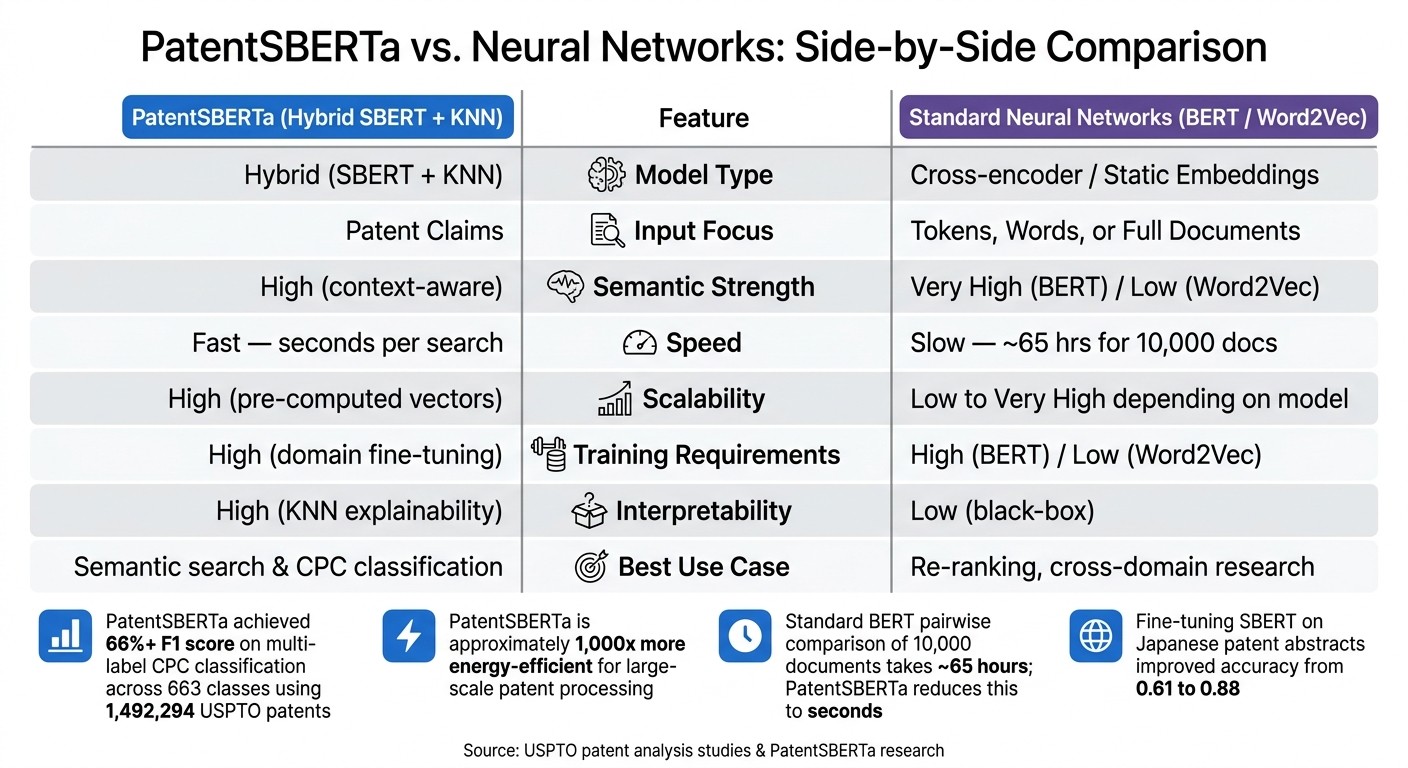
PatentSBERTa vs. Neural Networks: Side-by-Side Comparison
Comparison Table
Let’s break down the main architectural differences. PatentSBERTa combines Sentence-BERT with a K-Nearest Neighbors (KNN) algorithm, allowing it to pre-compute embeddings. This setup makes it both efficient and scalable. On the other hand, Standard BERT uses a cross-encoder approach, which directly compares document pairs. While highly effective, it’s much slower. Lastly, static models like Word2Vec are faster and cheaper but lack the ability to capture contextual meaning.
Feature | PatentSBERTa (Hybrid SBERT + KNN) | Standard BERT (Cross-encoder) | Word2Vec / Doc2Vec (Static Model) |
|---|---|---|---|
Model Type | Hybrid (SBERT + KNN) | Transformer Cross-encoder | Static Embeddings |
Input Focus | Patent Claims | Token-level context | Words or Documents |
Semantic Strength | High (context-aware) | Very High (deep interaction) | Low (fixed vocabulary) |
Scalability | High (pre-computed vectors) | Low (pairwise computation) | Very High (simple lookups) |
Training Requirements | High (domain fine-tuning) | High (pre-training) | Low (unsupervised) |
Best Use Case | Semantic search & classification | High-precision re-ranking | Fast, low-cost landscaping |
PatentSBERTa is tailored to process patent claims, whereas other models often handle titles, abstracts, or entire descriptions. These design choices directly affect how fast, scalable, and precise the models are in patent similarity tasks.
How These Differences Affect Patent Similarity Workflows
These technical distinctions play a big role in shaping patent search workflows. For example, PatentSBERTa's pre-computed embeddings allow it to handle millions of comparisons efficiently, making it ideal for large-scale searches in databases like the USPTO. Its focus on patent claims ensures it’s well-suited for comparing inventions with precision.
In contrast, Standard BERT excels as a re-ranking tool. It’s perfect for refining a shortlist of results after an initial search but struggles with large-scale, corpus-wide comparisons due to its computational demands. This makes it less practical for tasks like prior art searches, where speed and scalability are critical.
"The presented classification framework is simple and the results easy to interpret and evaluate by end-users." - Hamid Bekamiri, Daniel Hain, and Roman Jurowetzki
That emphasis on interpretability is crucial. PatentSBERTa’s hybrid design (SBERT + KNN) not only delivers reliable results but also makes them easier to understand and audit. This is especially important in legal and patent examination scenarios, where explainability can make all the difference.
Choosing the Right Approach for Your Patent Workflow
The choice of tools for your patent workflow depends on what you prioritize - whether it’s speed, precision, scalability, or interpretability. Each approach brings unique strengths to the table. Below, we break down when to use specific models and how Patently integrates these capabilities to support patent professionals.
When to Use PatentSBERTa
PatentSBERTa is a standout option for tasks like semantic patent searches, pairwise similarity rankings, and patent clustering. Its pre-computed embeddings make it ideal for large-scale patent comparisons, which is especially useful for classification tasks. For instance, pairing PatentSBERTa with a KNN algorithm can pinpoint the most similar patents, helping to justify results in legal and examination scenarios where interpretability is crucial. Using the combined text from the Title, Abstract, and Claims (TAC) provides the best representation for embedding-based retrieval and classification tasks.
When to Use Neural Networks
On the other hand, general-purpose neural networks, such as fine-tuned BERT models or large language models, excel in tasks that extend beyond patent-specific searches. These models are versatile, making them effective for cross-domain text mining, technology landscaping, or handling non-English patent corpora. Fine-tuning can significantly enhance classification accuracy for multilingual datasets. As noted by Grazia Sveva Ascione and Valerio Sterzi from the Bordeaux School of Economics, "The superiority in the performance of contextual embeddings may not be related to the actual architecture but rather to the way the training phase is performed".
How Patently Supports Patent Professionals

Patently combines the efficiency of PatentSBERTa with the adaptability of neural networks, creating a streamlined solution for diverse patent workflows. Its advanced Vector AI semantic search simplifies complex queries without requiring users to manage the underlying models. By automating embedding tuning and inference, Patently supports critical tasks like prior art searches, portfolio analysis, and SEP analytics. For professionals balancing speed and precision, Patently’s Starter plan - priced at $125 per user per month - offers semantic search, citation browsing, and analytics tools, making it an accessible option for daily patent-related tasks.
Conclusion
PatentSBERTa and general-purpose neural networks each bring unique strengths to patent similarity analysis. PatentSBERTa stands out for its speed and domain-specific accuracy, achieving over 66% F1 in multi-label CPC classification and being approximately 1,000 times more energy-efficient for large-scale tasks like processing thousands of patent documents. That kind of efficiency is hard to ignore.
On the other hand, neural networks shine in their ability to handle rare, emerging, and cross-domain technologies, especially in scenarios where data is limited. This adaptability makes them valuable for exploratory research and analyzing less-defined technological areas.
The key takeaway? PatentSBERTa is perfect for high-volume tasks like similarity searches and CPC classification, while neural networks are better suited for deeper dives into emerging or niche technologies.
For patent professionals, a hybrid approach often works best. PatentSBERTa can handle routine searches and classifications efficiently, while neural networks or large language models (LLMs) can focus on more complex, specialized analyses. Platforms like Patently demonstrate this layered strategy in action. By combining Vector AI semantic search with tools for prior art analysis, portfolio management, and SEP analytics, Patently eliminates the need for users to manage the underlying models themselves. This blend of efficiency and depth caters to the diverse needs of patent professionals.
FAQs
Can PatentSBERTa search full patent documents, not just claims?
PatentSBERTa is designed with a focus on patent claims. Its sentence-transformer architecture allows it to handle sentences and paragraphs effectively, making it suitable for semantic search. However, its primary use has been in the analysis of claims. There’s potential for future updates to include other sections of patent documents. Patently uses this advanced AI technology to improve patent analysis and simplify workflows for industry professionals.
When should I use a bi-encoder vs. a cross-encoder in patent search?
The choice between bi-encoders and cross-encoders comes down to your project's scale and computational demands.
Bi-encoders: These are the go-to option for large-scale retrieval tasks. They work by generating pre-computed embeddings, which makes comparing data incredibly fast. For example, they’re perfect for searching through massive patent datasets where speed is critical.
Cross-encoders: While slower, these provide greater accuracy. They process document pairs to capture deeper interactions, making them ideal for tasks like re-ranking results or labeling smaller, high-priority datasets where precision matters most.
Patently combines both approaches to enhance semantic search, ensuring efficiency and accuracy for patent professionals.
How can I validate similarity results for legal or examiner use?
To ensure accurate similarity results, blend automated semantic analysis with human oversight. Use benchmarks, such as overlapping claims in patent interference cases, to create a reliable baseline for similarity assessments. Evaluate the effectiveness of embeddings by analyzing how well they align with CPC subclass classifications, which reflect specific technology attributes.
Begin with a broad semantic search to cast a wide net. Then, narrow the results using Boolean filters, like date ranges or classification codes. Finally, re-rank the refined results to make manual review more efficient and precise. This combination of tools and methods balances automation with expert judgment for the best outcomes.