How NLP Improves Patent Keyword Extraction
Intellectual Property Management
Jun 4, 2026
NLP speeds and improves patent keyword extraction by resolving synonyms, extracting multi-word terms, using NER, and boosting recall and F1.
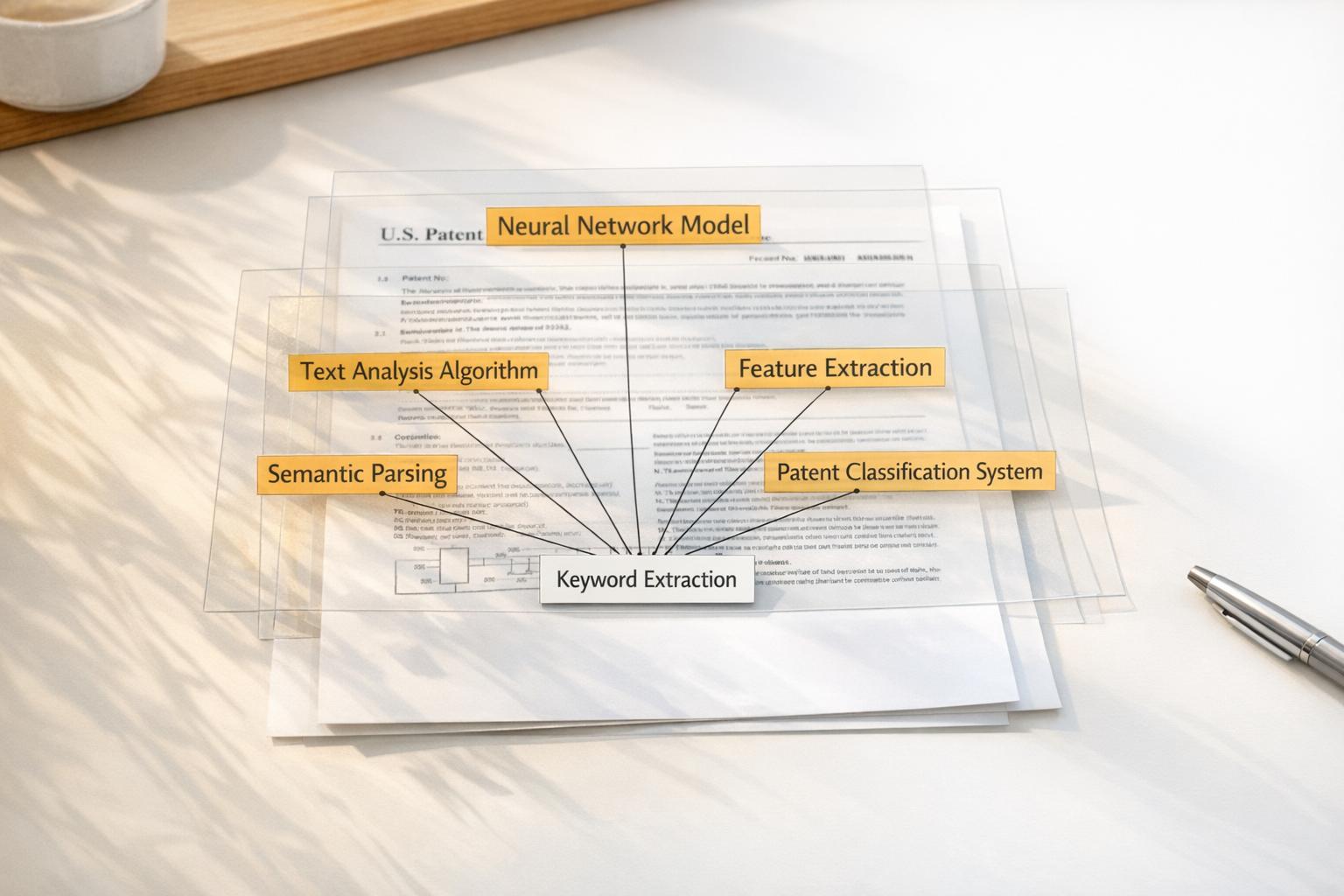
NLP tools make patent keyword extraction faster, more precise, and less error-prone. By automating tasks like identifying key terms, managing synonyms, and filtering noise, NLP reduces manual work and improves patent analysis. This is critical for tasks like prior art searches, claim drafting, and portfolio management, where accuracy is essential.
Key takeaways:
Core NLP techniques like tokenization, lemmatization, and semantic embeddings simplify the process.
Challenges in manual extraction include handling technical language, synonyms, and irrelevant terms.
Advanced methods like Named Entity Recognition (NER) and multi-word phrase extraction boost accuracy.
NLP tools significantly cut down time while improving F1-scores in keyword extraction models.
If you're navigating complex patent documents, NLP streamlines the workflow and ensures better results.
How KeyBERT Works | Keyword Extraction in NLP
Challenges in Manual Patent Keyword Extraction
Extracting keywords manually from patents is no walk in the park. These documents are notoriously lengthy and packed with dense, legal-technical language. Understanding the hurdles involved sheds light on why automated methods are becoming a necessity. Let’s dive into the specific obstacles that make manual extraction so tricky.
Ambiguous and Technical Language in Patents
Patent claims are intentionally crafted with broad, flexible language to ensure maximum legal coverage. For example, a single invention might be described as a "device for transmitting signals", a "communication apparatus", or a "signal relay mechanism" - all pointing to the same underlying concept. This ambiguity can trip up analysts, especially if they lack expertise in a specific technical field. They may stick to familiar terms, unintentionally overlooking equally valid alternatives. This not only slows the process but also increases the risk of errors.
Then there’s the challenge of multi-word technical phrases. Terms like "machine learning accelerator" or "thin-film deposition process" carry far more meaning as a whole than their individual words suggest. These nuanced phrases often get buried in the complexity of patent claims, making them easy to miss.
Managing Synonyms, Abbreviations, and Term Variants
Synonyms are a constant headache in patent analysis. A single technology might be described using multiple terms depending on the context. Take wireless communications patents, for instance: "UE" (user equipment), "mobile station", and "terminal device" might all refer to the same thing. Focusing on just one term risks missing other valid variations.
Abbreviations only add to the confusion. Terms like "gNodeB" in 5G patents, "FBAR" in acoustic resonator patents, or "CMP" in semiconductor patents carry critical technical meanings. Without proper context, these abbreviations can easily be overlooked, potentially leaving important prior art undiscovered. Missing even one key abbreviation could have serious consequences for novelty assessments or infringement analyses.
On top of all that, analysts also have to sift through irrelevant content, which only adds to the complexity.
Filtering Out Noise and Generic Terms
Patent texts are often cluttered with boilerplate language and generic terms, which can dilute keyword precision. Repeated phrases that add no technical value only serve to crowd keyword lists, forcing analysts to spend extra time weeding out unnecessary content.
Generic terms like "system", "method", or "device" are another major issue. These high-frequency words appear in countless patents but offer little to no specificity. Including them in keyword lists not only muddies the waters but can also lead to false positives during searches. Worse yet, poor handling of synonyms and alternative terminology can cause analysts to miss 20–40% of relevant patents altogether.
Applying NLP Techniques to Patent Text
When manual extraction methods fall short, NLP techniques step in to tackle the challenges of analyzing patent text. The process begins by preparing the raw patent documents, ensuring that extraction tools can process the information accurately and efficiently, often utilizing top patent tools to streamline the workflow.
Segmenting and Preprocessing Patent Text
Patent documents are typically divided into sections like the title, abstract, claims, and description. Each section plays a distinct role in keyword analysis. For instance, the abstract is written in simpler terms and is useful for initial screening, while the claims section defines the invention's legal boundaries and requires more complex NLP processing.
"The semi-structured format of patents introduces unique challenges... Directly concatenating all levels for [Keyphrase Generation] is impractical due to the length of patent documents." - Xin Xia, Researcher, Tsinghua University
A practical method involves treating each section based on its unique characteristics. Short sections like the title and abstract can be combined for added context, while longer sections, such as claims, should be split into manageable parts to avoid overwhelming the model. This hierarchical segmentation ensures that the structure and meaning of the document are preserved. This level of precision is a hallmark of AI-enabled patent analysis platforms used for complex landscape projects. At this stage, basic cleaning - like removing duplicates and handling missing abstracts - is also essential.
Normalizing Terms with Lemmatization and Stemming
Once the text is segmented, the next step is refining the terms to ensure accurate keyword extraction. Patent text often contains multiple forms of the same word. For example, "transmitting", "transmitted", and "transmission" all describe the same concept but might be treated as separate terms in a basic keyword search. Lemmatization and stemming help unify these variations.
Stemming is faster, as it simply chops off word endings, but it can be less precise. Lemmatization, on the other hand, uses vocabulary and grammar rules to return words to their proper base form, making it more accurate. Given the technical nature of patent text, lemmatization is generally the preferred choice.
Once terms are unified, the focus shifts to removing unnecessary language that could interfere with analysis.
Removing Stop Words and Boilerplate Language
With the text segmented and normalized, the final step is to filter out non-informative language that adds little value to keyword extraction. Patent documents often include generic terms like "system", "method", and "device", as well as standard legal phrases like "embodiment", "thereof", and "according to the present invention." These phrases, while necessary for drafting, do not provide meaningful technical insights and can clutter search results.
Advanced filtering tools, such as patiroha (introduced in April 2026), are specifically designed for patent analysis. These tools use dictionaries containing over 1,100 patent-specific stop words, organized into categories like "Patent Terms", "Structural", and "IT/Control". This approach allows analysts to remove legal and boilerplate language while retaining domain-specific terms. For example, when analyzing a chemistry patent, terms like "device" can be excluded while keeping relevant words like "polymer." Regular expressions can also be employed to clean up extraneous symbols, such as "Fig. 3" or "element [undefined]", that might clutter the text.
Advanced NLP Methods for Better Keyword Extraction
Advanced NLP techniques take keyword extraction in patents to the next level by building on foundational methods like segmentation and normalization. These approaches significantly improve precision, especially when dealing with the complexity of patent language.
Extracting Multi-Word Technical Terms
In patents, single words often fall short of conveying the full meaning. For example, "intelligence" is vague, but "artificial intelligence" provides clarity. This distinction is critical when searching or analyzing patent portfolios.
One effective method for identifying meaningful multi-word phrases is constituency parsing, which examines the grammatical structure of patent claims. This technique uncovers "composition" and "specialization" patterns, such as "a system comprising..." or "a system made of...". Adjusting part-of-speech (POS) classifications - like reclassifying "said" from a verb to a relative adjective - also improves accuracy in identifying key phrases.
Generative models, such as the One2Set paradigm, further enhance this process. These models predict keyphrases in parallel, avoiding the ordering bias seen in sequential methods. A standout feature of One2Set is its ability to identify absent keyphrases - concepts central to the invention that aren't explicitly stated in the text. This parallel approach is particularly useful for large-scale patent datasets, offering both speed and flexibility.
Beyond identifying phrases, pinpointing specific entities is another crucial step.
Using Named Entity Recognition (NER) in Patents
Named Entity Recognition (NER) focuses on identifying specific entities like chemical names, gene identifiers, technical components, and company names - terms that frequency-based methods often overlook but are essential in patent analysis.
A standout example is the BERT-refined keyphrase extraction (BRKE) method. Developed by researchers at Fudan University, BRKE was tested on 13,199 USPTO patents in robotics and automation. It outperformed KeyBERT by an impressive 9.52%.
Domain-specific tools further enhance performance. For instance, embeddings pre-trained on chemical patent corpora (ChemPatent) outperform general biomedical datasets by an average of 0.64 F1 points in patent NER tasks. Similarly, using a tokenizer like OSCAR4, optimized for chemical text, adds about 1.0 absolute macro-averaged F1 improvement.
"By enhancing the accuracy of patent keyphrase extraction, our contributions make patent analysis more efficient and accessible to both analysts and design engineers." - World Patent Information
Building Synonym Maps with Semantic Similarity
Once multi-word terms and entities are identified, the next step is addressing vocabulary mismatches. For example, one inventor might use "flexible substrate", while another refers to the same concept as a "bendable carrier layer." Without resolving these differences, keyword searches can miss critical connections.
Semantic similarity methods tackle this problem by encoding terms as high-dimensional vectors (embeddings) and grouping those with similar meanings into synonym clusters. These clusters link related terms - like "base station" and "eNodeB" - into a unified, searchable concept. Models tailored for patent language, such as BERT for Patents, excel in this area by understanding domain-specific jargon and technical acronyms.
Combining large language models (LLMs) with traditional thesauruses further expands coverage. Research shows that LLM-generated synonyms often have low co-occurrence with existing thesaurus entries, meaning they capture terms that standard lists miss. This approach creates a more comprehensive and reliable keyword set, adaptable across different inventors, time periods, and technical fields.
Putting NLP-Generated Keywords to Work in Patent Workflows
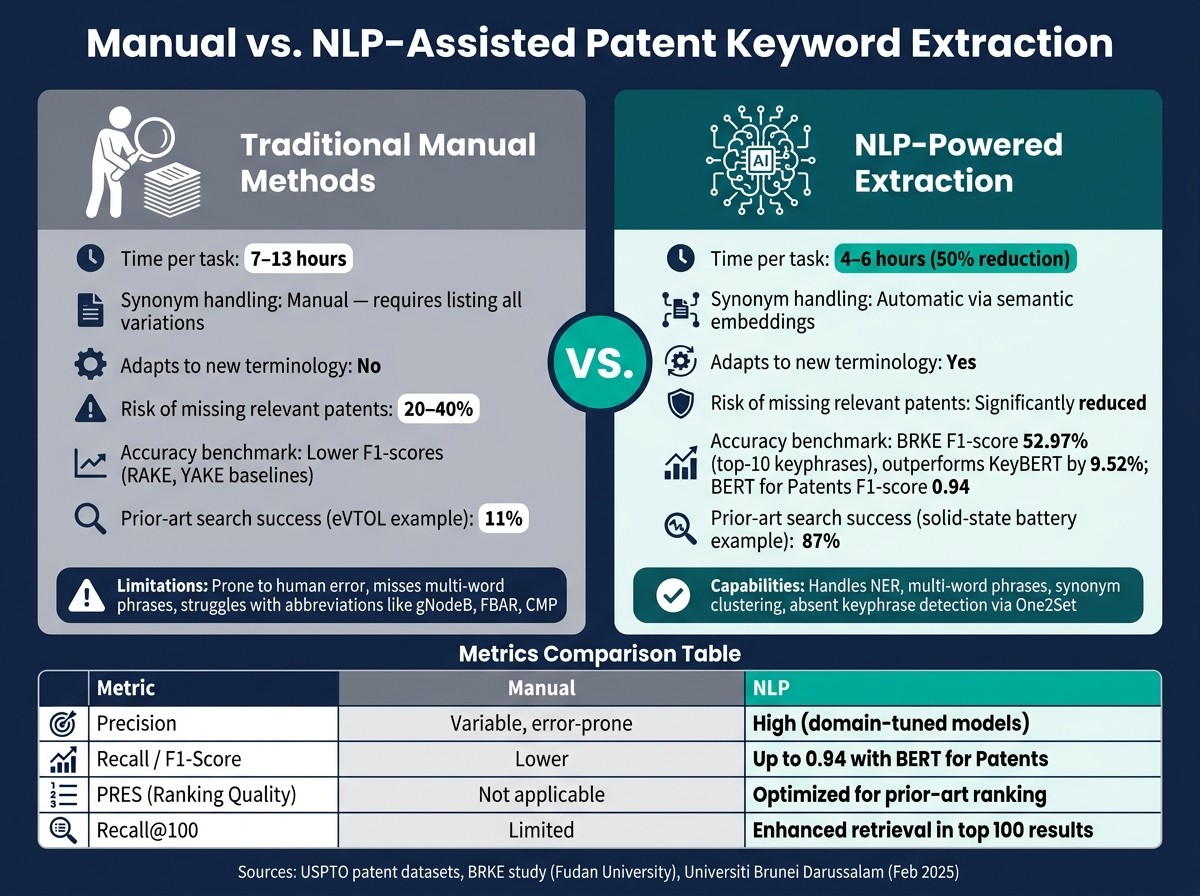
Manual vs. NLP-Assisted Patent Keyword Extraction: Key Differences
After creating a robust set of NLP-generated keywords and synonym maps, the next step is integrating them into your patent-related tasks. These tools can enhance everything from searching for prior art to drafting patent claims.
Strengthening Prior-Art and Clearance Searches
NLP-generated keywords bring a new level of efficiency to patent search workflows. Unlike traditional Boolean searches, which require manually listing every possible term variation (and still risk missing key results), NLP uses semantic embeddings to expand synonyms automatically. This approach adapts to the constantly evolving language in technical fields, reducing the chance of oversight.
The effectiveness of keyword-based searches can vary significantly by industry. For instance, research indicates an 87% success rate for solid-state battery searches but only 11% for eVTOL aircraft searches. This disparity highlights the challenge of static keyword lists in fields with rapidly changing terminology.
Search Approach | Synonym Handling | Adapts to New Terminology |
|---|---|---|
Traditional Boolean | Manual - requires listing variations | No |
NLP-Powered Semantic | Automatic via semantic embeddings | Yes |
Improving Semantic Patent Search and Portfolio Analysis
NLP-generated keywords also revolutionize how large patent portfolios are analyzed. Instead of examining patents one by one, tools like term co-occurrence networks and bigram word clouds can uncover thematic clusters across extensive datasets. Combining methods like TF-IDF, BERT-based Named Entity Recognition, and Large Language Model (LLM) refinement further enhances clustering and retrieval precision.
For example, the BERT-refined keyphrase extraction (BRKE) method achieved an F1-score of 52.97% for top-10 keyphrases, outperforming standard tools like YAKE and RAKE. Platforms such as Patently leverage these advancements through features like Vector AI, which organizes patents by concept rather than exact keyword matches. This layered approach merges quantitative data with qualitative insights, making it easier to navigate and analyze patent portfolios.
Guiding Claim Drafting and Specification Writing
NLP-generated keywords are just as valuable during the drafting phase. They help ensure broader claim coverage by surfacing a variety of terms. For instance, a synonym map might connect "flexible substrate" with "bendable carrier layer" and "compliant base film", allowing these terms to be integrated into specifications for broader interpretation. Additionally, generative AI patent drafting tools can analyze claim structures - covering preambles, transitions, and limitations - to identify inconsistencies and ensure the claims are both linguistically and legally sound.
Measuring and Refining NLP-Based Keyword Extraction
Metrics for Evaluating Keyword Extraction Quality
To gauge how well your NLP pipeline is performing, focus on three core metrics: precision, recall, and the F1-score. Precision tells you how many of the extracted keywords are actually relevant, while recall measures how many relevant terms the system captures. The F1-score combines these two, giving you a single number to compare models effectively.
For prior-art searches, there’s a specialized metric you should know: PRES (Patent Retrieval Evaluation Score). Researchers Julien Rossi, Matthias Wirth, and Evangelos Kanoulas describe it as:
"PRES is a metric... aiming at a better evaluation of the performance of a retrieval system in a setting with only a few actually relevant documents among many."
PRES is particularly useful because patent searches often involve finding just a few critical documents in a massive database. It evaluates not only if relevant documents appear but also how they rank in the results. Pairing PRES with Recall@100 - which measures how many relevant documents show up in the top 100 results - gives you a clearer picture of how well your system performs in practical scenarios.
Metric | What It Measures | Best Used For |
|---|---|---|
Precision | Relevance of extracted terms | General quality checks |
Recall / F1-Score | Completeness and overall balance | Model comparison |
PRES | Ranking quality of retrieved documents | Prior-art search evaluation |
Recall@100 | Retrieval success within the top 100 results | Search workflow testing |
These metrics provide a solid foundation for comparing both manual and automated keyword extraction methods.
Comparing Manual and NLP-Assisted Workflows
To evaluate your NLP pipeline, compare its output against labeled patent datasets like those from the USPTO or CLEF-IP. While accuracy is critical, computational efficiency is just as important. For example, a study by Universiti Brunei Darussalam in February 2025 revealed that fine-tuning a "BERT for Patents" model on abstracts and key terms - rather than full patent descriptions - achieved an impressive F1-score of 0.94, all while reducing processing complexity.
Recent research also shows that NLP models, such as BRKE, consistently outperform manual methods in accuracy and efficiency. To fine-tune your pipeline further, test keyword extraction quality at multiple cut-off points - like the top 10, top 20, and top 50 keywords. This approach helps balance capturing a wide range of terms while minimizing irrelevant noise.
Keeping Up with Changes in Patent Language and Standards
Keyword extraction in patents comes with its own challenges, especially as terminology evolves. Continuous updates to your NLP model are necessary to keep up with shifts in language, particularly in cutting-edge fields like 5G/6G communications, CRISPR-based therapeutics, and solid-state battery technologies. An NLP model trained on older patents will likely struggle to interpret newer filings accurately.
To address this, retrain your models using recent patent datasets from sources like the USPTO or EPO. Large language models (LLMs), such as GPT-4o-mini, can also be leveraged to refine candidate keywords generated by traditional statistical models. For instance, a BERT model fine-tuned specifically for patent text achieved an F1-score of 0.94 on testing data, demonstrating the value of targeted training.
Another hurdle is Part-of-Speech (POS) tagging errors. Patent-specific terms often confuse general NLP tools, which may misclassify legal terms like "said" or "claim" as verbs. Manually correcting these tags before parsing the data can significantly improve accuracy.
Conclusion: What NLP Means for Patent Keyword Extraction Going Forward
Natural Language Processing (NLP) has reshaped the way patent keyword extraction is done, making it faster and more effective. What once took 7–13 hours using manual methods can now be completed in just 4–6 hours with NLP-assisted workflows. That’s a 50% time reduction, all while identifying technical synonyms and complex multi-word phrases that manual methods might miss.
The improvements in accuracy are just as impressive. Modern NLP techniques outperform older algorithms like RAKE and YAKE, delivering better results for prior-art searches, claim drafting, and portfolio analysis. This leads to more precise patent documentation and stronger legal positioning.
Looking ahead, the future of NLP in this field is even more exciting. Emerging trends like multimodal NLP - which integrates patent drawings and chemical structures with text - are on the horizon. Explainable AI is also advancing, offering insights that are easier for legal professionals to interpret. Predictive analytics is another game-changer, with tools capable of forecasting Patent Trial and Appeal Board (PTAB) decisions with 70–75% accuracy. Additionally, cross-lingual NLP models are making it easier to align concepts across multiple languages, breaking down language barriers in global patent work.
For intellectual property (IP) professionals, the key takeaway is clear: NLP doesn’t replace expertise - it enhances it by automating tedious tasks. Tools like Patently are already leveraging this technology to streamline the entire patent lifecycle. For instance, Patently's Vector AI enables users to uncover hundreds of relevant prior-art results in under five minutes, a feat that traditional keyword-based searches struggle to match.
As NLP models trained on specialized patent data continue to advance, early adopters stand to gain the most. Those who embrace these tools now will be better equipped to handle the evolving demands of the patent landscape.
FAQs
Which patent sections should I analyze for the best keywords?
When it comes to extracting keywords from patents, claims and the abstract are your go-to sections. Why? Claims lay out the boundaries of legal protection and highlight the key technical aspects, making them the most crucial part of a patent. Meanwhile, the abstract delivers a compact summary of the main ideas, offering a treasure trove of high-value terms.
Patently takes this process to the next level with its AI-powered tools and advanced semantic search, specifically designed to meet the needs of patent professionals.
How does NLP handle synonyms and abbreviations in patents?
Natural language processing (NLP) dives deeper than simple word matching by grasping conceptual meaning, making it adept at handling synonyms and abbreviations. At its core, it uses semantic embeddings, which convert text into mathematical vectors. This allows related terms - like "autonomous vehicle" and "self-directed mobile platform" - to cluster together, showing their connection.
To refine language understanding, techniques like stemming are employed to reduce words to their base forms, ensuring consistency across variations. Meanwhile, transformer-based models take things further by capturing the subtle technical details of language. These models help bridge gaps in terminology, making it easier to align language differences and unify terms used by various inventors.
What’s the best way to measure keyword extraction quality for prior-art search?
Keyword extraction quality in prior-art search is typically evaluated using precision, recall, and F1-scores measured against manually annotated datasets. However, when no such ground truth is available, analysts turn to alternative methods like information gain, cross-validation, and techniques such as Support Vector Machine (SVM) classification.
For prior-art searches, the goal shifts toward improving recall and the ranking of relevant documents. The emphasis is placed on the quality of search results, rather than simply focusing on term frequency. This ensures that the extracted keywords lead to more comprehensive and relevant document retrieval.