How AI Improves Smart Grid Patent Search
Intellectual Property Management
Jun 5, 2026
Shows how semantic search, NLP, and clustering let AI find more smart-grid prior art and cut patent search time.

AI is transforming how patent searches are conducted in the smart grid sector, addressing challenges like fragmented terminology, classification gaps, and rising patent volumes. Traditional keyword searches often miss up to 40% of relevant prior art, especially in a field where technologies like edge AI, distributed energy resources (DERs), and predictive networks evolve rapidly. AI tools use semantic search, NLP, and clustering to identify conceptually similar patents, analyze claims, and map technology trends efficiently.
Key Takeaways:
Semantic Search: Finds patents by meaning, bridging terminology gaps and uncovering ~40% more relevant results.
NLP: Breaks down claims for deeper analysis, including cross-lingual retrieval for global filings.
Clustering: Groups patents into themes, revealing trends and innovation gaps.
AI-powered workflows reduce search time by up to 80% and improve search quality, but human expertise remains essential for legal validation and nuanced interpretation. A hybrid approach ensures accuracy, compliance, and actionable insights in patent search and management.
How Enterprises Uses Generative AI for Patent Search, Drafting & Classification | IP Author Webinar
Smart Grid Patent Search Challenges
The smart grid sector doesn’t fit neatly into one category, making patent searches in this area particularly tricky.
What Are Smart Grid and Energy Efficiency Technologies?
Smart grid technology integrates various systems to improve how electricity is generated, distributed, and consumed. Key components include advanced metering infrastructure (AMI), distributed energy resources (DERs), demand response systems, and microgrids. Beyond physical infrastructure, software plays a growing role, such as supply-demand forecasting, EV charging networks, and AI-driven grid management.
This field has seen rapid growth. Between 2010 and 2022, software advancements increased the presence of smart features in physical grid patents by 50%. As EPO President António Campinos noted:
"Significant progress has already been made, highlighting the urgency of investing in smarter, more flexible electricity networks to balance growing power demand with variable energy sources."
The wide-ranging nature of these technologies adds complexity to patent classification and search processes.
Why the Smart Grid Patent Landscape Is Complex
Smart grid systems bring together diverse fields like information and communications technology (ICT), power electronics, renewable energy, and even automotive innovations. This convergence blurs the boundaries between domains, making it harder to classify and search for patents using traditional methods.
For example, a single patent might cover IoT applications, grid-edge computing, and renewable energy storage. Determining the correct search scope or classification codes becomes a significant challenge. Adding to this complexity, there’s a noticeable geographic shift: in 2023, 46% of all smart grid patent applications came from Chinese applicants. Many of these filings remain within China’s CNIPA database, meaning U.S.-centric searches risk missing critical prior art.
Limits of Keyword-Based Patent Search Methods
Traditional keyword searches often fall short when it comes to capturing the full breadth of smart grid innovations. These methods rely on accurately guessing the terminology inventors use, which is no small feat. For instance, one patent might refer to a "flexible substrate", while another uses "bendable carrier layer" to describe the same concept. In a fast-moving field like smart grids, emerging ideas often lack standardized terms in IPC or CPC classification systems. As a result, keyword searches can overlook up to 40% of relevant prior art. For IP professionals handling AI-enabled patent analysis for freedom-to-operate or validity searches, this margin isn’t just inconvenient - it’s a serious risk.
Challenge | Impact |
|---|---|
Terminology ambiguity | ~40% of relevant prior art missed by keyword searches |
Classification lag | Emerging smart grid terms absent from IPC/CPC systems |
Geographic blind spots | 46% of filings from China, often not filed internationally |
Volume growth | AI-grid patents grew sixfold in recent years |
AI Techniques That Improve Patent Search
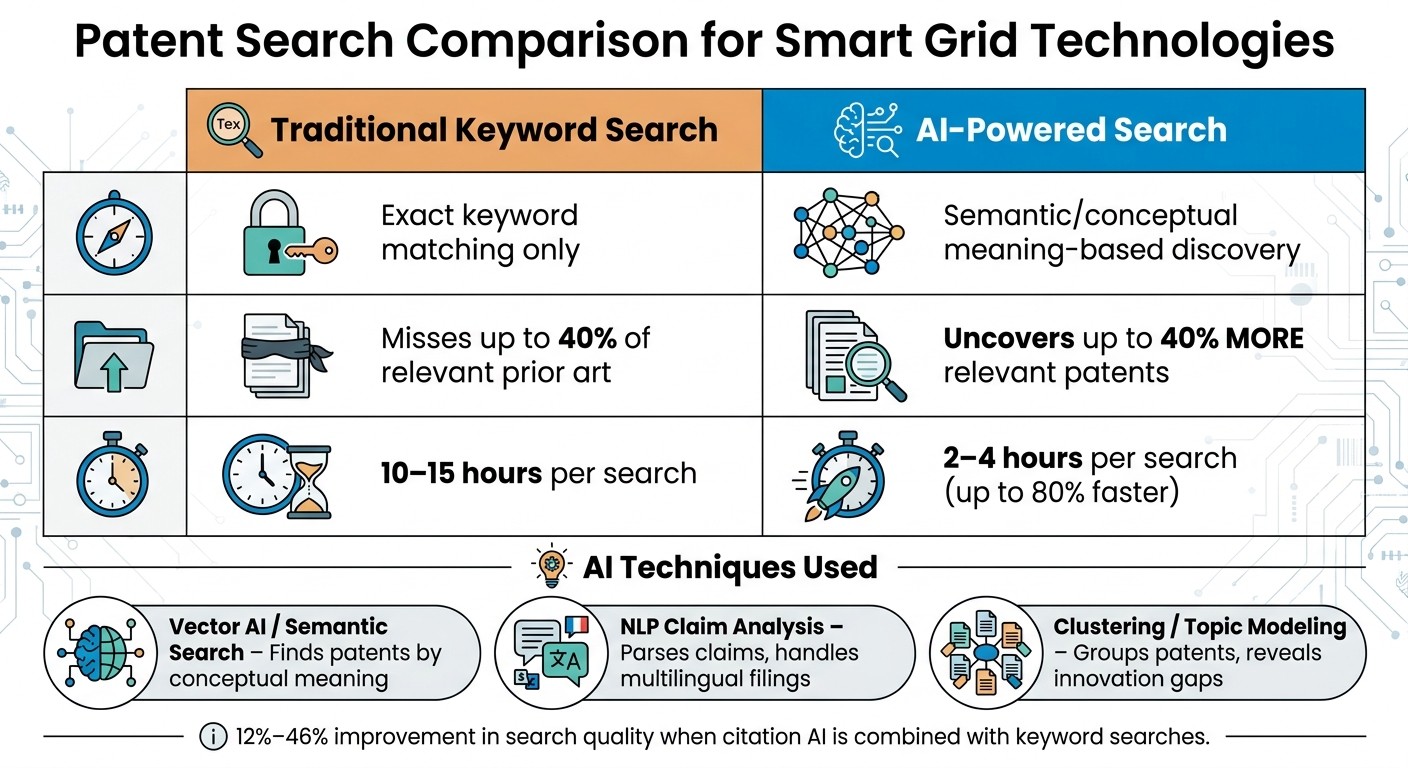
AI vs. Traditional Patent Search: Smart Grid Performance Comparison
Keyword searches often leave gaps that can lead to serious legal and business risks. AI bridges these gaps using three main techniques: semantic search, natural language processing (NLP), and clustering.
Semantic Search and Vector AI
Semantic search tackles the limitations of keyword-based methods by focusing on meaning rather than exact terms. Using Vector AI, patent text is transformed into embeddings that reflect conceptual relationships, allowing searches to uncover relevant patents even when different terminology is used. For instance, a query like "AI-based distributed energy management" could reveal patents discussing the same idea using terms like "demand response optimization" or "grid-edge control system."
This approach improves results significantly, uncovering up to 40% more relevant patents compared to keyword searches. For example, in smart grid technologies, where terminology is highly varied, semantic search minimizes the risk of missing critical prior art. Platforms like Patently incorporate this technology, enabling users to perform conceptual searches across vast patent databases.
However, semantic drift - where AI links unrelated patents due to functional similarities - can be a challenge. To counter this, combining Boolean filters with semantic search ensures results remain legally accurate.
NLP takes this a step further by breaking down complex patent claims for deeper analysis.
Using NLP to Analyze Patent Claims
NLP is essential for understanding the intricate claims often found in patents. It breaks down these claims into independent and dependent components, mapping technical relationships and identifying key entities like devices, systems, or energy types. It also captures functional details such as "convert", "store", and "transmit."
A 2025 study demonstrated NLP's effectiveness by analyzing solid-state battery patents. The system identified core terms like "active material", "positive electrode", and "electrolyte layer", while filtering out irrelevant documents that used broader terms like "electronic device" or "neural network". Traditional keyword searches would struggle to achieve this level of precision.
NLP also excels in cross-lingual retrieval, a critical feature since many smart grid patents originate in non-English-speaking countries like China, Japan, and Korea.
Clustering and Technology Mapping
Clustering goes beyond analyzing individual patents by grouping results into meaningful categories, providing actionable insights. In the dynamic smart grid sector, algorithms like HDBSCAN automatically form clusters around natural technology themes, revealing trends and gaps in innovation.
"Unsupervised machine learning (HDBSCAN) automatically groups patents into natural 'Technology Clusters,' revealing the true sub-domains of an industry." - Patgrid
In April 2026, researchers at the Singapore University of Social Sciences used SciBERT-based semantic clustering on 10,692 USPTO patents (2005–2025). Their study highlighted a shift in green energy innovation - from broad renewable approaches to material-driven optimization. It also showed the industry reorganizing into a hierarchical technology stack, rather than isolated fields. For IP professionals, this kind of mapping identifies emerging opportunities and tracks where technologies are evolving, maturing, or consolidating - insights that could take weeks to uncover manually.
AI Method | What It Does | Why It Matters for Smart Grid Search |
|---|---|---|
Vector AI / Semantic Search | Finds patents by conceptual meaning | Captures synonyms and paraphrases in fragmented terminology |
NLP Claim Analysis | Parses and extracts entities and relationships | Speeds up scope analysis and handles multilingual filings |
Clustering / Topic Modeling | Groups patents into natural technology themes | Highlights innovation gaps and tracks trends across domains |
Building a Smart Grid Patent Search Strategy with AI
Defining Search Scope and Objectives
Before diving into patent searches, it’s crucial to define your goal. Are you looking for prior art, conducting a landscape analysis, or scouting for new technologies? Each of these objectives requires a distinct strategy. Trying to tackle multiple goals at once can lead to inefficient and unfocused searches. A clear scope is the foundation for creating precise queries and adapting them to specific jurisdictions.
Start by identifying your target jurisdictions and applying relevant legal status filters. For example, if you’re preparing for the U.S. market, focus on USPTO filings with an "active" status. This allows you to identify potential blocking patents while steering clear of expired or abandoned ones, which could highlight areas of opportunity or "white space." For smart grid-related searches, the Y04S CPC subclass is a great place to start, as it’s dedicated to smart grid technologies. Subgroups like Y04S 10/12 (focused on distributed energy resource monitoring) and Y04S 20/30 (centered on smart metering) can help refine your search and avoid unrelated energy classifications.
Another helpful metric to monitor is forward citation counts. Patents with 30 or more forward citations often represent core technologies in the smart grid sector. These patents are more likely to pose blocking risks, making them critical to review during clearance assessments. Keeping this in mind can significantly improve the accuracy of your search in this intricate field.
Once you’ve set clear objectives, the next step is to design AI-powered queries that maximize search precision.
How to Build Effective AI Search Queries
Avoid the temptation to use simple keyword strings when crafting AI search queries. AI systems excel when provided with detailed descriptions of the technology rather than a basic list of terms.
For example, instead of searching for "demand response" AND "grid control", describe the concept in detail: "A system that automatically adjusts residential electricity consumption in response to real-time grid load signals, using two-way communication between a utility and smart meters." This approach enables the AI to identify conceptually related patents, even when different terminology is used. If your technology includes specific parameters - like a battery that operates between -40°F and 302°F or meets a particular energy density - include those details in your query. Adding such specifics helps the AI focus on patents within the relevant engineering scope.
After crafting a detailed natural language query, apply filters to narrow your results. Combining a well-thought-out prompt with filters like CPC codes, assignee names, and filing date ranges ensures you maintain semantic depth while honing in on relevant results. With approximately 3.7 million patent applications filed globally in 2024, unfiltered results can quickly become overwhelming.
Adapting AI Searches to U.S.-Specific Contexts
Once you’ve developed effective query strategies, it’s essential to tailor them for U.S.-specific requirements. Smart grid patents in the U.S. often reflect domestic regulations, so aligning your approach with these frameworks can produce more relevant results. For instance, references to FERC compliance rules, interconnection queue requirements, or NERC standards can make your prompts more targeted compared to generic phrases like "grid management".
Additionally, U.S. patent filings typically use imperial and U.S. customary units. Energy is commonly measured in kilowatt-hours (kWh), distances in miles (for grid infrastructure), and temperatures in degrees Fahrenheit. Including these units in your prompts ensures the AI distinguishes U.S. filings from international ones that might use metric equivalents.
For USPTO database searches, leverage the .CPCI. (Inventive) or .CPCA. (Additional) field codes at the subgroup level rather than relying on broader class-level queries. This approach keeps queries manageable and avoids exceeding system limits, as queries matching more than 20,000 records may fail. Combining these focused CPC indexes with natural language prompts gives you the precision of structured searches along with the broader conceptual reach of AI.
Getting the Most Out of AI in Smart Grid Patent Workflows
By integrating AI-enabled query strategies into entire patent workflows, organizations can uncover actionable insights that drive smarter decisions.
Patent Landscape Analysis and Innovation Mapping
AI transforms the traditionally labor-intensive task of patent landscape analysis into a fast, on-demand process. Instead of manually sorting through countless documents, AI tools can group patents by technical themes and highlight white-space opportunities - areas with little or no patent activity - within minutes.
This capability is particularly valuable in dynamic smart grid sectors like grid-edge solutions and transactive energy models, where the patent landscape evolves rapidly. Advanced clustering techniques allow intellectual property (IP) teams to pinpoint areas of high innovation density and identify gaps, helping guide research and development (R&D) investments more effectively. These insights enable IP professionals to take a proactive role in shaping R&D efforts and maintaining a competitive edge in the ever-changing smart grid space. Competitive analyses can also be bolstered by leveraging authoritative sources such as the USPTO, EPO Espacenet, and technical publications from IEEE or arXiv.
Such landscape insights naturally lead to more thorough and efficient prior art identification.
Prior Art and Freedom-to-Operate Searches
AI dramatically improves the completeness of prior art searches, addressing the limitations of traditional keyword-based methods.
For Freedom-to-Operate (FTO) analysis, AI can break down independent patent claims into their individual elements and match each element to specific sections in prior art or product documentation. This process, often one of the most time-consuming parts of FTO work, can now be automated, allowing attorneys to focus on the nuanced legal judgments that require their expertise. Tools like Patently’s semantic search with Vector AI and its Forward and Backward citation browser simplify deep-dive analyses, enabling users to trace citation chains efficiently without needing to juggle multiple databases.
AI-enhanced workflows have demonstrated a 12% to 46% improvement in search quality when citation AI is used alongside keyword searches. By narrowing the pool of references and prioritizing high-risk prior art, AI allows legal teams to focus their efforts on evaluating novelty and obviousness. This targeted approach leads to more confident and defensible decisions within AI-powered patent workflows.
Portfolio Management and Competitor Monitoring
AI doesn’t just improve search accuracy - it also makes managing patent portfolios and monitoring competitors more efficient.
For large smart grid patent portfolios, manual management is no longer practical. AI can automatically organize patents by technical themes or custom taxonomies, helping IP teams identify redundancies, uncover licensing opportunities, and align portfolio strategies with broader business objectives.
On the competitive monitoring front, AI turns static landscape snapshots into dynamic, real-time maps. Semantic search is particularly effective at identifying competitors who use unconventional technical language, such as startups or academic spinouts that might otherwise evade detection through traditional keyword searches. Automated alerts can track filings that match specific smart grid profiles or competitor assignees, keeping your team informed about competitor R&D shifts before they translate into product launches.
For technologies tied to technical standards, AI can also distinguish standard-essential patents (SEPs) from non-essential ones by aligning claim structures with specific standard specifications. This capability is increasingly important as grid interoperability standards continue to evolve. Together, these AI-driven tools empower IP teams to make quicker, more informed decisions throughout the patent management lifecycle.
Validating AI-Generated Patent Search Results
AI tools can process thousands of smart grid patents in record time, but their results need to be verified for accuracy and reliability. Validation plays a critical role in turning an automated search into one that can stand up to scrutiny.
Manual Review of AI Search Results
A balanced approach, combining AI and human expertise, works best. Start by using AI's natural language processing to identify around 500 semantically related patents. Then, refine the results with Boolean logic and filters, such as date ranges, CPC classifications, or exclusion terms, to narrow down the list for human review.
When reviewing, focus on specific claim details. A patent might initially seem relevant, but if its claims don't align with the limitations of your application, it likely won't qualify as prior art. Pay close attention to spatial and structural terms like "adjacent", "between", or "under." These terms are often crucial in claim analysis, even though AI might overlook them as minor details. Additionally, manually examine patent figures and non-patent literature, as AI can struggle with older, poorly scanned drawings or inconsistently formatted documents.
Leverage the top AI results to fine-tune your Boolean queries, ensuring they capture nuanced language. After refining the shortlist, address any inherent biases in the AI-generated results. This step ensures the final set of patents is as accurate and relevant as possible.
Spotting and Addressing AI Bias
AI systems aren't perfect and can sometimes produce skewed results. A common issue is semantic drift, where the AI confuses how a technology works (functional similarity) with where it's used (field-of-use similarity). For example, an AI might mistakenly flag an automotive ultrasonic sensor as relevant prior art for a smart grid application because both use similar signal-processing methods, even though they serve entirely different purposes. To avoid this, apply strict CPC/IPC classification filters to keep results focused on the correct technical domain.
Another challenge is the underrepresentation of foreign filings. Many AI models are trained primarily on English-language sources, which can lead to less coverage of patents from countries like China, Japan, and South Korea. Tools with automated cross-lingual retrieval capabilities can help bridge this gap.
"The most reliable approach today is not to discard AI, but to put it in its proper place inside a hybrid workflow." - Jennifer, Global Patent Solutions
U.S. Legal Considerations in AI-Assisted Patent Search
While AI enhances the efficiency of patent searches, U.S. patent law requires human oversight at every stage. Under 37 CFR 1.56, legal practitioners must disclose all material information through a reasonable inquiry. An AI-generated reference list alone doesn't meet this standard; each result must be assessed for materiality before being included in an Information Disclosure Statement (IDS).
Additionally, under 37 CFR 11.18, any filing with the USPTO must be signed by a licensed practitioner who certifies that a reasonable inquiry was conducted. This responsibility cannot be handed off to AI or non-practitioners. Confidentiality is another concern - inputting sensitive client data into third-party AI platforms could lead to exposure risks, particularly if the AI server is located outside the U.S. and subject to export control laws.
Lastly, AI results must be validated against 35 U.S.C. § 101 eligibility standards. For smart grid software claims, this means demonstrating a practical application or technological improvement rather than just an abstract idea. While AI can generate potential references, determining whether these meet § 103 standards for analogous art - such as in cases like In re Klein - requires the expertise of a legal professional.
"A person of ordinary skill is also a person of ordinary creativity, not an automaton." - U.S. Supreme Court, KSR v. Teleflex
These legal safeguards ensure that AI outputs effectively support strategic decisions in patent searches.
Conclusion: Using AI for Smarter Smart Grid Patent Searches
Smart grid patent searches are anything but simple. These technologies span numerous overlapping fields, terminology evolves across regions and inventors, and the sheer volume of filings continues to grow. Relying solely on traditional keyword searches just doesn't cut it anymore.
AI changes the game by enabling concept-based discovery rather than sticking to exact-word matches. This means it can find patents that describe the same technical concept but use entirely different language - something Boolean searches often miss. The time savings are impressive too, cutting search efforts from 10–15 hours down to just 2–4 hours when using a well-designed AI workflow.
Even with these advancements, human expertise is irreplaceable. The best results come from a hybrid approach: AI for broad and efficient discovery, paired with human insight for detailed claim analysis and legal interpretation. Tools like Patently are built with this balance in mind, combining advanced Vector AI semantic search with collaborative project management to help IP teams work faster without sacrificing precision.
FAQs
How do I reduce semantic drift in AI patent searches?
To keep semantic drift in check during AI-powered patent searches, an iterative approach works best. Begin by clearly outlining your invention's main functionality, technical methods, and related industry, using precise and technical language. Tools like Patently’s Vector AI can assist with semantic understanding. If your results start to veer off course, think of the initial search as a trial run. Adjust your terminology, tweak filters, and conduct more focused searches. Pairing vector search with well-chosen keyword filters can also help keep your results on track.
What’s the best way to search Chinese smart grid patents from the U.S.?
The best approach is to use AI-powered semantic search tools that offer cross-lingual capabilities. These tools can translate English queries into Chinese, making it easier to align concepts despite differences in language and terminology.
For more precise results, focus on specific technical keywords, leverage Boolean operators like AND, OR, and NOT, and narrow your search using classification codes such as IPC or CPC. Additionally, exploring patent families can reveal inventions filed in multiple regions, providing a broader view of related innovations.
How do I validate AI search results for U.S. patent compliance?
To ensure AI search results align with U.S. patent compliance, it's important to blend automated tools with expert evaluation. Start by concentrating on the claims in the retrieved documents, as these are the core of any patent. Next, review the accompanying drawings and technical descriptions to get a fuller understanding of the invention.
Carefully map the claim elements to the disclosures in the documents. This helps pinpoint any overlaps or areas where the invention might seem obvious. Make sure the analysis complies with 35 U.S.C. §§ 101, 102, and 103, which cover patent eligibility, novelty, and non-obviousness.
Throughout the process, maintain a detailed, audit-ready log. This log should include metadata, citations, and relevance scores to ensure transparency and accountability in your findings.