AI vs. Manual Data Integration in IP Workflows
Intellectual Property Management
Dec 21, 2025
Compare AI and manual data integration for patent workflows—speed, accuracy, costs, risks, and why a hybrid approach often delivers best results.
Missed deadlines in IP management can cost millions. For patent professionals, choosing between manual and AI-powered data integration isn't just about efficiency - it's about avoiding costly mistakes and improving accuracy. Here's the key takeaway:
Manual methods rely on human effort, offering flexibility but are prone to errors and inefficiencies. On average, each manual data entry costs $4.70, and errors can lead to malpractice claims, like a $90 million case in 2024 caused by a one-year typo in a patent's priority date.
AI-driven tools automate repetitive tasks, extract deadlines, and integrate data with high accuracy but require upfront investment and proper training. They save time, reduce risks, and scale effortlessly for large portfolios.
Organizations integrating AI report up to 30% productivity gains and significant cost reductions over five years. However, a hybrid approach - combining AI's speed with human oversight - offers the best balance of efficiency and accuracy. Whether you're managing a small practice or a large portfolio, leveraging AI can help avoid errors, protect rights, and save millions.
How AI Is Reshaping Patent Strategy and Portfolio Management - with Shandon Quinn of Clarivate

Manual Data Integration in IP Workflows
Manual data integration depends on human effort to gather, organize, and update intellectual property (IP) data from sources like the USPTO and litigation databases. IP professionals often rely on basic tools such as spreadsheets, calendars, and email reminders to keep track of filing deadlines, renewals, and other critical dates. This process frequently involves tasks like using docketing applications, chasing down signatures, compiling documents, and entering the same data multiple times to ensure records are aligned across systems [15, 16].
This approach leads to fragmented data management, making it difficult to maintain centralized oversight. It also demands repetitive handovers and duplicate entries across various platforms [13, 15]. For instance, a paralegal might receive an office action from the USPTO via email, manually extract the response deadline, log it into a calendar, update a shared spreadsheet, and then inform the assigned attorney. On average, each manual data entry costs $4.70. The following sections explore the pros and cons of manual workflows.
Advantages of Manual Integration
Manual processes bring human judgment into the equation, which is critical for handling complex or nuanced situations. They also require minimal upfront investment, as they rely on simple tools like Excel, making them a practical choice for smaller practices [19, 20, 22]. For example, patent attorneys can evaluate intricate scenarios - such as determining the applicability of a foreign filing deadline under specific treaty provisions - and make informed decisions that require context and expertise.
Another benefit is the flexibility for handling unique or one-off tasks that don’t align with standard automation patterns. This adaptability allows teams to adjust workflows quickly when priorities shift or unexpected situations arise.
Drawbacks and Risks of Manual Integration
While manual integration has its merits, it comes with notable risks. Human errors - like typos in patent numbers or incorrect priority dates - can have costly repercussions. Even a 1% error rate can lead to mistakes in 40% of documents.
"A straightforward error - missing a critical deadline or overlooking a legal change - can have severe financial consequences." - Anuj Bhardwaj, Head of Paralegal Support, Evalueserve
Scalability is another significant issue. Processes that work for a small portfolio of 50 patents become unmanageable when scaling up to 500 or 5,000 patents across various jurisdictions with differing regulations [13, 15]. The manual nature of these workflows often pulls skilled patent attorneys away from strategic, high-value tasks and into time-consuming data entry.
Beyond direct labor costs, manual methods come with hidden expenses. These include time wasted on repetitive tasks, missed deadlines, outdated data leading to poor decisions, and potential damage to a firm’s reputation [13, 21]. Additionally, manual workflows struggle to handle unstructured data, such as the text of patent claims or images in litigation filings, which don’t fit neatly into predefined categories. When critical IP data is scattered across emails, chats, and personal spreadsheets, it becomes nearly impossible for teams to track task ownership or monitor progress in real time.
These challenges highlight the need for exploring AI-driven solutions that can address the inefficiencies of manual processes.
AI-Powered Data Integration in IP Workflows
AI is reshaping how patent professionals manage data by automating repetitive tasks. For example, AI agents equipped with document parsing and OCR capabilities can extract deadlines from PDFs, streamlining data entry processes.
But AI doesn't stop at basic data extraction. It also integrates various data sources - like patent literature, scientific papers, and internal databases - into a single, cohesive digital workspace. A great example of this is Royal Philips, which reported a 20% boost in patent drafting efficiency in 2023. According to Tom Tassignon, AI cut a 30-minute task down to just 20 seconds by creating concise summaries.
Core AI Capabilities for IP Data Integration
One of AI's standout features is semantic search, which moves beyond traditional keyword-based methods. While manual Boolean searches rely on exact terms, AI uses natural language processing to grasp context. This allows it to identify relevant prior art even when different terminology is used. For instance, AI can link "nutrition tracking blender" with "dietary analysis food processor" by understanding the concepts behind the terms rather than just matching words.
AI also simplifies automated docketing by extracting deadlines from USPTO communications and updating internal systems through APIs. These systems can detect errors proactively, flagging issues like conflicting deadlines or missing dates that might go unnoticed with manual entry. Tools like Patently use Vector AI for semantic search, helping professionals identify conceptually similar inventions across massive datasets.
These capabilities provide a strong foundation for improving efficiency and accuracy in IP workflows.
Benefits of AI-Powered Integration
AI can process data in seconds, tackling tasks like document summarization, deadline extraction, and portfolio categorization at scale.
Accuracy is another major advantage. For example, in April 2024, the Georgia Court of Appeals reviewed a case (Robinson v. CPA Global Support Services, LLC) where a manual docketing error - entering a priority date as March 15, 2014, instead of March 15, 2013 - resulted in a $90 million malpractice claim due to missed international filing deadlines and lost patent rights. AI's ability to parse data automatically and flag potential errors can help avoid such costly mistakes.
The financial benefits are also striking. AI tools deliver a return on investment ranging between 3x and 10x. Brazil's National Institute of Industrial Property (INPI) saw a 50% reduction in patent examination times after adopting AI. Furthermore, organizations that integrate AI into three or more workflows report significantly higher confidence levels, with Net Promoter Scores jumping from 0% to over 50%.
However, implementing AI isn't without its hurdles.
Challenges and Requirements for AI Adoption
While AI offers clear benefits, its adoption comes with challenges. The quality of data is a critical factor. Systems trained on publicly available, uncurated data may include transcription errors or mislabeled information, leading to unreliable outcomes.
"AI built on open access data is prone to deliver biased and less reliable results" - Vasheharan Kanesarajah, Head of Strategy at Clarivate
Security is another concern. Using public AI models to process sensitive invention details could result in a "public disclosure", jeopardizing patent eligibility and creating malpractice risks. To mitigate this, firms must prioritize end-to-end encryption and private cloud networks to safeguard confidential information.
AI serves as a smart assistant rather than a replacement for human expertise. A human-in-the-loop approach remains essential, with professionals verifying AI outputs before finalizing them.
"Our position since the very beginning has been to design tools that actually support the practitioners... but in no case to replace the attorney. We need human intelligence everywhere" - FX Leduc, CEO of DeepIP
Adopting AI also requires time and training. Staff typically need 2–3 months to get comfortable with AI tools, focusing on skills like prompt engineering and understanding system limitations.
AI vs. Manual Data Integration: Side-by-Side Comparison
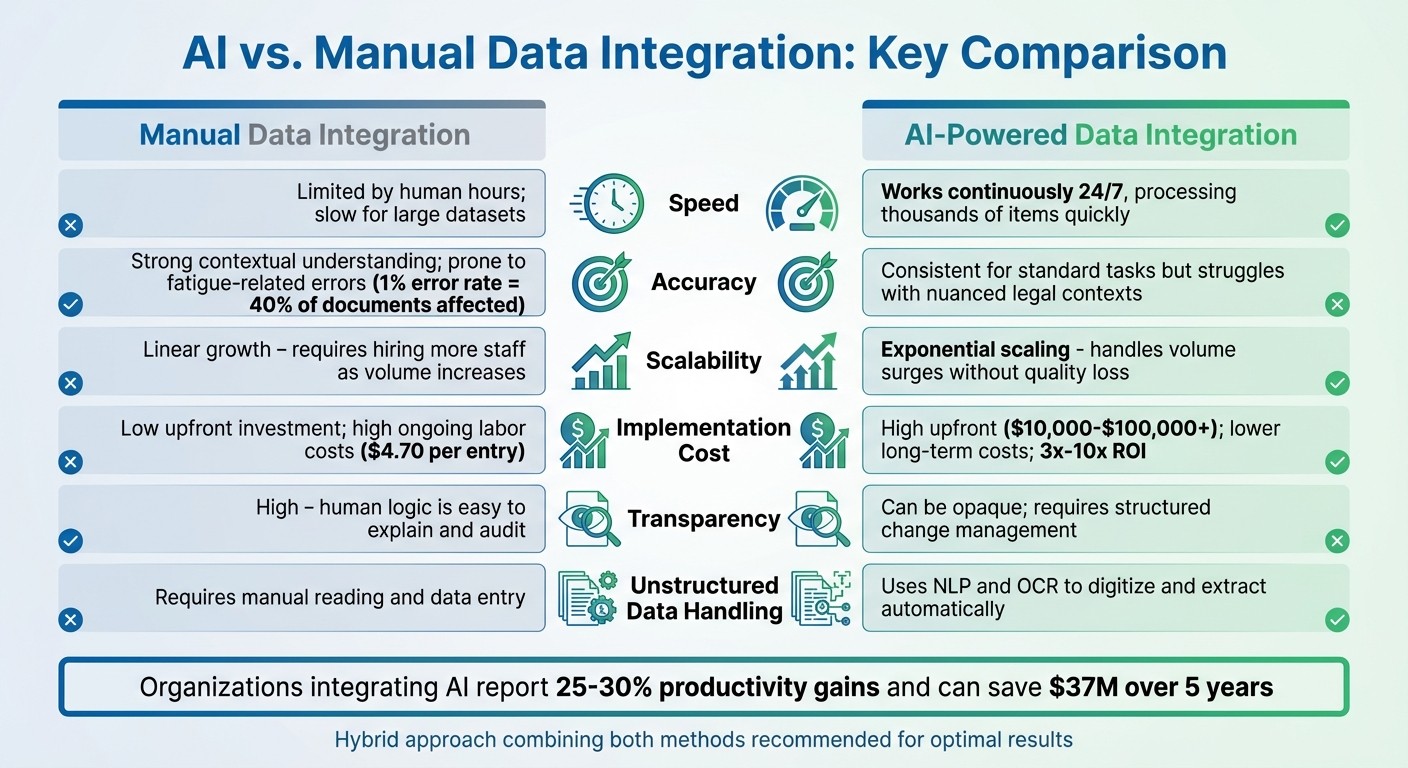
AI vs Manual Data Integration in IP Workflows: Key Comparison
Comparison by Key Criteria
When evaluating AI and manual integration methods, several key criteria stand out: speed, accuracy, scalability, transparency, implementation cost, and handling unstructured data. Let’s break it down.
Speed is where AI clearly takes the lead. It can process thousands of documents per hour, working 24/7 without breaks. In contrast, manual workflows are limited by human capacity and working hours. Organizations leveraging AI-powered automation have reported productivity gains of 25-30% on average.
Accuracy, however, is more complex. AI is highly consistent for standard data extraction tasks, but it struggles with edge cases or intricate legal language that requires deeper interpretation. Manual methods, on the other hand, excel at identifying unusual patterns and providing contextual understanding, but they are prone to errors caused by fatigue. Consider this: data scientists spend 80% of their time on manual data cleaning and validation instead of focusing on model development.
When it comes to scalability, AI is unmatched. Manual integration grows linearly - adding more volume means hiring more staff. AI, however, scales exponentially, managing sudden volume increases without compromising quality.
Implementation costs show a trade-off. Manual methods require minimal upfront investment but incur high labor expenses over time. AI solutions, while requiring a significant initial investment (ranging from $10,000 to over $100,000 annually for enterprise-level tools), tend to have lower ongoing costs.
The table below provides a quick comparison of these criteria:
Key Criteria | Manual Data Integration | AI-Powered Data Integration |
|---|---|---|
Speed | Limited by human hours; slow for large datasets | Works continuously, processing thousands of items quickly |
Accuracy | Strong contextual understanding; prone to fatigue-related errors | Consistent but struggles with nuanced legal contexts |
Scalability | Linear; requires hiring more staff as volume grows | Exponential; handles volume surges without quality loss |
Transparency | High; human logic is easy to explain | Can be opaque; requires structured change management |
Implementation Cost | Low upfront; high ongoing labor costs | High upfront ($10,000-$100,000+); lower long-term costs |
Unstructured Data | Requires manual reading and entry | Uses NLP and OCR to digitize and extract automatically |
Performance in Specific IP Tasks
The strengths and weaknesses of AI and manual integration become even clearer when applied to specific intellectual property (IP) tasks.
For prior art searches, combining AI with human expertise delivers the best results. AI quickly narrows down relevant documents, allowing experts to focus on validating the finer details and specific legal contexts.
Docketing is a task where automation shines. AI can extract deadlines directly from USPTO communications and flag inconsistencies, such as conflicting deadlines for the same action. This reduces the risk of missed filings, which can lead to malpractice claims.
However, for Freedom-to-Operate (FTO) analysis, manual methods still dominate during the final review. This task requires critical thinking and a deep understanding of complex legal frameworks - areas where AI currently falls short. Similarly, SEP mapping benefits from AI's ability to perform initial technical comparisons, but human judgment is crucial for interpreting semantic meaning and claims. As iPNOTE points out, AI and manual methods often complement each other, leveraging their respective strengths.
Selecting the Right Approach for Your IP Workflow
Choosing between AI and manual integration depends largely on the size of your firm and the complexity of your data. Portfolio size plays a crucial role here. Small to mid-sized firms can use AI to expand their capacity without needing to hire more staff, while larger organizations benefit from AI's ability to streamline data from disconnected systems into a cohesive "single source of truth". If you're managing patents across multiple jurisdictions, AI becomes even more critical. It can automatically calculate international filing deadlines based on priority dates, reducing the risk of missed deadlines and global patent issues.
Another important factor is risk tolerance. Administrative errors are a major concern in patent law, accounting for one in five malpractice claims. A recent example is the April 2024 Georgia Court of Appeals case, where a single-digit error in a priority date led to a $90 million malpractice claim due to lost patent rights across multiple countries.
Data complexity is also a key consideration. With the growing volume of global patent data, manual searches are becoming less effective. In fact, nearly 65% of IP professionals are already using or planning to adopt AI tools for patent searches. However, the USPTO requires practitioners to personally review AI-generated outputs, as the "reasonable inquiry" obligation cannot be delegated to AI. To determine where AI can provide the most value, conduct a needs assessment to identify bottlenecks, such as lengthy prior art searches or manual docketing. Additionally, ensure your AI provider offers robust security measures like 256-bit AES encryption, multi-factor authentication, compliance with ISO 27001 or GDPR, and a "zero data retention" policy to safeguard confidentiality.
Combining AI and Manual Methods
A hybrid workflow combines AI's efficiency with human expertise. AI can handle initial data aggregation, while humans validate the results. For instance, set up a system to flag discrepancies, such as conflicting deadlines or an Office Action mistakenly classified as a Notice of Allowance, for immediate human review. This approach balances AI's speed with the nuanced understanding and accountability that only humans can provide.
Training your staff is essential. They should not only know how to use AI tools but also how to critically evaluate and correct AI outputs to avoid over-reliance. Consider running training simulations using mock USPTO communications with intentional errors to help staff identify and address inaccuracies or "hallucinations" from AI.
"Optimizing IP management can have a significant positive economic impact by modernizing systems, minimizing inefficiencies and reducing commercial risks through improved patent and trademark strategies." - Glen Nath, Vice President of Product Management at Clarivate
The financial benefits of this approach are clear. Inefficiencies and risks tied to outdated IP management systems can cost organizations up to $123 million over five years. Modernizing these systems and reducing manual inefficiencies can save approximately $37 million in the same period. A hybrid workflow lays the foundation for how Patently enhances IP management.
How Patently Supports Data Integration

Patently builds on the hybrid workflow model by offering AI-driven tools specifically designed for patent professionals. Its semantic search with Vector AI eliminates the need for manual searches through extensive patent databases, enabling quick and accurate identification of relevant prior art. The Forward and Backward citation browser provides instant insights into patent relationships, saving time on manual cross-referencing.
For project management, Patently centralizes all IP data into a single, user-friendly interface. It offers features like hierarchical project categorization, access control, and collaboration tools to streamline teamwork while maintaining data security. Custom fields and fee tracking simplify administrative tasks that would otherwise require spreadsheets and manual data entry.
The platform's AI patent drafting assistant (Onardo) takes care of repetitive, data-heavy aspects of patent creation, freeing practitioners to focus on strategic legal decisions and client counseling. Additionally, Patently’s SEP analytics for 4G/5G technologies delivers in-depth data analysis, helping organizations uncover monetization opportunities and evaluate patent strength across large portfolios - tasks that would be nearly impossible to handle manually.
Patently’s design supports the hybrid workflow by combining AI-powered automation with necessary human oversight. Its robust security measures, including 256-bit AES encryption and advanced access controls, address concerns about integrating AI into IP workflows. With flexible plans ranging from a free tier for individuals to fully customizable enterprise solutions, Patently scales to meet the needs of any organization, all while keeping administrative overhead in check.
Conclusion
The debate isn’t about choosing between AI and manual methods - it’s about using each where they shine. Manual processes bring a deep understanding of context and can adapt to unique situations, but they’re prone to clerical errors. On the other hand, AI can handle thousands of transactions per hour with consistent precision. Still, human oversight is crucial for interpreting complex legal nuances and managing exceptions.
By 2025, 92% of executives anticipate their workflows will incorporate AI-driven automation. Modernizing IP management systems offers serious financial benefits - organizations could save around $37 million over five years by cutting down on manual inefficiencies and reducing commercial risks. A real-world example? Brazil's National Institute of Industrial Property saw a 50% reduction in examination times and an 80% drop in backlog after implementing AI-enabled workflows in March 2022. These numbers highlight why combining AI’s speed with human judgment is the way forward.
"AI might contribute to the 'productivity paradox'... instead of taking everyone's jobs, it might enhance the quality of the work being done by making everyone more productive." – Rob Thomas, SVP Software and Chief Commercial Officer, IBM
The future of IP workflows lies in blending AI with expert oversight. This hybrid model is the gold standard for balancing efficiency and accuracy. AI takes care of repetitive tasks like large-scale data extraction, prior art screening, and deadline tracking. Meanwhile, humans step in to provide strategic thinking, validate results, and ensure that ethical standards are met. This partnership addresses a critical challenge: AI delivers speed and scalability, but human expertise ensures accountability and prevents costly errors.
Patently exemplifies this hybrid approach by merging AI-powered automation with the human touch. Its tools - like semantic search, AI drafting assistants, and centralized project management - streamline repetitive tasks while maintaining the precision and security that IP professionals demand. Whether you’re a solo attorney or managing a large portfolio, Patently adapts to your needs, offering both speed and accuracy without compromise.
FAQs
What advantages does AI offer over manual methods for integrating IP data?
AI brings a host of benefits to IP data integration by simplifying workflows, improving precision, and saving time. It can quickly sift through massive databases, delivering thorough and current results in a fraction of the time it would take using manual methods.
On top of that, AI significantly reduces the chances of human error, offering more dependable outcomes. This allows professionals to dedicate their energy to more strategic and decision-driven tasks. The blend of speed, reliability, and efficiency positions AI as a game-changer for today's IP processes.
How can combining AI and manual methods improve efficiency and accuracy in IP workflows?
A hybrid approach combines the strengths of AI and human expertise to improve efficiency and precision in intellectual property (IP) workflows. AI excels at processing large volumes of patent data quickly, identifying critical insights, and finding connections that might take humans much longer to uncover. This frees up professionals to concentrate on higher-level tasks like interpreting claim language and evaluating prior art.
At the same time, human oversight plays a crucial role in addressing edge cases, ambiguous terminology, and subtle details - areas where AI might struggle. On the flip side, AI helps overcome human challenges like fatigue and the slower pace of manual data analysis. Together, this partnership minimizes errors, speeds up processes, and enhances the overall quality of patent portfolios. Tools like Patently make this collaboration even smoother by blending AI-powered features with options for teamwork, creating an efficient workspace for patent professionals.
What obstacles might arise when implementing AI in IP workflows?
Implementing AI in intellectual property (IP) workflows is no walk in the park. One big hurdle is that AI tools, while powerful, aren’t flawless. They can misinterpret data or miss deadlines, which means human oversight is still a must to ensure everything stays accurate and compliant. On top of that, integrating AI into existing docketing and portfolio management systems can get tricky. It requires not only smooth compatibility but also strong security measures to avoid disruptions.
Another sticking point is getting internal teams on board. Adopting AI often demands training and a mindset shift. Some team members might lean too heavily on AI outputs, while others could resist using them entirely. Moving AI from a small-scale pilot to full-scale implementation adds another layer of complexity. It’s essential to align these tools with the organization’s processes and manage the transition carefully. Plus, IP professionals face added challenges like updating legacy systems, staying compliant with regulations, and tackling thorny issues like inventorship and ownership when AI becomes part of the workflow.
Platforms like Patently, which provide AI-powered tools for patent drafting, semantic search, and workflow management, must rise to these challenges. They need to deliver tools with high accuracy, secure integration, and comprehensive user training to help IP teams adopt them effectively.