Natural Language in Patents: Common Challenges
Intellectual Property Management
Dec 22, 2025
Natural language issues—abstract‑idea rejections, inconsistent terminology, multilingual and technical jargon—complicate patent search and drafting; AI tools can help.
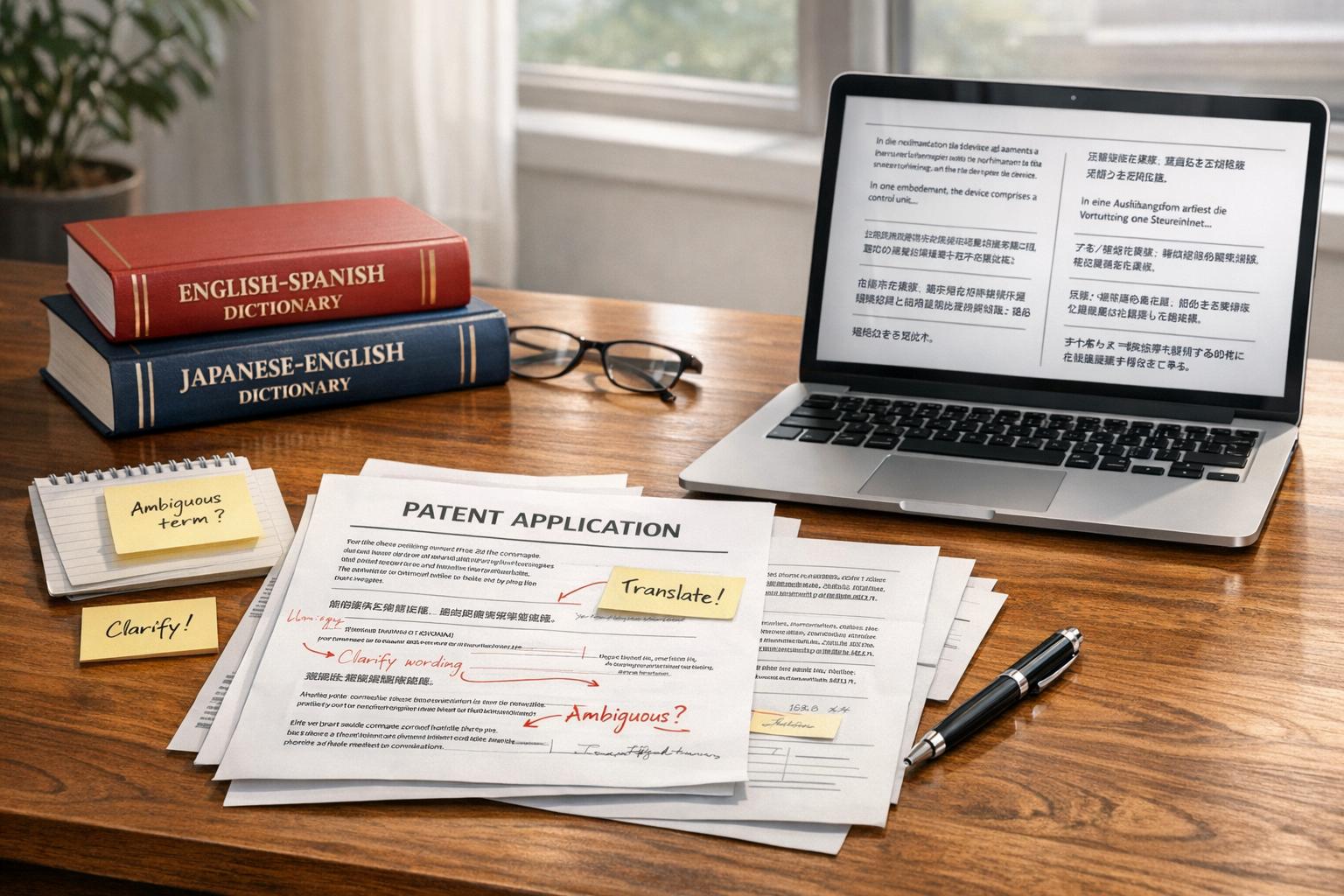
Patent work is complex. Searching for prior art, drafting claims, and managing applications require precision, especially when dealing with natural language. Traditional keyword searches often fail to capture the nuances of patent language, like synonyms or vague terms. AI tools with natural language understanding (NLU) are changing the game, but they come with challenges:
Search Limitations: Traditional methods miss relevant patents due to inconsistent terminology. NLU systems aim to understand concepts but often lack transparency in their results.
Abstract Idea Rejections: U.S. patent law, influenced by the Alice decision, makes it tough to patent NLU-related inventions. Specific claims showing technical improvements are key to overcoming this.
Multilingual and Semantic Issues: Patents written in multiple languages or using vague terms create hurdles for AI models.
Technical Jargon: Patent documents often use specialized terms that confuse general-purpose AI models.
AI-powered tools like Patently address these issues with semantic search, extended context handling, and drafting assistance. They save time, improve relevance, and help navigate a crowded patent landscape while reducing rejection risks.
Challenge 1: Patent Eligibility and Abstract Ideas
Navigating the U.S. patent system is no small feat, especially for Natural Language Understanding (NLU) inventions. Beyond the complexities of semantic interpretation, these inventions often hit a major roadblock: U.S. patent eligibility. Thanks to the Supreme Court’s Alice decision, the bar for patenting anything that could be considered an "abstract idea" is sky-high. Between 2002 and 2018, AI-related patent applications climbed from 9% to about 16% of all U.S. filings, but many of these applications ran into trouble for being deemed too abstract.
What Is Algorithmic Abstraction?
In patent law, inventions are frequently boiled down to their simplest components. If an NLU invention is reduced to something like "organizing information through mathematical correlations", it’s likely to be labeled as an abstract idea and deemed ineligible for patent protection. The Patent Trial and Appeal Board (PTAB) has often taken a skeptical stance. Consider this statement from the Ex parte Kneuper case:
"At the end of the day, 'machine learning' is little more than just another, known, data processing technique."
The Alice test, which courts use to evaluate patent eligibility, involves two steps. First, it determines whether a claim is directed toward an abstract idea - such as a mental process or mathematical formula. If it is, the next step is to look for an "inventive concept" that transforms the claim into something more than just the abstract idea itself. This is where many NLU inventions falter, as they are often seen as performing tasks like data collection, analysis, or display - activities that the USPTO commonly categorizes as abstract mental processes. Overcoming this requires crafting claims with greater specificity.
How to Overcome Abstract Idea Rejections
Specificity is key. To avoid rejection, your application should clearly describe how your invention improves computer performance. For example, does it reduce CPU usage, enhance memory management, or boost computational efficiency? Highlighting these technical advancements can make all the difference. It’s also crucial to frame your invention as solving a problem that’s deeply tied to computer technology.
Take a look at two contrasting cases: DDR Holdings succeeded because it tackled a problem unique to computer networks - preventing website visitor loss. On the other hand, Digitech failed because its claims weren’t tied to a specific machine. The USPTO’s 2019 Revised Patent Subject Matter Eligibility Guidance has helped clarify these issues, leading to a 25% drop in first office action rejections for AI technologies and a 44% reduction in eligibility-related uncertainty.
For a more precise approach, tools like Patently’s Vector AI can assist in drafting applications. These tools help pinpoint technical improvements and ensure that claims focus on how the NLU system enhances computer operations, rather than just automating human thought processes. This level of detail can be the difference between rejection and approval.
Challenge 2: Standing Out from Extensive Prior Art
Navigating Crowded Patent Landscapes
The world of natural language understanding (NLU) patents is packed to the brim. With over 130 million patent documents globally, proving your invention is genuinely new feels like finding a needle in a haystack. Traditional keyword searches often bring back irrelevant results, and even one similar invention can put your application at serious risk.
What makes this even trickier is the language used in patents. Inventors often rely on "patentese" - a mix of jargon and technical phrasing that can obscure the true meaning of innovations. For instance, an invention described as "purifying drinking water" might hide behind terms like "photocatalytic filtration". This makes it challenging to determine whether your NLU invention truly stands apart from the rest.
But there’s a way to cut through the noise: AI-powered semantic search.
Using AI to Analyze Prior Art
Semantic search is a game changer for patent analysis. Unlike traditional keyword searches, it focuses on understanding the underlying concepts of your invention. Tools like Patently's Vector AI leverage natural language processing to go beyond surface-level terms, identifying patents based on their technical essence and intent. For example, it can recognize that "marking device" and "pen" refer to the same idea, even if the exact words don’t match.
A case in point: In June 2025, a top Am Law 100 firm adopted an AI-driven platform for patent searches. The results were striking. What used to take 100 billable hours was slashed to just 20 - a massive 80% time savings - without compromising quality. This leap forward was possible because the AI shifted from basic keyword matching to understanding concepts, uncovering prior art that traditional methods often missed.
Patently’s semantic search goes a step further by allowing you to input detailed queries - up to 32,000 characters, or roughly 10 pages of text. This provides the AI with a rich context for your invention, enabling it to comb through massive patent databases and rank results by conceptual relevance instead of keyword frequency. The result? The most relevant documents rise to the top, giving you the clarity you need to stand out in a crowded field.
Challenge 3: Semantic and Multilingual Complexities
Unclear Language in Patent Documents
Patent language is intentionally vague. Inventors and attorneys often use broad, imprecise terms to ensure their claims cover as much ground as possible. A study published in World Patent Information highlights this issue:
"One major issue is that patents are usually described in generic terms in order to avoid narrowing down the scope of the inventions... This has prompted the current research efforts into how to tackle cross-lingual patent search issues."
This vague phrasing creates hurdles for natural language understanding. For instance, a single concept might be described as a "marking device", a "writing instrument", or just a "pen." Traditional keyword searches struggle to account for these variations. Even deep learning models designed to detect multi-word technical terms in patents achieve only about 75% precision and 74% recall. While ambiguous language complicates semantic searches, the challenge grows when multilingual variations are introduced.
Handling Multilingual Patent Documents
The difficulties don’t end with ambiguous wording. Multilingual patents add another layer of complexity. When patents are written in multiple languages, standard multilingual models can fall short. For example, models like XLM-R use a shared vocabulary of 250,000 tokens across more than 100 languages. This averages out to just 2,500 tokens per language - a limitation that can fragment technical terms and weaken the model’s ability to understand them.
In January 2023, researchers at Meta AI, including Davis Liang and Hila Gonen, introduced XLM-V, a multilingual language model with a significantly expanded one-million-token vocabulary. XLM-V groups similar languages, such as Chinese, Japanese, and Korean, and allocates tokens specifically for these clusters. This approach has shown impressive results, improving F1 scores for African language tasks by 11.2% and accuracy for indigenous American languages by 5.8%, with 90% of tokens in each cluster being unique.
To tackle these challenges, patent platforms are combining domain-specific language models like SciBERT with multimodal techniques. These approaches analyze both textual descriptions and technical diagrams. Since diagrams often bypass language barriers, they serve as a crucial tool for verifying technical details that might otherwise be misinterpreted in multilingual contexts. These combined efforts underscore the importance of advanced AI tools for improving natural language understanding in patent-related workflows.
Challenge 4: Technical Language and Context Limitations
Domain-Specific Terms in Patents
One of the biggest hurdles for standard natural language understanding (NLU) models is their inability to handle the highly specialized language of patents. Unlike everyday language, patents are packed with technical jargon, legal expressions, and even newly invented terms that don’t appear in regular dictionaries. As researchers Lekang Jiang and Stephan Goetz from the University of Cambridge point out, patent language is "highly specialized", making it tough for general-purpose models to interpret.
Adding to the complexity, patents often define terms in unique ways. For instance, a patent might refer to a simple "pen" as a "marking device." A typical NLU model trained on general text might fail to recognize these terms as being connected. This gap in understanding can lead to missed prior art, flawed search results, or even patent rejections.
Another challenge is the sheer length of patent documents, which often exceed 11,000 tokens. This is far beyond the 4,000-token limit of many models, like Llama-2. When a model can’t process the entire document, it risks missing critical technical details hidden in the specification. However, newer models like GPT-4 and Llama-3.1 can now handle up to 128,000 tokens, enabling them to capture essential information from these lengthy documents. Tackling these issues requires advanced AI systems that can manage both specialized language and extensive context.
Better Context Understanding with AI
To address the dual challenges of specialized terminology and lengthy content, improved context understanding has become a game-changer. Advanced AI tools are now stepping up with broader contextual capabilities. In August 2025, a leading patent office conducted a comparative study of AI tools, including IP Author and three other top platforms. The results were striking: IP Author achieved a 100% success rate in locating at least one relevant document for every query, while one competitor managed only 33%. This success is attributed to its ability to go beyond simple keyword searches, identifying both direct matches and related prior art through a deeper contextual understanding.
Patently's AI-powered platform is another example of how these challenges are being tackled. Through features like semantic search and expanded context windows, the platform analyzes entire patent descriptions instead of just skimming titles and abstracts. This allows patent professionals to use natural language queries and receive results ranked by their technical similarity, even when different terms are used. Additionally, Patently’s AI-assisted drafting tools ensure patent claims are both technically accurate and legally robust. By addressing language and length limitations, these tools help reduce the risk of patent rejection or infringement while providing thorough protection for intellectual property.
Solutions: Using AI Tools to Address NLU Challenges
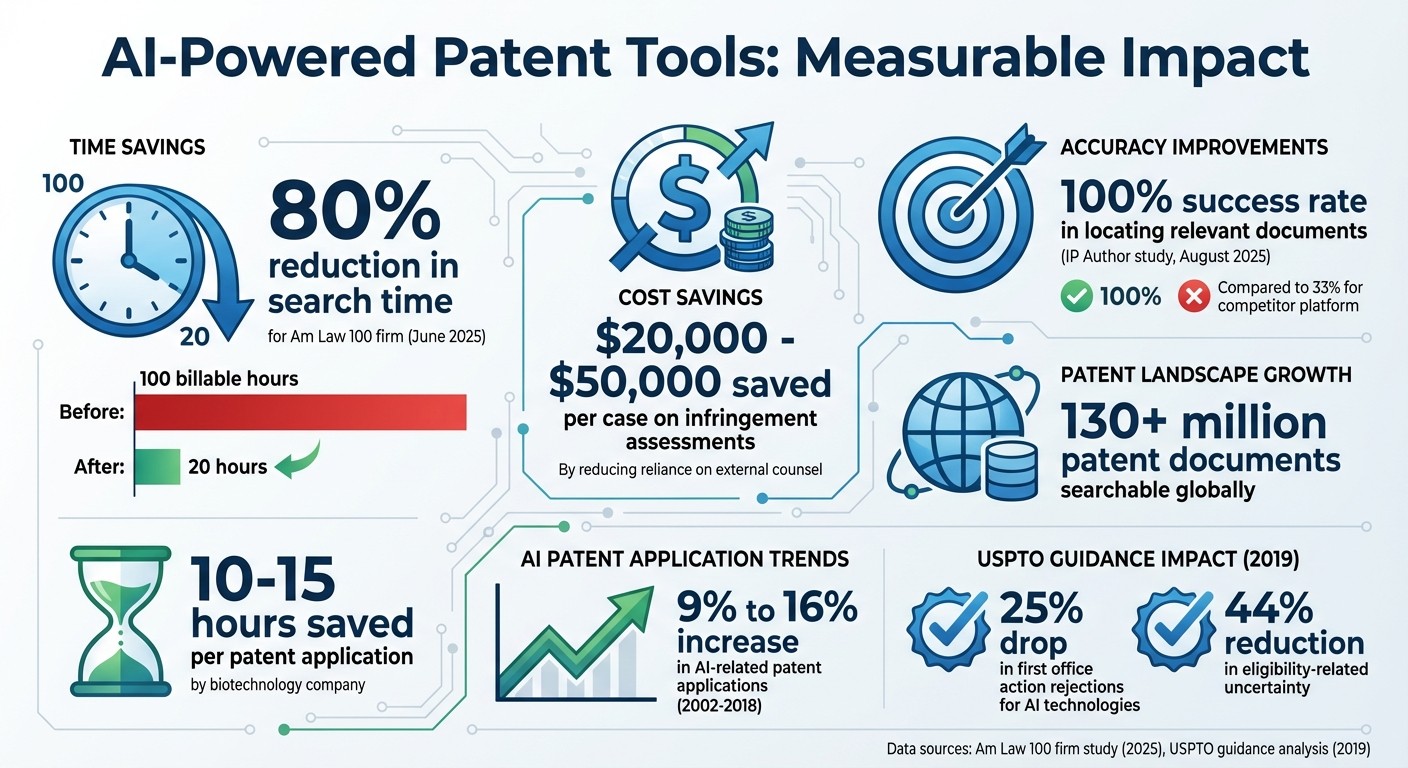
AI Impact on Patent Work: Time and Cost Savings Statistics
Semantic Search for Better Accuracy
AI-powered tools are reshaping how patent searches handle the challenges of ambiguous terminology and extensive prior art. Traditional keyword-based searches rely on exact matches and Boolean operators, which often fail to capture relevant patents that use different terms. In contrast, natural language understanding (NLU) enables semantic search, shifting the focus from specific words to broader concepts. This approach tackles the "vocabulary problem" in patent law, where inventors, attorneys, and examiners often describe the same idea using different language.
For instance, semantic search can link "photocatalytic filtration" to "water purification" or connect "means for transmitting data wirelessly" to "radio frequency communication module." By identifying conceptual similarities, these tools ensure nothing important is overlooked due to differences in terminology.
The time savings are impressive. A biotechnology company reported cutting 10–15 hours per patent application by leveraging AI-assisted search tools. These systems can process thousands of patents in mere minutes, a task that would otherwise take human researchers days - or even weeks.
Patently’s Vector AI semantic search exemplifies this capability. It analyzes entire patent documents, not just titles and abstracts, allowing users to input natural language queries with technical context. The tool then ranks results based on conceptual relevance, scanning over 130 million patent records worldwide. This method not only identifies direct matches but also uncovers related technologies in adjacent fields that traditional searches might miss.
AI-Assisted Drafting for Clearer Claims
Drafting clear and defensible patent claims is a meticulous process requiring both technical precision and legal clarity. AI-assisted drafting tools simplify this by ensuring consistent terminology throughout a patent document. This consistency is vital since patent law generally prohibits substituting defined terms with synonyms unless explicitly stated.
These tools use algorithms to structure patent claims, identifying key components, relationships, and dependencies within technical specifications. As PowerPatent explains:
"NLP provides a level precision and consistency that is unmatched in this process".
One IP law firm president highlighted the impact of these tools:
"We saw a notable decrease in the time spent on routine drafting tasks. That meant we could focus more on strategy and high‑value legal work instead of repetitive writing".
Patently’s AI-assisted drafting feature, known as Onardo, supports professionals by analyzing the invention’s context to craft claims that maximize protection without infringing on prior art. However, while these tools streamline the process, human oversight remains essential. Patent experts ensure that claims meet legal standards and align with strategic goals.
Customizing Patent Workflows with Patently
Managing patents effectively requires more than just search and drafting - it demands a cohesive workflow that integrates all stages of the patent lifecycle. Modern platforms like Patently bring together search, drafting, infringement detection, and portfolio management into unified systems.
Patently’s project management tools let teams organize patents using hierarchical categories, custom fields, and access controls. Professionals can track fee deadlines, monitor prosecution status, and collaborate in real time with colleagues or clients. This integration ensures that firms can manage tasks by client matter while maintaining confidentiality.
The financial benefits are tangible. By using AI for internal infringement risk assessments, companies have saved between $20,000 and $50,000 per case by reducing reliance on external counsel.
Additionally, Patently’s export and integration features ensure seamless data flow into existing systems. Whether analyzing SEP portfolios for 4G/5G technologies or conducting freedom-to-operate searches, the platform equips professionals to tackle natural language understanding challenges while retaining the human expertise needed for strategic decisions.
Conclusion
The hurdles of natural language understanding in patent work lead to inefficiencies that can bog down even the most experienced professionals. From navigating abstract idea rejections to combing through mountains of prior art, the challenges go beyond what traditional keyword searches can handle. The disconnect between how inventors describe their innovations and how examiners search for relevant prior art often results in wasted time and resources.
AI tools are stepping in to bridge this gap, revolutionizing how patent searches and drafting are handled. With semantic search, it’s now possible to find patents that share conceptual similarities, even when the language used differs. AI-assisted drafting ensures claims are consistent and precise, even in complex cases. For example, a major Am Law 100 firm slashed their search time by 80% in 2025, cutting 100-hour projects down to just 20 hours. Similarly, a biotechnology company reported saving 10–15 hours per patent application.
Patently’s Vector AI semantic search scans an impressive database of over 130 million global patents, while Onardo’s drafting assistant helps refine claims to withstand scrutiny. These tools also come with project management features, enabling teams to track deadlines, collaborate efficiently, and maintain confidentiality.
The financial benefits are equally striking. Companies using AI tools for initial infringement assessments have saved $20,000 to $50,000 per case. One IP law firm president highlighted the shift in focus these tools allow:
"We saw a notable decrease in the time spent on routine drafting tasks. That meant we could focus more on strategy and high-value legal work instead of repetitive writing".
These savings underline the broader strategic shift brought about by AI. Moving from basic keyword searches to tools that understand concepts isn’t just an upgrade - it’s becoming essential. Patent professionals who embrace these AI-driven solutions gain speed, precision, and the freedom to prioritize strategic, high-value work over tedious document reviews. AI takes care of the routine, letting experts focus on what truly matters.
FAQs
How does the Alice decision affect the patent eligibility of natural language understanding (NLU) inventions?
The Alice decision clarified that using a generic computer to execute a Natural Language Understanding (NLU) method is often categorized as an abstract idea. Because of this, many NLU-related inventions may be ruled ineligible under 35 U.S.C. §101 unless they clearly showcase a specific technical advancement that goes beyond standard programming techniques.
Since this ruling, patent rejections for technologies influenced by Alice have noticeably risen. To strengthen eligibility, inventors should emphasize the distinct technical breakthroughs and real-world applications of their NLU innovations.
How does semantic search enhance patent analysis?
Semantic search leverages AI-driven technology to grasp the meaning behind words and phrases, going beyond simple keyword matching. By evaluating the context and relationships between terms, it helps patent professionals find more relevant results - even when different terminology is used. This approach minimizes the chance of overlooking critical references and streamlines the process of prior-art searches.
This technology makes tasks like similarity-based prior-art retrieval, grouping related inventions, and spotting trends in patent filings quicker and more precise. By prioritizing conceptual relevance over straightforward keyword matches, semantic search delivers deeper insights into the technological landscape and enhances the reliability of analysis.
Patently incorporates cutting-edge semantic search functionality through its Vector AI engine, enabling professionals to draft, search, and analyze patents more efficiently - all within a single, integrated platform.
How do AI tools handle multiple languages and technical terms in patent documents?
AI tools tackle the multilingual challenges of patents by leveraging advanced technologies like multilingual transformers and language-agnostic embeddings. These tools are fine-tuned with patent-specific data, enabling them to process documents in multiple languages while maintaining their original meaning. Thanks to integrated translation systems, users can conduct searches in English and seamlessly access patents written in languages such as Chinese, German, or Japanese - without losing the context or intent of the original text.
When it comes to technical jargon, AI systems utilize specialized preprocessing techniques to handle the unique vocabulary often found in patents. This includes chemical formulas, engineering symbols, and legal terms. Large language models (LLMs), trained on vast patent datasets, further strengthen their ability to decode complex terminology and acronyms. Tools like Patently incorporate these advanced methods to provide precise and efficient semantic search and patent drafting, helping professionals navigate the intricate and highly specialized world of patents.