How AI Tracks Competitor Patent Filings
Intellectual Property Management
May 16, 2026
How AI uses semantic search, entity resolution, and relevance scoring to monitor competitor patent filings and surface risks.

Top patent tools are transforming how businesses monitor competitor patent filings, offering faster, smarter, and more accurate ways to track innovation. By analyzing patents using natural language processing (NLP) and semantic search, AI identifies trends, detects filing patterns, and highlights potential risks or opportunities. Here's what you need to know:
Why it matters: Patent filings reveal competitors' R&D focus and market strategies, often 18 months before products launch.
How it works: AI uses semantic search to interpret patent claims, improving accuracy by 40–70% compared to traditional keyword searches.
Key features: Real-time alerts, entity resolution for tracking subsidiaries and inventors, and relevance scoring to prioritize critical patents.
Next steps: Focus on 10–15 key competitors, set up alerts, and review filings regularly to align insights with business goals.
AI simplifies patent monitoring, turning complex data into actionable insights for legal and R&D teams. Platforms like Patently integrate these capabilities into a streamlined workflow for better decision-making.
Defining Monitoring Priorities and Criteria
Identifying Key Competitors to Monitor
Before setting up an AI-driven monitoring system, it’s important to identify which competitors deserve your attention. Casting too wide a net can lead to information overload, making it harder to catch critical developments.
Focus on creating a targeted list of 10–15 competitors. This list should include not only direct competitors targeting the same customer base but also broader players like technology leaders, research institutions, well-funded startups, and supply chain entities that could disrupt through vertical integration.
AI tools can simplify this process through entity resolution, which automatically maps out relationships between parent companies, subsidiaries, acquired brands, and joint ventures. This ensures no filings are missed due to name variations or corporate changes. Additionally, tracking key inventors can reveal hidden projects, even when filings are made under shell companies or newly formed subsidiaries.
Once you’ve nailed down your competitor list, the next step is to define the specific data points and layers you’ll monitor.
Setting the Scope of Your Monitoring
After identifying who to monitor, the question becomes: what exactly should you track? Here are the key monitoring layers:
Monitoring Layer | What It Tracks |
|---|---|
Assignee/Applicant Name | Competitor names, including variations and transliterations |
Inventor Name | Filings under individual names or shell companies, signaling shifts in R&D focus |
Classification (CPC/IPC) | Filings in specific tech areas or from new entrants |
Semantic/Keyword Search | Technologies described using different terminologies |
Defining these layers ensures your monitoring efforts align with broader business objectives.
Geographic coverage is another critical factor. A comprehensive approach should include filings from the USPTO, EPO, CNIPA, JPO, and KIPO, as well as international PCT filings through WIPO. Monitoring patent families - where the same invention is filed across multiple countries - can also highlight which markets competitors see as strategically important.
Additionally, consider the type of events you’ll track. Monitoring applications (published 18 months after filing) offers an early warning system, while keeping an eye on granted patents confirms enforceable rights. Don’t overlook legal status changes, such as abandonments or reassignments, which can also provide valuable insights.
Aligning Monitoring Goals with Business Needs
Your monitoring strategy should directly support your business goals. For instance, if you’re conducting an FTO (Freedom to Operate) assessment, focus on critical technology areas 3–6 months before a product launch to identify potential risks from blocking filings.
In industries like telecommunications or high-tech, Standard Essential Patents (SEP) require a specialized approach, such as tracking activity in standardization bodies and specific classification codes tied to emerging technical standards.
Set up alerts for instances when competitors cite your patents. This can signal areas of adjacent technology and open up potential licensing opportunities. By tying these triggers to your strategic goals, you can reduce information noise and ensure your team concentrates on developments that genuinely impact your business.
With these priorities and criteria in place, AI tools can seamlessly integrate into your workflow, making patent monitoring more efficient and actionable.
How AI Finds and Organizes Competitor Filings
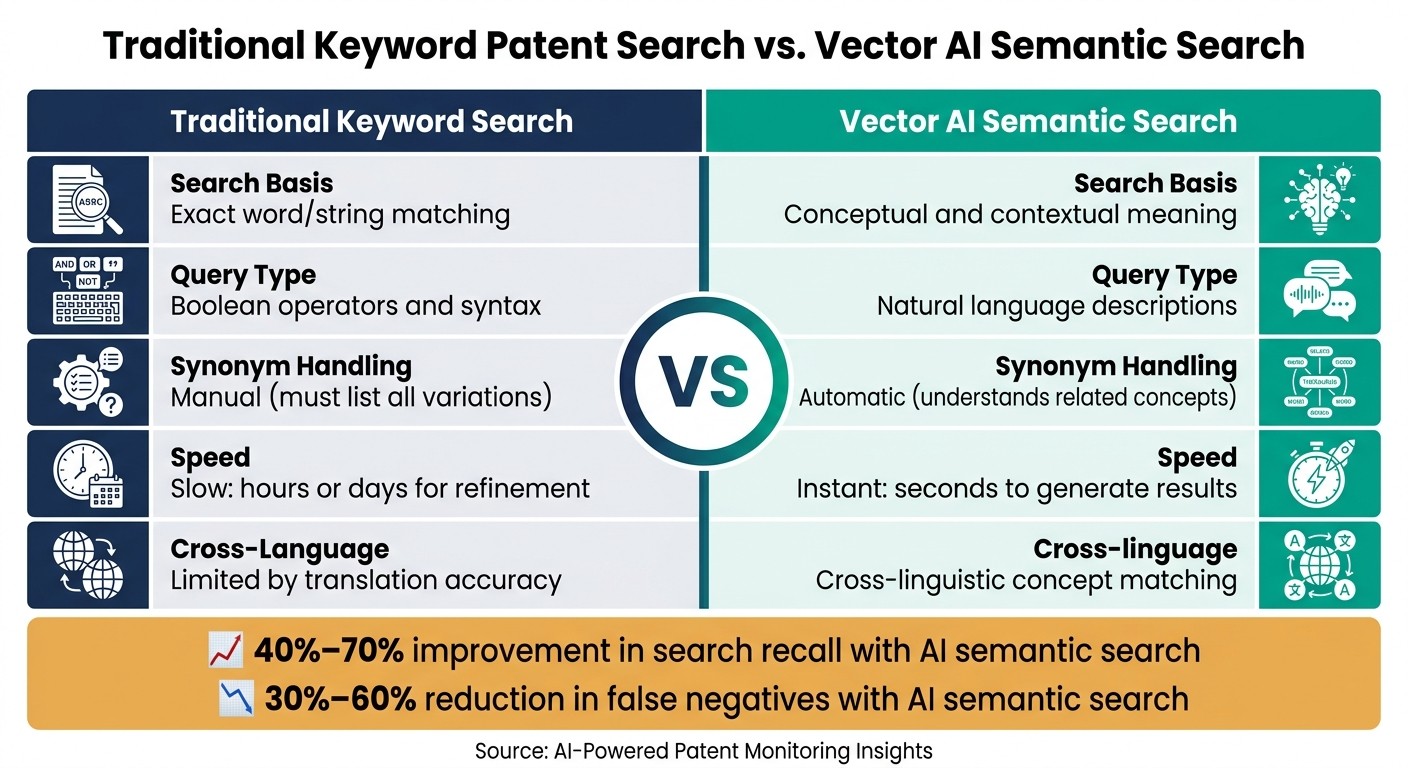
AI vs. Traditional Patent Search: Key Differences & Performance Gains
Once you've established the key players to monitor and the specific data to track, AI steps in to simplify the process of gathering and organizing information. By transforming raw patent records from global databases into a cohesive view of competitor activity, AI makes patent monitoring more efficient and actionable.
Entity Resolution for Accurate Assignee Tracking
Tracking patents can get tricky when a single company appears under multiple names across different patent offices. For example, "Google LLC" might have filings listed under regional or subsidiary names, creating inconsistencies in the data. These variations - whether caused by misspellings, abbreviations, or regional naming differences - can lead to important filings being overlooked.
AI solves this problem using entity resolution. It automatically consolidates name variations, transliterations, and subsidiary entities under the correct parent company. Databases that are regularly updated with information on mergers, acquisitions, and restructurings ensure that when a competitor acquires another company, the acquired entity’s past and future filings are linked to the parent organization. This capability also extends to tracking individual researchers, uncovering hidden R&D efforts even when patents are filed under new holding companies.
After resolving these discrepancies, AI aggregates and standardizes data from multiple sources to provide a clearer picture of competitor activity.
Aggregating and Normalizing Patent Data
Competitors often file patents across multiple jurisdictions, including the USPTO, EPO, CNIPA, JPO, and KIPO. AI-powered platforms pull data from over 100 patent authorities and consolidate it into a single, standardized format. This eliminates the need for manually cross-referencing databases.
The normalization process includes standardizing classification codes, translating metadata into uniform formats, and resolving patent families. This way, an invention filed in multiple countries appears as one unified record instead of separate, disconnected entries. The result? A streamlined, cross-jurisdictional view of competitor activity that’s easy to analyze.
With this organized data, advanced search tools can uncover relevant filings more effectively.
Using Semantic Search to Find Relevant Filings
Keyword searches often fall short because competitors may describe the same technology using different terms. For instance, a patent for "wireless energy transfer" might not show up in a search for "inductive charging" unless every possible synonym is included in the query.
Semantic search powered by Vector AI changes the game by focusing on the meaning behind a query rather than relying on exact word matches. This approach allows users to describe a technology in plain language, enabling the system to surface related patents - even if they use different terminology or are filed in another language.
The benefits are significant: semantic search improves recall by 40%–70% and reduces false negatives by 30%–60%. Patently’s Vector AI applies this approach specifically for patent professionals, enabling faster and more comprehensive searches without requiring expertise in Boolean query construction.
Feature | Traditional Keyword Search | Vector AI Semantic Search |
|---|---|---|
Search Basis | Exact word/string matching | Conceptual and contextual meaning |
Query Type | Boolean operators and syntax | Natural language descriptions |
Synonym Handling | Manual (must list all variations) | Automatic (understands related concepts) |
Speed | Slow - hours or days for refinement | Instant – seconds to generate results |
Cross-Language | Limited by translation accuracy | Cross-linguistic concept matching |
Analyzing and Prioritizing Competitor Patent Activity
Once AI organizes competitor patent filings, the next step is uncovering the insights hidden within the data. Not every patent demands your attention, and AI plays a critical role in identifying which ones truly matter.
Relevance Scoring for Better Decision-Making
AI assigns relevance scores to competitor patents, ranking them based on how closely they align with your products, claims, or core technologies. Instead of wading through hundreds of filings manually, your team can focus on a prioritized list where the most pressing patents rise to the top.
This process goes beyond simple keyword matching. AI evaluates claim scope and technical overlap, flagging patents that could potentially impact your freedom to operate. High-priority filings are addressed immediately, while less relevant ones are set aside for occasional review.
Modern tools use explainable AI to highlight the specific claims and sections that triggered a high relevance score. This transparency allows legal and technical teams to validate the AI's findings and act with greater confidence. Building on this, natural language processing (NLP) further enhances your understanding of each patent's key points.
Using NLP to Extract Key Patent Details
Reviewing patents in their entirety can be time-consuming. NLP simplifies this by extracting critical elements like independent claims, priority dates, and technical features, organizing them into a clear and digestible format. This complements semantic search capabilities, reinforcing the utility of integrated AI tools throughout the monitoring process.
This approach is especially useful when tracking multiple competitors across various jurisdictions. NLP can even match competitor claims to available product documentation - such as technical manuals or developer specifications - to identify potential infringement risks for startups before they reach your legal team.
Detecting Competitor Filing Patterns
AI doesn't just analyze individual patents; it also uncovers broader filing patterns that hint at strategic shifts. While individual patents show what is being protected, patterns reveal a competitor's long-term plans.
By monitoring filing frequency and timing, AI can detect trends, such as a spike in applications within a specific technology area. This could indicate an upcoming product launch or an intensified R&D effort. Filing patterns also reveal strategies - whether a competitor is building a licensing portfolio, securing key product features, or filing defensively to block competition.
AI extends its analysis by connecting new filings to key engineers or inventors, especially after they move to a new company. This can expose stealth R&D initiatives that might otherwise remain hidden. Together, these tools provide a comprehensive view of competitor activity, starting with data aggregation and culminating in actionable insights.
Building an AI-Powered Monitoring Workflow
Tracking competitor patents is just the beginning; the real challenge lies in creating a workflow that keeps your team informed without overwhelming them. These strategies leverage AI to streamline data organization and improve monitoring processes.
Setting Up Alerts and Watch Lists
Start by configuring alerts that track various identifiers like assignee names, subsidiaries, and even name variations caused by transliteration. Go beyond just company names - set up alerts for key inventors and R&D leaders as well. Why? Because when a key inventor switches to a competitor, their new filings might reveal strategic shifts or hidden projects that wouldn't show up in a standard company name search.
To stay ahead, also monitor CPC/IPC classifications. This helps you spot patents from emerging players or joint ventures that might not be on your radar yet. For even better accuracy, incorporate semantic search to fine-tune your alerts.
Creating a Regular Review and Analysis Schedule
Once you’ve automated data collection, establish a consistent review schedule. AI-powered tools can help you filter through critical alerts, making the process efficient. Here's a sample breakdown:
Frequency | Time Commitment | Focus |
|---|---|---|
Weekly | 30–60 minutes | Sort alerts by priority (high, medium, low) and assign high-priority filings for deeper review |
Monthly | 2–3 hours | Examine filing trends and update competitor profiles |
Quarterly | Half-day session | Conduct freedom-to-operate (FTO) or novelty assessments, align R&D efforts, and review strategic goals |
Weekly summaries generated by AI allow you to quickly triage alerts, ensuring that critical filings are addressed without delay. This structured approach ensures your team stays focused and aligned with your broader patent monitoring strategy.
Using Project Management Tools for Team Collaboration
Once your alerts and review schedule are in place, bring in project management tools to turn insights into actionable decisions. For instance, platforms like Patently offer features that let teams organize findings into projects, delegate tasks, and track progress - all within a shared workspace.
This is particularly important because patent monitoring often requires collaboration across multiple departments. For example, a flagged patent might need input from engineering, product development, or legal before any action can be taken. Using collaborative project management tools, these handoffs happen seamlessly within the same platform where the analysis is conducted. This reduces the risk of losing context in scattered email threads or disconnected documents. The result? A streamlined system that not only identifies critical insights but also ensures they reach the right people to act on them.
Conclusion and Next Steps
Key Takeaways
AI is reshaping how businesses monitor competitor patents. With semantic search, it’s now possible to uncover relevant patents with 40%–70% higher recall. Automated entity resolution helps track filings from subsidiaries and acquired companies, eliminating blind spots. Plus, relevance scoring cuts through the noise, helping teams focus on the most critical information. By adopting structured review schedules - like weekly triage sessions and monthly trend analyses - you can ensure your team stays aligned and effective. These practices lay the groundwork for refining your approach.
Refining and Scaling Your Monitoring System
Your monitoring system should grow alongside your business needs. Start small by focusing on 10–15 key competitors to ensure detailed tracking, then gradually expand as your processes become more efficient. Adjust search queries every quarter to minimize false positives while still capturing essential filings.
When competitors acquire new companies or form joint ventures, update your entity lists immediately - filings often continue under legacy names even after deals close. For international growth, extend monitoring efforts beyond the USPTO to include organizations like WIPO (PCT filings), EPO, and CNIPA. This ensures you’re covering patents tied to global commercialization efforts.
"The most actionable intelligence emerges from connecting patent signals with other data sources." - Wicely Team
Using Patently for End-to-End IP Management
Patently takes these AI-driven insights and integrates them into one streamlined platform. It connects competitor monitoring with tools for patent drafting, portfolio management, and SEP analytics. This ensures that insights you uncover can directly inform your next patent application or freedom-to-operate (FTO) analysis.
With features like Vector AI semantic search, a forward and backward citation browser, and collaborative project management, Patently provides a unified workspace. Whether you’re working solo or as part of a larger team, this platform helps turn raw competitive data into actionable strategies, giving you a real edge in the IP landscape.
FAQs
How do I choose which competitors to track?
When analyzing competitors, focus on those whose patent filings and developments align closely with your business or technology interests. Pay special attention to companies actively filing patents in your industry, particularly in areas tied to emerging trends or essential technological advancements.
To ensure you’re not missing anything, track details like subsidiaries, inventor names, and variations in assignee names. These details can help you build a more complete picture of their activities. Keeping tabs on these competitors can offer valuable insights into their R&D priorities, market strategies, and potential shifts in focus.
How does semantic search find patents without exact keywords?
Semantic search transforms how patents are identified by moving beyond exact keyword matches. Using natural language understanding, it analyzes the relationships between concepts. Essentially, it converts patent texts into mathematical representations, called vectors, which capture their meaning and context. This approach allows the system to locate patents that are conceptually similar, even if they use different terms or synonyms. As a result, professionals can navigate vocabulary differences and conduct more precise and efficient searches.
How can I reduce false positives in patent alerts?
To cut down on false positives in patent alerts, try incorporating AI-powered semantic search. This approach focuses on analyzing the meaning behind concepts rather than just matching specific keywords. It's also a good idea to keep track of subsidiary names, inventor names, and variations in assignee names to ensure you don't overlook important patents. Using classification-based monitoring can help identify filings that are more relevant to your needs. Lastly, make it a habit to regularly review and refine alerts so you can zero in on the information that matters most, improving the precision of your monitoring system.