Benefits of Vector AI in SEP Analytics
Intellectual Property Management
May 15, 2026
Vector AI boosts SEP analytics with fast, concept-driven patent search, natural-language queries, and live updates.

Managing Standard Essential Patents (SEPs) effectively requires handling massive datasets with precision and speed. Traditional keyword-based tools often fail due to inconsistent language and slow processing times. Vector AI addresses these challenges by focusing on the meaning behind text rather than exact matches, enabling faster, more accurate, and easier patent searches.
Key improvements with Vector AI include:
Speed: Processes millions of patents in real-time.
Accuracy: Understands concepts, not just keywords, reducing missed results.
Ease of Use: Allows natural language queries, eliminating complex search syntax.
Up-to-Date Data: Continuously integrates new patent filings and updates.
Platforms like Patently leverage this technology to analyze over 135 million patents, transforming SEP workflows. While Vector AI requires specialized infrastructure and training, its conceptual search capabilities significantly outperform older methods in most scenarios.
Quick Comparison:
Feature | Keyword-Based Search | Vector AI (e.g., Patently) |
|---|---|---|
Search Method | Exact word matching | Conceptual understanding |
Query Complexity | Boolean operators required | Natural language queries |
Synonym Handling | Manual | Automatic |
Speed | Slow | Real-time |
Handling New Terms | Strong | Dependent on training data |
Computational Cost | Low | High |
Conclusion: Vector AI simplifies SEP analytics by improving search quality and efficiency, though a hybrid approach combining both methods may yield the best results for certain use cases.
Build a Patent Search App with Gemini and Vector Search
1. Traditional SEP Analytics Approaches
Before Vector AI became part of the conversation, patent professionals relied heavily on keyword-based search tools and manual workflows. While these methods worked for smaller datasets, they began to buckle under the weight of growing patent databases, which now contain millions of entries. These challenges highlighted the need for more advanced solutions like Vector AI.
Speed
Traditional systems used brute-force search methods, going through records one at a time. With a computational complexity of O(n), this approach quickly became impractical for databases containing millions of patents. Real-time analysis was simply out of reach. Large enterprises often spent thousands of hours each year just to analyze and manage their patent portfolios using these outdated methods.
"Brute-force search is impractical in real time." - Sandhya Krishnan, Senior Python Developer
When speed becomes a bottleneck, accuracy is the next major hurdle.
Accuracy
Keyword-based systems are highly sensitive to variations in language. Even small changes in phrasing can drastically alter search results. Studies show that minor differences in query formulation can reduce retrieval performance by as much as 40.41%. In Standard Essential Patent (SEP) analytics, where overlooking even one relevant patent can impact licensing or litigation outcomes, this margin of error is unacceptable.
Another challenge is the associativity gap - traditional tools often fail to link related concepts across multiple documents. As Anthony Alcaraz, Author and AI Specialist, puts it:
"An agent that misses 12% of relevant information could miss critical context for important decisions."
Usability
Using top 10 patent tools often requires a high level of technical skill. Searches depend on complex Boolean operators - strings like (wireless OR contactless) AND (power OR energy) - which demand precision and expertise. Users must manually account for synonyms and variations, a process that can take hours. These usability issues are compounded by infrequent updates, which further hinder decision-making.
Reporting tools in older systems are also rigid. They typically rely on static dashboards built from historical data, lacking the flexibility to adapt in real time.
"Traditional analytics tools depend on analysts defining key metrics, setting parameters and manually interpreting insights. This approach is not only time-consuming but also prone to bias." - A.I Hub
Lifecycle Coverage
Traditional methods rely on batch processing, where data is updated on a monthly or periodic basis instead of continuously. In the fast-paced world of SEP analytics, where new filings and updates to standards happen regularly, this lag can lead to outdated conclusions. Without real-time updates, decisions are often based on incomplete or stale data.
2. Vector AI–Driven SEP Analytics (e.g., Patently)
Vector AI is changing the way SEP (Standard Essential Patent) analytics work by focusing on conceptual understanding rather than just matching exact words. Patently, for example, uses semantic search powered by Vector AI to grasp the meaning of a query, not just the words used.
This approach brings noticeable improvements in speed, accuracy, usability, and lifecycle coverage.
Speed
Traditional SEP analytics often depend on exact matches or manually listing synonyms, which can be time-consuming. Vector AI, however, identifies connections based on concepts, dramatically reducing search times. This allows for real-time analysis, even when dealing with databases containing millions of records.
Accuracy
With Vector AI, patent text is converted into embeddings that reflect deeper conceptual relationships. For instance, a search for "wireless power transfer" might also uncover patents discussing "contactless energy delivery" or "inductive charging" without needing to list every possible synonym. Additionally, modern AI workflows classify claim limitations into categories such as Normative (explicitly required), Implied (naturally satisfied), Informative (described but not mandatory), and Contextual (indirectly related). This classification provides analysts with a more detailed understanding of key elements than traditional keyword-based tools can offer.
Usability
Vector AI makes SEP analytics more accessible by enabling searches in plain English, removing the need for complex Boolean queries. Patently’s semantic search interface is designed around this natural language capability, making it easier for professionals who aren’t experts in search syntax. Furthermore, agentic AI can now respond to natural language questions with citation-backed explanations, simplifying even the most intricate workflows.
Lifecycle Coverage
Unlike traditional batch processing, which can leave SEP datasets outdated, Vector AI platforms continuously ingest data. This ensures that new patent filings and updates to standards are incorporated without delay. For example, Patently’s SEP analytics for 4G/5G technologies rely on this always-up-to-date system. Additionally, platforms implement staged upgrade pipelines, such as sandbox testing and shadow deployment, to verify AI updates and prevent errors or policy inconsistencies.
Pros and Cons
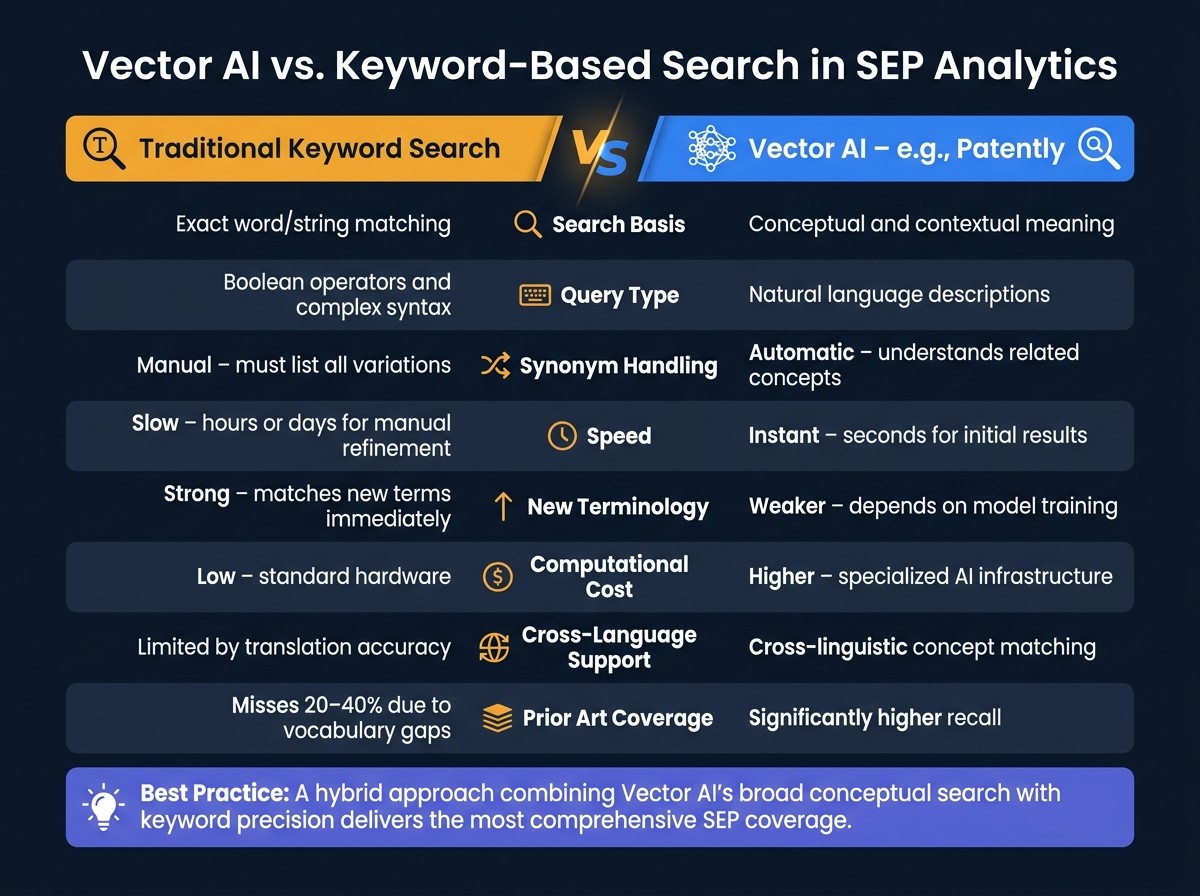
Vector AI vs Keyword Search in SEP Analytics: Feature Comparison
This section compares traditional keyword search with Vector AI in the context of SEP analytics, highlighting their strengths and limitations. By understanding how these approaches differ, teams can make more informed choices about their search strategies.
Traditional keyword search offers simplicity and affordability. It operates on standard hardware, doesn’t need specialized infrastructure, and reliably finds exact matches - especially when terminology is clear and well-established. For example, if a new standard introduces a specific term, keyword search can locate it immediately. However, this method requires significant manual effort. Searches often need refinement, and vocabulary mismatches can result in 20–40% of relevant prior art being overlooked.
Vector AI, on the other hand, prioritizes conceptual understanding over exact matches. It automatically handles synonyms, allows plain English queries, and reduces search time by 40–60% compared to manual methods. Tools like Patently Know use this technology to uncover patents that are conceptually linked, even if they don’t share exact wording. However, Vector AI comes with higher computational costs and depends heavily on quality training data. For brand-new technologies not well-represented in the training set, it may struggle, sometimes performing worse than a traditional keyword search.
Feature | Traditional Keyword Search | Vector AI (e.g., Patently) |
|---|---|---|
Search Basis | Exact word/string matching | Conceptual and contextual meaning |
Query Type | Boolean operators and complex syntax | Natural language descriptions |
Synonym Handling | Manual (must list all variations) | Automatic (understands related concepts) |
Speed | Slow (hours/days for manual refinement) | Instant (seconds for initial results) |
New Terminology | Strong (matches new terms immediately) | Weaker (depends on model training) |
Computational Cost | Low (standard hardware) | Higher (specialized AI infrastructure) |
Cross-Language | Limited by translation accuracy | Cross-linguistic concept matching |
Prior Art Coverage | Misses 20–40% due to vocabulary gaps | Significantly higher recall |
Given these differences, a hybrid approach often delivers the best results. Combining Vector AI’s broad conceptual search with the precision of keyword filters and metadata - like priority dates or assignees - can ensure comprehensive coverage. This strategy is particularly critical in SEP analytics, where overlooking even a single relevant patent could lead to costly licensing or litigation issues.
Conclusion
The divide between traditional keyword-based search methods and the capabilities of Vector AI in SEP analytics is becoming more apparent. While keyword searches can handle straightforward or newly introduced terms, they often fall short when navigating the intricate 4G/5G SEP landscape. This gap can lead to missed insights, potentially resulting in legal and financial challenges.
Vector AI steps in to address these shortcomings by understanding concepts beyond just words. It offers faster results, improved recall, and the ability to query in natural language, giving patent professionals the tools they need to make more informed and confident decisions. Patently takes this a step further by combining Vector AI-powered semantic search, SEP analytics, citation browsing, and collaborative project management into a unified workflow. This comprehensive approach ensures thorough coverage, enabling decisive and effective actions in the complex realm of SEP management.
FAQs
How does Vector AI find relevant SEPs without exact keywords?
Vector AI pinpoints relevant SEPs by diving into the meaning and context of patent texts using semantic analysis. This method allows it to identify patents with similar concepts, even if they use different wording, delivering results that are both precise and thorough.
When should I use keyword search instead of Vector AI?
When you need to match exact terms or prefer a straightforward and budget-friendly option, keyword search is the way to go. On the other hand, Vector AI shines when you're dealing with tasks that require semantic understanding, finding conceptually similar content, or working with multilingual data for in-depth SEP analysis. Each method caters to different needs, so your choice should depend on how complex and detailed your search demands are.
What data or setup is needed to get accurate Vector AI results?
Accurate results in Vector AI depend on transforming patent text into high-quality embeddings. This process uses NLP and transformer-based models specifically trained on patent datasets. These embeddings work alongside semantic algorithms, such as KNN and cosine similarity, to grasp the meaning and context of the data. This combination ensures precise and reliable analysis.