How AI Improves Patent Landscape Monitoring
Intellectual Property Management
May 17, 2026
How semantic search, data normalization and clustering let AI automate patent monitoring and reveal trends.
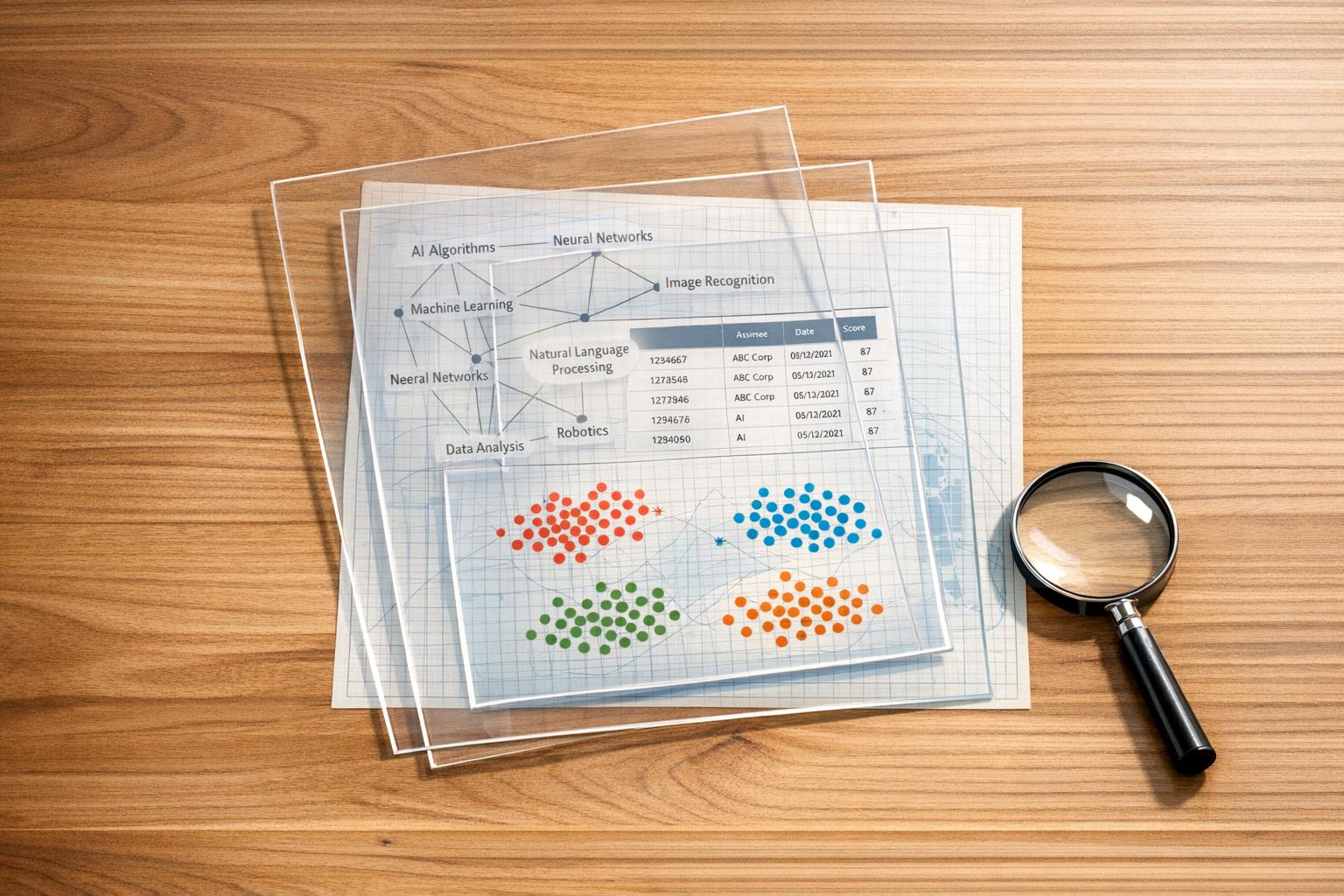
AI is transforming patent landscape monitoring by automating tedious tasks, improving accuracy, and delivering actionable insights faster than ever. Traditional methods often miss critical patents due to outdated keyword searches and manual reviews. AI changes this with tools like semantic search, automated data normalization, and technology clustering, which streamline the process and uncover trends that were previously hard to detect.
Key Takeaways:
Semantic Search: Finds patents based on concepts, not just keywords, ensuring no relevant filings are missed.
Data Normalization: Cleans up messy patent data (e.g., inconsistent assignee names) for accurate analysis.
Technology Clustering: Groups patents by conceptual similarities to highlight innovation trends and gaps.
Citation Analysis: Tracks patent relationships to identify influential filings and emerging technologies.
Real-Time Monitoring: Alerts you to new filings, competitor activity, and legal updates within hours.
By cutting analysis time by up to 70%, AI tools help businesses reduce risks, manage portfolios efficiently, and make informed R&D decisions. Platforms like Patently integrate these features to simplify the process and keep your team ahead of the competition.
Using AI to Transform and Unlock Your IP Landscape 1
Core AI Features in Patent Landscape Monitoring
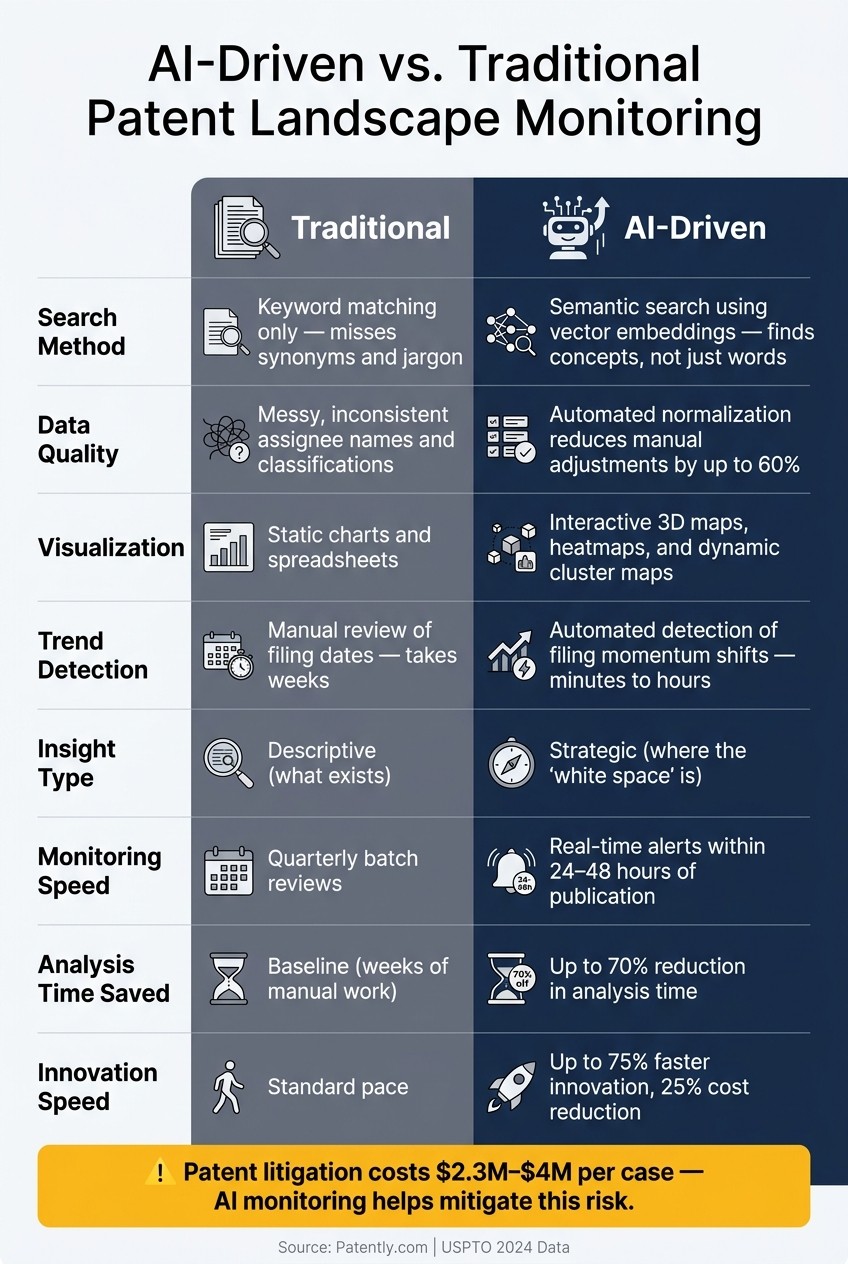
AI vs. Traditional Patent Landscape Monitoring: Key Differences
Semantic Search for More Precise Queries
Traditional patent searches can be frustratingly rigid. If you don’t guess the exact words or phrases an inventor used, you risk missing relevant patents. This is where semantic search changes the game - it doesn’t just look for matching words, it interprets the meaning behind your query.
Using vector embeddings, semantic search organizes technical concepts into a multi-dimensional space. This means patents describing the same innovation are grouped together, even if they use completely different terminology. This is a huge advantage in fields like AI hardware or biotech, where new terms and jargon emerge constantly. Platforms like Patently leverage Vector AI to make these searches more intuitive, helping professionals uncover precise results without needing to predict every possible phrasing. Once the results are refined, automated tools can extract and organize the data seamlessly.
Automated Data Extraction and Normalization
Patent data is often messy and inconsistent. Take assignee names, for example - "International Business Machines", "IBM Corp.", and "I.B.M." all refer to the same company, yet they’re often treated as separate entities in raw data. This lack of standardization can make competitive analysis a nightmare.
AI-powered extraction tools solve this by normalizing data like assignee names, priority dates, CPC classifications, and legal statuses. They even analyze claim language, identifying legal markers like "comprising" or "consisting of" to help compare patents against prior art or technical standards. By automating this process, manual adjustments can be reduced by up to 60%, allowing IP professionals to shift their focus from tedious data cleaning to strategic decision-making. Plus, real-time updates replace outdated batch processing, ensuring your patent landscape stays current as new filings and legal events roll in. Clean, standardized data then becomes the foundation for advanced insights like technology clustering.
Technology Clustering for Dynamic Insights
Once data is cleaned up, AI takes it a step further by grouping patents based on conceptual similarities rather than just shared keywords. Algorithms like K-Nearest Neighbors (KNN) analyze vector embeddings to cluster related patents, even when they span different industries or use varied terminology.
These clusters are then visualized in interactive formats - think heatmaps that show innovation density, 3D landscapes pinpointing filing hotspots, and clear "white spaces" where no patents exist yet. Tracking momentum within these clusters can also reveal early signals, like a sudden surge in filings from a new assignee in a niche area. This kind of insight often identifies emerging competitors before traditional methods catch on. These dynamic clusters not only enhance patent landscape monitoring but also help uncover innovation gaps and guide strategic decisions in real time.
Feature | Traditional Landscape Analysis | AI-Driven Technology Clustering |
|---|---|---|
Data Basis | Keyword matching and manual classification | Semantic meaning and vector embeddings |
Visualization | Static charts and spreadsheets | Interactive 3D maps and dynamic heatmaps |
Trend Detection | Manual review of filing dates | Automated detection of filing momentum shifts |
Insight Type | Descriptive (what exists) | Strategic (where the "white space" is) |
Efficiency | Weeks of manual categorization | Minutes to hours for automated clustering |
Building an AI-Driven Patent Monitoring Workflow
Defining Monitoring Goals and Scope
Before diving into AI tools, it's crucial to pinpoint the decisions your monitoring is meant to support. Without a clear focus, you'll likely end up buried in irrelevant data.
Some common objectives include competitor tracking, freedom-to-operate (FTO) analysis, technology scouting, and spotting white spaces in crowded markets. Each of these requires a tailored approach. For instance, FTO analysis demands a narrow, jurisdiction-specific focus with careful attention to claim language. On the other hand, technology scouting benefits from a more expansive, cross-industry perspective. To keep the results manageable and relevant, limit your timeframe to the last 10 to 15 years of patent filings, and focus on specific geographies.
It's also helpful to map the boundaries of your current portfolio. By monitoring technologies that are just outside your existing claims, you can identify areas where competitors are already active. This insight can give you a strategic advantage.
Once your goals are set, the next step is designing precise semantic queries to ensure your monitoring efforts are efficient and effective.
Designing Effective Semantic Queries
A well-defined goal serves as the foundation for building targeted semantic queries. These queries should capture the concept you're investigating while filtering out irrelevant noise, ensuring your team only sees meaningful results.
The process typically unfolds in three steps:
Retrieval first: Start with a broad semantic search to map the overall landscape.
Selective deepening second: Analyze patent families and citations for the most relevant results.
Synthesis third: Identify patterns and translate them into actionable decisions.
Skipping the initial retrieval and filtering stages can compromise the insights gained during synthesis.
If you're exploring a new technology area without much expertise, leverage "More Like This" features in semantic search tools. By inputting a relevant core patent, you can let the AI surface similar filings. Tools like Patently's Vector AI are designed for this type of concept-driven exploration.
To refine your results, combine natural language queries with structured filters like CPC classifications, assignee names, or priority date ranges. Using classification codes alongside two or three targeted keywords can cut down on irrelevant alerts by 60–80%.
Setting Up Real-Time Monitoring Systems
Once your queries are optimized, it's time to decide what to monitor and how often. Set up systems to track competitors, technology classifications (CPC/IPC), key inventors, and patent citations all at once.
Your monitoring frequency should align with the level of business risk. Here's a quick breakdown:
Target Type | Priority | Update Frequency | Typical Alert Volume |
|---|---|---|---|
Primary Competitors | High | Weekly | 5–20 patents/month each |
Secondary Competitors | Medium | Monthly | Review top filings only |
Core Technologies (CPC) | High | Weekly | 20–50 patents/month |
Adjacent Technologies | Medium | Monthly | Scan for breakthrough signals |
One often-overlooked tactic is monitoring prolific inventors at rival companies. Their new filings can provide early clues about where competitors are channeling their R&D efforts - sometimes months before public announcements.
Finally, integrate your monitoring output into your R&D planning cycles. For example, ramp up monitoring in a specific technology area 3 to 6 months before a planned product feature launch. This timing allows you to identify potential blocking patents early enough to take action.
Visualizing Patent Landscapes with AI
Once your monitoring system identifies relevant patents, the next hurdle is understanding the data. At scale, raw patent lists can be overwhelming. This is where top patent visualization tools come in, turning complex datasets into intuitive maps, graphs, and charts that reveal patterns you might otherwise miss.
Technology Clusters and Evolution Maps
Building on earlier automated clustering techniques, AI visualization tools create dynamic maps that make it easier to see trends. These tools group patents based on conceptual similarities and display them as cluster maps or heat maps, highlighting areas of innovation and identifying gaps.
Unlike static PDF reports that quickly become outdated, these maps update automatically as new patents are published. This allows your team to track how clusters evolve - whether they're growing, shrinking, or splitting apart. For instance, rapid growth in a cluster can signal a hotbed of innovation, while a shrinking cluster might indicate a maturing field or a shift in research priorities. These insights can guide timely strategic decisions.
Evolution maps are also a great tool for spotting white space opportunities. If a cluster shows heavy activity around a central technology but little activity on its edges, those underexplored areas could represent valuable opportunities for new filings.
Citation and Collaboration Network Analysis
Citation graphs provide a clear view of how patents reference each other, helping you trace the development of a technology and pinpoint foundational patents that others build upon. A patent with a high number of forward citations often acts as a key blocking patent, shaping the competitive landscape.
Beyond individual patents, collaboration networks reveal partnerships between companies and research institutions. These alliances might not be immediately obvious from public announcements but can signal strategic moves in the market. Tracking citation velocity - the rate at which a patent family accumulates citations - can also help you identify emerging technologies early. A sudden spike in citations often indicates growing commercial interest in a technology.
By proactively analyzing citation networks, your team can gain the context needed to negotiate around blocking patents or avoid potential disputes. Adding a geographic layer to these networks further enhances your understanding of competitive and innovation landscapes.
Geographic and Jurisdictional Patterns
Geographic visualizations take AI-driven data clustering a step further by highlighting regional trends and showing where competitors are focusing their patent protection efforts. This matters because where a company files patents signals where it plans to compete. For example, a company filing aggressively with the USPTO, EPO, and CNIPA is likely pursuing a global commercialization strategy rather than just protecting its domestic market.
However, data quality can complicate this process. Patent databases often have inconsistencies, such as a 15% variation in assignee name spellings. AI normalization tools resolve these discrepancies, ensuring your maps reflect a complete and accurate picture of a competitor's activities rather than fragmented data.
The scale of patent activity also underscores the importance of geographic visualization. For instance, the USPTO granted 324,042 patents in 2024, a 4% increase from the previous year. Meanwhile, China's patent applications have surpassed those in the U.S.. Geographic maps help teams cut through this immense volume of data, focusing on jurisdictions that matter most - whether it's assessing freedom-to-operate risks before launching a product or identifying underprotected markets where filing patents could be a smart investment.
Practical Uses of AI in Patent Monitoring
AI has evolved beyond visualization and workflow improvements to become a tool for turning insights into actionable business strategies. By leveraging advanced semantic search, data normalization, and dynamic clustering, AI transforms raw patent data into meaningful strategies for businesses.
Competitive Intelligence and Planning
AI allows businesses to monitor competitor activity in the patent landscape with greater clarity and speed. Through assignee normalization, AI tools consolidate filings from subsidiaries, acquired companies, and related entities under a single corporate profile. This ensures that patents from lesser-known subsidiaries of large corporations don't slip through the cracks. Moreover, AI systems can flag key events - such as new filings, changes in legal status, and citation updates - within just 24 to 48 hours of publication. These insights enable businesses to refine their innovation strategies with precision.
Innovation Strategy and White Space Identification
AI plays a crucial role in finding unprotected technology areas and investment opportunities. By generating technology whitespace maps, AI compares an organization’s patent coverage with that of competitors at the claim-element level. This process highlights unprotected features, revealing genuine opportunities for new filings. Additionally, AI uses NLP-based clustering to identify emerging functional themes. It also tracks filing rates, helping businesses distinguish between saturated, stagnant areas and zones with rapid innovation and untapped potential.
"The result is a visual map of the innovation landscape: which technology spaces are crowded and which are open, where you have unique strength, and how your portfolio stacks up against others." - Lexology/DeepIP
Tools like Patently enhance strategic searches by using semantic Vector AI to identify conceptually relevant patents, rather than relying solely on keyword matches. This approach makes it easier to map the boundaries of your portfolio and uncover nearby opportunities.
In addition to guiding R&D decisions, AI also simplifies portfolio management to maximize value.
Portfolio Management and Cost Optimization
Managing a large patent portfolio can be costly, with renewal fees, legal reviews, and administrative tasks across jurisdictions piling up - especially for patents that no longer align with business goals. AI helps by identifying non-core assets through citation frequency analysis and market relevance scoring. This enables IP teams to make data-driven decisions about abandoning or maintaining certain assets. AI-driven portfolio heatmaps also spotlight patents with strong potential for infringement or licensing, while automated renewal tracking reduces administrative burdens. This transforms portfolio management from a reactive task into a proactive strategy.
Conclusion: Using AI for Smarter Patent Monitoring
Key Takeaways
AI has reshaped the way patents are monitored, turning what was once a slow, manual task into a real-time, strategic process. Gone are the days of quarterly reviews - IP teams now receive instant alerts for new filings and portfolio updates, keeping them ahead of the curve.
Organizations leveraging AI-powered tools can innovate up to 75% faster while cutting costs by 25%. Considering that patent litigation costs range from $2.3 million to $4 million per case, AI-driven tools not only enhance productivity but also help mitigate risks. The growing importance of AI in this field is reflected in the 33% increase in AI-related patent applications reported by the USPTO in 2025.
Three standout features are driving these advancements: semantic search, which identifies patents based on concepts rather than just keywords; automated data normalization, ensuring consistent and reliable analysis; and dynamic clustering, which reveals emerging trends in technology. These capabilities are transforming raw patent data into actionable insights.
Next Steps for Using AI Tools
To fully harness AI's potential, start by narrowing your focus to avoid being overwhelmed by data. Define a clear objective - whether it’s identifying white space, monitoring competitors, or prioritizing renewals.
Integrate patent monitoring into your regular planning cycles. Sync alerts with product development schedules, clean and normalize your data before drawing conclusions, and refine your search parameters as results evolve. By using tools that offer semantic search, data normalization, and clustering, your team can turn data into action. Platforms like Patently bring these features together, combining advanced Vector AI search, collaborative project tools, and SEP analytics, enabling your team to transform patent data into strategic decisions with ease.
FAQs
How do I choose what to monitor in a patent landscape?
Zero in on areas that match your strategic objectives and the competitive landscape you're navigating. Keep an eye on emerging technologies, patent filing trends, and what your competitors are doing in industries that matter to you.
Leverage AI tools to streamline tasks like analyzing filing patterns, mapping out competitor patent portfolios, and spotting potential risks or opportunities. By customizing your monitoring efforts to fit your specific industry and technological focus, you'll ensure you're getting the most value from your efforts.
How can semantic search reduce missed patents and false alerts?
Semantic search reduces the chances of overlooking patents or generating irrelevant alerts by focusing on the meaning behind search queries and patent texts. By understanding context and intent, it can locate related documents even when different words or phrases are used, enhancing both precision and thoroughness in results.
What should I trust (or verify) in AI patent clustering results?
When examining AI patent clustering results, it's important to ensure that patents are grouped in a way that makes sense based on their technical content. This means verifying that the clusters show semantic coherence - in other words, the patents within each group should share a clear and logical connection. To achieve this, you need to evaluate the reliability of the AI algorithms and the data sources driving the clustering process.
Human oversight plays a key role here. It helps catch issues like patents being placed in the wrong groups or biases in the clustering process. Additionally, regular updates and a thorough contextual analysis are necessary to keep the clustering relevant, especially since the patent landscape evolves constantly.