How AI Simplifies FRAND Licensing Analysis
Intellectual Property Management
May 3, 2026
AI automates SEP verification, claim-to-standard mapping, and FRAND royalty benchmarking to speed licensing and reduce risk.
AI is transforming how FRAND licensing works by automating complex tasks like verifying patent claims, mapping them to standards, and calculating fair royalty rates. The traditional manual approach is slow, costly, and prone to errors, especially when dealing with thousands of patents. AI tools streamline this process, delivering faster, more precise results while reducing costs and compliance risks.
Here’s what AI can do for FRAND licensing:
Verify SEPs (Standard Essential Patents): AI uses natural language processing to determine if patents are truly aligned with standards, cutting analysis time from days to minutes.
Map Patent Claims: AI links patent claims to technical standards with high accuracy, avoiding human errors and saving hours of manual work.
Calculate Royalty Rates: AI analyzes global licensing data to provide precise, data-driven royalty benchmarks, ensuring compliance with FRAND guidelines.
Support Negotiations: AI-powered SEP analytics help build stronger licensing strategies by categorizing patents and providing defensible evidence.
Monitor Compliance: Real-time AI dashboards track licensing agreements, ownership changes, and litigation trends to manage risks effectively.
AI tools like Patently simplify workflows by integrating data from standards organizations, patent offices, and litigation records, ensuring every aspect of FRAND licensing is handled efficiently. With courts increasingly focused on fair and transparent licensing practices, adopting AI is no longer optional - it’s essential for staying competitive.
GSLC Tim Pohlmann Welcome Remarks - SEP determination using AI
Step 1: Verify SEP Essentiality with AI Analysis
Standards-essential patents (SEPs) protect the core innovations that power technologies like 5G, Wi-Fi, and IoT. However, standards-setting organizations such as ETSI don't verify whether patents labeled as "essential" truly meet that criteria. This lack of oversight has led to widespread over-declaration, creating market distortions.
Accurate essentiality determination is the backbone of FRAND (Fair, Reasonable, and Non-Discriminatory) licensing. It ensures royalty rates are based on actual technical contributions, not just the sheer number of declared patents. The traditional manual verification process, though, is far from ideal. It’s slow, costly, and subject to bias. Each review can take 1–2 days and cost up to $7,860. For portfolios with thousands of patents, this approach becomes unmanageable. This is where AI steps in, providing a faster, more reliable solution.
How AI Identifies SEPs
AI leverages Natural Language Processing (NLP) to map patent claims to standard specifications. By analyzing claim language and aligning it with technical standards - like 3GPP 5G NR or IEEE Wi-Fi - AI reduces the time required for analysis from days to mere minutes.
Modern AI systems use section-aware parsing to maintain the structure of documents, connecting tables, equations, and figures to specific technical criteria. These platforms go a step further by offering detailed essentiality ratings, such as:
Normative: Explicitly required by the standard.
Implied: Naturally satisfies the standard's requirements.
Informative: Described but not mandatory.
Contextual: Indirectly related to the standard.
For instance, in March 2026, Patently introduced its Next-Generation SEP Analysis Workflow, which processes over 4 million pages of standards documents and 1 million images and tables through a multi-modal pipeline.
Improving Accuracy in Essentiality Determination
AI not only speeds up the process but also ensures consistency and accuracy, achieving up to 95% accuracy while operating 10 times faster than manual methods. Tools like Patently's platform assign Semantic Essentiality Scores (ranging from 1 to 100), helping teams prioritize valuable patents and filter out irrelevant ones. This allows legal teams to focus their manual reviews on patents that are most likely essential, saving time and resources. Identifying SEPs accurately is crucial for determining fair FRAND royalties and crafting effective negotiation strategies.
Here’s a quick comparison of manual versus AI-driven methods:
Feature | Manual Method | AI-Driven Approach |
|---|---|---|
Time per Patent | 1–2 days | Minutes |
Cost per Patent | $4,159–$7,860 | Much lower with automation |
Accuracy | Variable, prone to bias | Up to 95%–99.9% with expert oversight |
Scalability | Limited for large portfolios | Capable of analyzing 100,000+ SEPs |
Step 2: Automate Claim Mapping to Standards Specifications
Once AI confirms essentiality, the next challenge is mapping patent claims to standards with precision. This process, traditionally a time-consuming task, required experts to sift through technical PDFs for hours - often exceeding 10 hours per patent. The sheer volume of work and potential for human error made it a daunting task, especially for large patent portfolios.
AI is changing the game. By leveraging semantic search instead of basic keyword matching, AI captures the technical context of claims. What once took days can now be completed in minutes, with AI delivering results up to 75% faster than manual methods.
Use Machine Learning to Map Claims
AI’s ability to simplify claim mapping stems from its use of Natural Language Processing (NLP). Machine learning models break down complex patent claims into structured elements. This allows AI to analyze claims at a granular level, linking specific language to the technical details in standards specifications.
Unlike traditional keyword searches that might miss important references due to terminology differences, AI uses section-aware parsing. This method creates section graphs that connect text, figures, tables, and equations, ensuring all relevant evidence is captured. By processing multiple formats - text, formulas, and diagrams - AI builds a comprehensive evidence package, assigning precise citations to specific sections.
The results speak for themselves: AI platforms, including some of the top patent tools, achieve 95% mapping accuracy and successfully identify 94% of essential patents through verified mapping.
Improve Team Collaboration with AI Tools
AI doesn’t just make claim mapping faster - it also improves how teams work together. Traditional methods often relied on siloed spreadsheets, leading to version control issues and fragmented workflows. AI platforms solve this by providing centralized repositories where teams can collaborate in real time. Edits, annotations, and claim charts are accessible to everyone, reducing errors and streamlining the process.
These tools also embed visual evidence - like diagrams and technical drawings - into claim charts, highlighting crucial elements for quicker decision-making. Teams can export their work to Word, Excel, or PDF while preserving AI-generated annotations. Real-time updates ensure everyone operates from a single, consistent source, eliminating the hassle of managing email attachments.
AI also identifies gaps in evidence during the mapping process, catching potential errors before final review. This allows legal teams to focus on strategic tasks rather than manual data entry. For large portfolios, bulk processing features help prioritize high-value patents and filter out non-essential claims efficiently.
Step 3: Calculate FRAND Royalty Rates Using AI Models
Once claims are mapped and SEPs verified, AI takes on the challenge of calculating royalty rates with precision. The stakes are high - just a 1% change in the royalty rate can impact an asset's value by 15–25%.
Traditionally, determining fair, reasonable, and non-discriminatory (FRAND) royalty rates required extensive manual work. Analysts combed through market data, comparable licenses, and economic models, making the process both time-consuming and complex. AI models have streamlined this by analyzing global licensing databases to establish accurate benchmarks. For example, telecommunications SEPs typically yield royalties between 1% and 5% of revenue. Instead of relying on standard ranges, AI evaluates comparable deals, adjusts for differences, and applies economic principles to deliver more precise, data-driven results.
Use Data-Driven Insights for Royalty Rates
AI platforms like RoyaltyStat, ktMINE, and IPlytics gather data on comparable licensing transactions. But raw data itself isn’t enough. AI incorporates Semantic Essentiality Scores to focus on core patents, ensuring payments reflect the true value of the licensor’s market share while avoiding overpayment for less critical patents.
AI also unpacks bundled agreements - those combining intellectual property with services - to isolate the actual royalty rate. This step is essential since bundled deals can obscure the real market value of the IP. Additionally, AI adjusts royalty rates based on deal specifics. For instance, exclusive licenses typically command higher rates, while non-exclusive or cross-licensing agreements often lower them. Ivan Gowan, CEO of Opagio, highlights the importance of this approach:
"A defensible royalty rate is not plucked from an industry range. It is derived from comparable transactions, adjusted for relevant differences, and cross-checked against economic logic."
Ensure Compliance with FRAND Guidelines
Using these data insights, AI ensures rates comply with FRAND guidelines through rigorous validation tests. Two key tests include:
Profit Split Test: Ensures the royalty rate reflects a fair sharing of economic benefits between licensor and licensee.
EBITDA Margin Test: Confirms the rate doesn’t exceed the licensee’s EBITDA margin, as no rational licensee would accept terms that erase all profit.
These safeguards prevent rates from being unreasonably high, even if they fall within typical industry ranges. AI also meticulously documents adjustments for factors like exclusivity, geography, or market position, ensuring valuations are audit-ready. This level of transparency not only strengthens negotiations but also helps uphold FRAND commitments during disputes or litigation.
Step 4: Build Negotiation Positions with SEP Analytics
After determining data-driven royalty rates, the next step is to use this analysis to solidify your negotiation strategy. By integrating AI-powered SEP analytics, you can perform AI-enabled patent analysis on entire portfolios and uncover technical evidence to support licensing discussions.
Develop Negotiation Strategies with AI
Armed with the royalty rates and essentiality ratings from earlier steps, negotiators can now create strategic positions backed by detailed, machine-generated evidence.
AI tools assess SEP portfolios by applying detailed essentiality ratings, which categorize patents into distinct groups. Normative patents are explicitly required by the standard and provide the strongest leverage. Implied patents represent the natural way to meet standard requirements, while Informative and Contextual patents offer additional supporting evidence. This structured approach allows negotiators to focus on their strongest assets rather than relying on a narrow "proud list" of selected patents.
AI workflows also enable automated claim mapping, linking patent claims to specific sections of technical standards (like 3GPP) in just minutes. These tools maintain the document hierarchy and produce citations that are both accurate and defensible. Additionally, interactive natural language analysis lets negotiators ask targeted questions about essentiality and receive immediate, citation-backed answers. This capability helps teams explore "what-if" scenarios and adjust their strategies in real-time.
Present Data-Driven Evidence
AI-generated claim charts play a critical role during negotiations by providing structured evidence to support licensing terms. These charts map claims on a per-limitation basis, pulling technical equations (in LaTeX), tables, and illustrations directly from standards documents. The result is audit-ready documentation, complete with precise page references and excerpts.
Instead of relying on a few cherry-picked examples, this approach emphasizes a full portfolio analysis, offering negotiators a broader and more defensible position. AI-powered knowledge graphs further enhance this process by connecting sections, figures, and equations within standards. These tools automatically follow cross-references like "see section X" to compile complete evidence packages. This comprehensive strategy not only strengthens your case but also demonstrates compliance with FRAND obligations, which is crucial in avoiding or addressing potential litigation.
Step 5: Monitor Compliance and Litigation Trends with AI Dashboards
After establishing your negotiation position, the next step is to keep a close watch on compliance obligations and litigation trends across various jurisdictions. Leveraging the detailed SEP verifications and royalty analyses from earlier steps, AI dashboards provide the critical context needed for effective risk management. These tools consolidate data from standards bodies like ETSI and IEEE, offering a centralized view of over 100,000 SEPs tied to 5G, WiFi, and IoT standards. This kind of continuous oversight strengthens earlier strategies, making FRAND analysis more efficient.
Track Compliance in Real Time
AI platforms play a key role in monitoring licensing agreements by identifying pricing irregularities and deviations that could hint at FRAND violations. Using "ultimate owner" models, these dashboards track patent transfers, mergers, and acquisitions, simplifying ownership clarity across different legal codes and numbering systems. This is especially crucial as UK courts now expect licensees to proactively engage with SEP owners and allocate royalty reserves from the beginning of use.
Setting aside royalty reserves early signals a serious commitment to FRAND compliance, reducing the likelihood of financial penalties. Cross-referencing internal SEP declarations with independent essentiality assessments from organizations like Sisvel adds credibility to your compliance efforts. Additionally, establishing shared metrics across departments minimizes the risk of metric inconsistencies, ensuring alignment with FRAND standards - something regulators like the U.S. Department of Justice are increasingly scrutinizing.
Analyze Litigation Data with AI
AI isn't just useful for compliance; it also revolutionizes how litigation trends are analyzed. These dashboards track litigation activities, including the growing use of Anti-Suit Injunctions (ASI) and Anti-Anti-Suit Injunctions (AASI) across regions like the U.S., Europe, China, and the UK. Predictive analytics dive into historical court data, judicial trends, and key milestones like Markman hearings to forecast litigation outcomes. For example, in September 2025, the Unified Patent Court’s Mannheim Division issued an ex-parte anti-interim-license injunction to InterDigital against Amazon. Similarly, in May 2025, the same court granted an anti-anti-suit injunction involving Disney, Hulu, and ESPN+, while the Delhi High Court set significant security deposits in July 2025. These cases underscore the high stakes and intricate dynamics of SEP litigation.
AI tools also track pivotal milestones in litigation, such as motions for summary judgment, which often act as key turning points in settlement negotiations. They can even identify "soft" enforcement signals, like reminder letters from China’s State Administration for Market Regulation (SAMR), signaling potential investigations before they formally begin. These insights enable organizations to anticipate risks and adjust their strategies proactively, avoiding costly escalations.
Use Patently's SEP Analytics for Better Workflows
Once you've tracked compliance and litigation trends, the next logical step is adopting a platform that brings all these capabilities under one roof. Patently's SEP analytics tools are designed to tackle the challenges of FRAND licensing. They consolidate data from standards organizations like ETSI and IEEE while offering AI-powered insights to simplify every part of the analysis process. Covering over 82 million patent families, the platform provides specialized workflows for technologies like 5G/LTE (3GPP Releases 8-19), WiFi (802.11n to 802.11be), and key video/audio codecs such as H.266 (VVC) and AV1 as of March 2026. This unified approach builds on earlier AI-driven tools to refine FRAND licensing workflows.
Key Features of Patently for FRAND Licensing
Patently's True Essentiality filter, developed in collaboration with industry experts, helps eliminate over-declared SEPs by applying expert-verified criteria. This feature is crucial since many declared SEPs may not actually meet essentiality standards, which could lead to inflated royalty demands if left unchecked.
Vector AI employs semantic search to understand technical meanings, allowing full-sentence searches across different terminologies. This is particularly helpful for mapping claims to specifications, as it can uncover prior art and related SEPs that conventional keyword searches might overlook.
Automated claim mapping simplifies the process of linking claims to technical standards like 3GPP 5G NR. The platform's Agentic AI Chat lets analysts query claim charts and essentiality ratings, providing strong, defensible evidence. Additionally, Patently integrates data from standards bodies, patent offices, and litigation records, while standardizing names and mapping patent families to prevent double-counting - a common issue that can skew royalty estimates.
Improve Collaboration and Decision-Making
Patently bridges technical insights with collaborative tools, enabling better decision-making across teams. Its project management features include customizable workspaces with hierarchical organization, secure data-sharing options, and access controls, making it easier for departments to work together efficiently. The platform updates automatically every 30 days, ensuring teams stay informed about changes in the "SEP stack" and shifts in ownership due to patent transactions, mergers, or acquisitions.
With portfolio visualization tools in Patently Know, teams can map out intricate patent families and highlight valuable assets within a portfolio. This visual evidence strengthens negotiation strategies. Customizable reports can also be generated for stakeholders or court presentations, clearly presenting data-backed insights. By focusing on patents with genuine legal and economic value using the True Essentiality filter, teams save time by avoiding over-analyzing non-essential SEPs, improving the efficiency of licensing negotiations and litigation efforts.
Benefits of AI-Driven FRAND Analysis
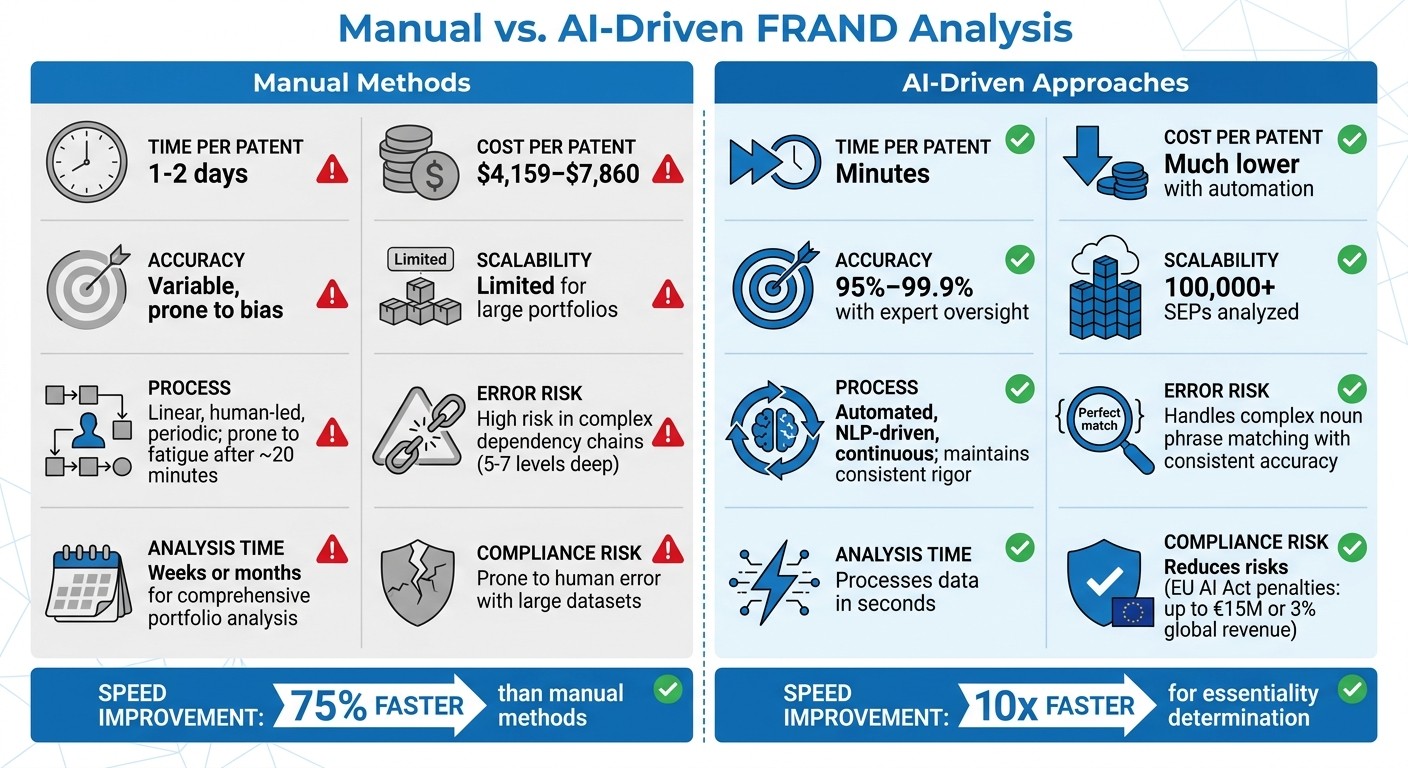
Manual vs AI-Driven FRAND Analysis: Speed, Cost, and Accuracy Comparison
AI simplifies the complexities of FRAND licensing, saving time, reducing costs, and minimizing errors. Traditional manual analysis struggles to keep up with the vast amount of Standard Essential Patent (SEP) data. Reviewing thousands of patents across multiple standards is a daunting task requiring sustained focus - something human analysts can’t maintain indefinitely. Research shows that after just 20 minutes of manual proofreading, performance drops significantly, leading to missed errors in intricate dependency chains. This issue is reminiscent of earlier challenges in manual claim mapping and essentiality verification, both of which AI now handles effectively. Unlike humans, AI tools maintain consistent accuracy and efficiency across thousands of claims without fatigue.
For example, in March 2023, the English High Court’s 17-day trial in InterDigital v. Lenovo resulted in a $138.7 million license fee - much closer to Lenovo’s $80 million offer than InterDigital’s $337 million demand. This case involved 23 witness statements, 10 witnesses, and a 225-page judgment. Judge Mellor J highlighted the inefficiencies of the current system, stating:
"There is no doubt in my mind that the SEP universe would be able to converge on and agree FRAND terms very much more quickly if the basics of each SEP licence were made public."
AI platforms address these inefficiencies by automating repetitive tasks and improving transparency, which leads to more defensible FRAND analyses. These improvements pave the way for the detailed, step-by-step FRAND analysis outlined earlier.
Comparison: Manual Methods vs. AI Approaches
The advantages of AI-driven approaches become clearer when compared to traditional manual methods.
Feature | Manual | AI |
|---|---|---|
Process | Linear, human-led, and periodic; prone to fatigue after ~20 minutes | Automated, NLP-driven, and continuous; maintains consistent rigor across all documents |
Accuracy | High risk of errors in complex dependency chains (5-7 levels deep) | Handles complex noun phrase matching and ensures consistent accuracy across claims |
Time Savings | Takes weeks or months for comprehensive portfolio analysis | Processes data in seconds, allowing experts to focus on strategic tasks |
Risk Reduction | Prone to human error, especially with large datasets | Reduces compliance risks - non-compliance with the EU AI Act could result in penalties up to €15 million or 3% of global revenue |
AI doesn’t replace human expertise - it enhances it. By integrating a "two-pass" workflow, AI handles tasks like antecedent basis checks and identifying dependency gaps. This frees legal professionals to concentrate on high-level decisions, such as claim scope and strategic judgment.
Conclusion
FRAND licensing has always been a challenging process, demanding extensive effort and meticulous attention to detail across thousands of patents and intricate standards documents. AI is reshaping this process by automating critical tasks like essentiality checks, claim mapping, and royalty rate calculations - achieving levels of precision that manual methods struggle to reach.
The move toward AI-driven workflows is gaining momentum. IP teams are now embracing advanced techniques like section-aware extraction, which maintains the hierarchical structure of large standards documents while creating comprehensive evidence packages for claim charting. Interactive AI tools take this further, enabling analysts to ask natural language questions about essentiality and receive real-time, citation-supported insights. This transition marks a significant step forward from traditional manual methods to more efficient, AI-powered approaches.
Organizations face a choice: stick with slow, error-prone manual processes or adopt AI tools that deliver accurate results in seconds. Platforms like Patently provide the specialized capabilities required for precise claim parsing and standards analysis - areas where general-purpose language models often fall short due to issues like hallucinations or misinterpretation of legal boundaries.
But the benefits go beyond speed. AI-powered FRAND analysis minimizes compliance risks, improves transparency in negotiations, and frees legal teams to focus on strategic decisions rather than tedious manual reviews. With new SEP enforcement trends emerging in regions like Brazil and China, and courts issuing decisions with global FRAND implications, leveraging AI tools is becoming essential to stay competitive.
Incorporating AI into FRAND licensing isn't just about keeping up with technological advances - it's about building stronger legal positions, cutting litigation costs, and navigating the complexities of the patent world more effectively.
FAQs
How do I validate AI SEP essentiality results before relying on them?
To ensure the accuracy of AI-determined SEP (Standard Essential Patent) results, it's important to combine AI-driven analysis with expert validation. While AI tools such as Patently can efficiently map patent claims to standards and evaluate market data, the intricate nature of technical standards demands a manual review. Experts should carefully verify the AI's claim-to-standard mappings, assess the technical specifics, and evaluate the market relevance. This thorough cross-checking process builds confidence in the results, making them more reliable for licensing or legal decisions.
What data does AI need to calculate defensible FRAND royalty benchmarks?
AI needs access to critical data to determine defensible FRAND royalty benchmarks. This includes market data, comparable licensing agreements, and patent claim details. It also evaluates patent declarations, licensing terms, and market conditions to spot irregularities and ensure alignment with FRAND principles. By considering these factors, AI helps establish royalty rates that are fair, reasonable, and non-discriminatory.
How can AI dashboards help prevent FRAND compliance issues over time?
AI dashboards play a crucial role in avoiding FRAND compliance issues by providing real-time monitoring of Standard Essential Patent (SEP) declarations, licensing details, and market activity. These tools can flag potential violations early, helping ensure licensing terms remain fair and reasonable. They also use AI-driven forecasts to assess and predict risks related to litigation. Additionally, automated systems continuously track compliance updates, allowing businesses to address potential problems proactively - minimizing penalties and cutting down on legal expenses before issues grow out of hand.