How AI Optimizes SEP Cross-Licensing
Intellectual Property Management
Apr 10, 2026
AI turns SEP cross-licensing from slow manual work into precise, data-driven valuation, negotiation, and global portfolio management.

Faster Patent Evaluation: AI tools analyze thousands of patents quickly, identifying which ones matter most for standards like 5G or Wi-Fi. This cuts down on manual reviews and errors.
Better Negotiations: Predictive analytics help companies estimate fair royalty rates and forecast outcomes, reducing disputes over pricing and terms.
Simplified Data Management: AI organizes and tracks massive patent portfolios in real time, keeping data accurate and easy to access across jurisdictions.
The Problem
SEP cross-licensing involves exchanging patent rights for technologies essential to industry standards. But the process can be slow and messy:
Determining which patents are truly relevant is costly and time-consuming.
Negotiations often stall over disagreements about fair pricing and terms.
Managing thousands of patents across global systems creates data headaches.
The AI Solution
AI tools are solving these challenges by automating key steps:
Patent Valuation: AI filters out irrelevant patents and calculates their market worth.
Negotiation Support: Predictive analytics provide data-driven insights for better deals.
Portfolio Management: AI platforms track ownership, compliance, and licensing data seamlessly.
By 2025, 68% of patent professionals were using AI tools, showing how quickly the industry is adopting these solutions. AI isn't just speeding up the process - it’s making it more accurate and efficient.
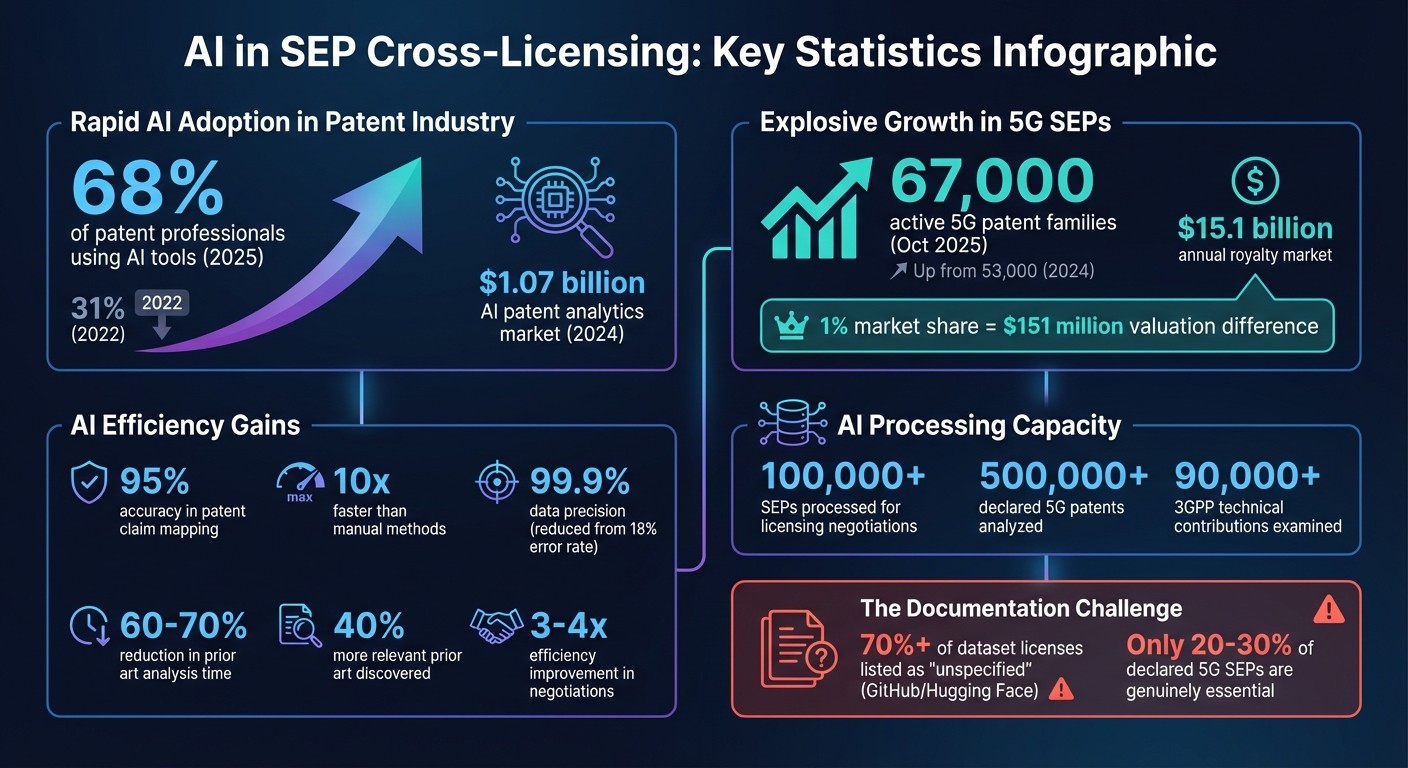
AI Impact on SEP Cross-Licensing: Key Statistics and Market Growth
Can AI Help Manage Your Global Patent Portfolio? - Trademark and Patent Law Experts
Main Problems in SEP Cross-Licensing
Before diving into how AI might help, it’s important to understand the persistent hurdles in traditional SEP cross-licensing. These challenges boil down to three main issues: figuring out the real value of patents, navigating tricky negotiations, and dealing with an overwhelming amount of data.
Determining Patent Value and Essentiality
One of the biggest headaches in SEP cross-licensing is figuring out which patents are truly essential and what they’re worth. Organizations like ETSI rely on companies to self-declare their patents in "good faith", but there’s no independent verification process. This often results in companies declaring far more SEPs than are actually essential. In fact, estimates suggest that only 20%–30% of declared 5G SEPs are genuinely tied to the standard.
This over-declaration is further fueled by practices like "contribution inflation", where companies split proposals or submit excessive paperwork to inflate their portfolios. To make things worse, the raw data from ETSI isn’t perfect - it has an 18% error rate due to mismatched patent numbers and ownership tracking issues.
Why does this matter? The financial stakes are massive. The cellular licensing market is valued at $15 billion–$20 billion annually. On a $15.1 billion royalty market, even a single percentage-point shift in portfolio share can mean a $151 million valuation difference. Verifying essentiality through manual claim-to-standard mapping is the gold standard, but it’s incredibly expensive. Managing portfolios with thousands of patent families can cost millions in expert fees. For example, in the TCL v. Ericsson case, the California District Court used a sampling method to estimate essentiality rates and calculate FRAND rates.
Beyond valuation, the negotiation process adds another layer of complexity.
Handling Complex Negotiations
Negotiating SEP licenses isn’t just about agreeing on the price. It involves hammering out details like whether to license specific patents or entire families, the duration of the license, exclusivity terms, and territorial rights - all while navigating different legal systems.
Jurisdictional differences make things even more complicated. A licensing deal that works in the U.S. might hit regulatory roadblocks in the EU. Companies often have to align their compliance efforts across these varying standards. A recent example from September 2025 highlights this challenge: the Unified Patent Court’s Mannheim Local Division issued the first-ever anti-interim-license injunction for InterDigital against Amazon.com, showcasing how jurisdictional nuances can lead to unexpected litigation.
On top of that, when major players dominate SEP ownership and enter exclusive cross-licensing agreements, they face scrutiny for potentially anti-competitive behavior. These negotiation hurdles are further exacerbated by the sheer amount of data professionals have to manage.
Managing Large Amounts of SEP Data
The sheer scale of SEP data is staggering. By October 31, 2025, there were over 66,000 active 5G patent families globally - up from 53,000 just a year earlier. Each jurisdiction has its own framework, creating what’s often called "documentation debt", where licensing details and data lineage are poorly tracked.
This problem isn’t limited to SEPs. On platforms like GitHub and Hugging Face, over 70% of licenses for popular datasets are listed as "unspecified", leaving legal professionals to navigate murky waters. This ambiguity is further complicated by "license laundering", where restrictive terms are overwritten with inaccurate permissive ones through successive repackaging. As a result, companies often avoid using valuable assets simply because they can’t be sure of the legal permissions.
Manually sorting through thousands of patents is neither practical nor affordable. Without automated tools, professionals struggle to verify ownership, trace data origins, and ensure compliance across jurisdictions. A case in point: in July 2025, Velocity Communication Technologies, LLC filed lawsuits against 11 defendants in the Eastern District of Texas, asserting patents linked to the Wi-Fi 6 standard. This highlighted how poor data management can snowball into large-scale litigation.
"The race to train language models on vast, diverse and inconsistently documented datasets raises pressing legal and ethical concerns." - Nature Machine Intelligence
How AI Improves SEP Cross-Licensing
AI is reshaping the way Standard Essential Patent (SEP) cross-licensing is handled by tackling challenges in valuation, negotiation, and portfolio management. The adoption of AI in this field is gaining momentum - by 2025, 68% of patent practitioners were using AI-assisted search tools, a significant jump from 31% in 2022. The AI patent analytics market also hit $1.07 billion in 2024, underscoring the industry's growing reliance on these technologies.
Automated Patent Value Assessment
One of the most impactful changes AI brings is automating the evaluation of patent value and essentiality. Traditionally, determining which patents are truly essential and their worth was a labor-intensive task. AI tools now streamline this process by assessing "True Essentiality", filtering out non-essential patents from declared SEPs to focus only on those required for the standard. These platforms use decision-tree systems to analyze factors like Technical Merit, Commercial Value, and Legal Strength, creating automated value assessments.
AI tools have achieved remarkable efficiency, with 95% accuracy in mapping patent claims to specifications and speeds up to 10 times faster than manual methods. For example, platforms like Patently provide insights into essentiality, technical relevance, and market impact, enabling teams to efficiently triage large portfolios and pinpoint high-value assets. AI even supports advanced valuation methods like "Real Options", where patents are treated as call options. In one study, an early-stage IP portfolio had a real options value of $9.2 million, despite a negative Net Present Value (NPV) of $11.2 million.
These automated assessments provide a solid foundation for more effective and informed negotiations.
Better Negotiation Strategies with Predictive Analytics
AI doesn't just stop at valuation - it also enhances negotiation strategies through predictive analytics. These tools forecast negotiation outcomes, calculate a Semantic Essentiality Score (ranging from 1 to 100), and deliver market share analysis to support FRAND (Fair, Reasonable, and Non-Discriminatory) rate positions.
AI-powered market share analysis places a patent holder's portfolio in the broader context of the standard landscape. This gives negotiators objective data to strengthen their arguments. Companies can benchmark their SEP portfolios to identify strengths, weaknesses, and unique opportunities for leverage in cross-licensing discussions. Additionally, AI tracks changes in ownership and litigation trends, helping teams assess risks and plan royalty payments with greater accuracy.
Easier Portfolio Management with AI Platforms
AI platforms also simplify the complex task of managing SEP portfolios. Instead of relying on periodic manual updates, these systems enable real-time organization, categorization, and analysis of SEP portfolios. For instance, platforms like Patently automate claim-to-product mapping and provide detailed analysis for technologies like 4G and 5G.
Secure "Deal Rooms" within these platforms allow licensing teams to share analysis, claim charts, and market data directly with counterparties in real time, speeding up deal closures. By integrating portfolio evaluation, evidence building, and negotiation materials into a single workflow, these platforms eliminate data silos and reduce the burden of maintaining outdated documentation. This streamlined process makes it easier for teams to assemble comprehensive evidence linking patent claims to specific products and standards.
AI in SEP Cross-Licensing: Practical Examples
Building on how AI improves valuation and negotiation, practical applications in SEP analytics highlight its transformative role.
AI-Based SEP Analytics for 4G/5G Technologies
The 5G licensing landscape shows how AI simplifies the intricate process of SEP analysis into actionable insights. As of October 31, 2025, there were over 67,000 active 5G patent families worldwide, compared to 53,000 in 2024. Managing this growing volume manually is nearly impossible, but AI-powered top patent tools handle the data with impressive accuracy.
AI doesn't just count patents - it ensures the data is clean and precise, which is critical in a $15.1 billion royalty market. These platforms process data from over 500,000 declared 5G patents, reducing errors caused by matching, ownership discrepancies, and normalization issues from 18% to 99.9% precision through direct validations.
The financial implications of accurate data are massive. In a $15.1 billion market, even a 1% change in market share translates to about $151 million in valuation. AI-verified databases prevent valuation errors, which could otherwise lead to losses of $136 million to $272 million annually for portfolios holding a 5–10% share.
AI also examines over 90,000 3GPP technical contributions from 2024 to identify which companies are shaping 5G standards. It segments portfolios by technical working groups, such as RAN 1 for physical layer technologies or SA 2 for network architecture. This allows negotiators to determine if patents cover core mandatory elements or optional features. For instance, while one company might lead in total 5G patents, another could rank higher on the Patent Asset Index, which considers citation patterns and geographic coverage instead of sheer volume.
Faster Licensing Agreements with AI Tools
AI tools are speeding up licensing negotiations by automating tasks that used to take weeks. For example, AI-powered patent searches cut prior art analysis time by 60–70%, turning multi-week efforts into just a few days. Semantic search enhances this process, uncovering 40% more relevant prior art by identifying conceptually similar inventions.
By streamlining prior art analysis and automating evidence compilation, AI reduces delays that previously hindered negotiations. These tools also maintain 95% accuracy in mapping patent claims to standards. To date, they’ve processed over 100,000 SEPs for licensing negotiations. Their automation capabilities extend to building invalidity cases, generating detailed claim charts, and analyzing non-textual materials like demo videos and product images - tasks that once required significant manual effort.
Secure "Deal Rooms" within AI platforms enable real-time sharing of analysis, claim charts, and market data with counterparties. This feature improves efficiency by 3x to 4x, bridging the gap between technical engineers and patent attorneys. By integrating portfolio evaluation, evidence building, and negotiation materials into one streamlined workflow, these platforms eliminate data silos and significantly cut down the time needed to link patent claims to specific products and standards.
These examples highlight how AI is reshaping SEP negotiations and portfolio management, making processes faster and more precise.
Conclusion: AI and the Future of SEP Cross-Licensing
AI is transforming SEP cross-licensing, shifting it from manual, reactive processes to a dynamic, data-driven approach. Traditional methods, which relied heavily on slow and subjective manual reviews, struggled to handle the scale of portfolios like IBM's 155,000+ patents. Now, AI automates essentiality assessments, standardizes ownership data across massive patent collections, and provides transparent valuations that highlight market relevance and claim scope.
This evolution isn't just technical - it has gained acknowledgment across the industry.
"The focus on consolidation and segmentation means that portfolio managers spend less time reconciling data and more time understanding it – seeing the forest and the trees in their patent holdings." – Lexology
Through what’s referred to as "agentic portfolio intelligence", AI enables active portfolio management. This includes running real-time "what-if" scenarios, spotting underutilized patents via citation analysis, and automating evidence-of-use detection from product documentation. These capabilities turn patent management into a proactive, research-oriented activity.
AI-powered systems deliver actionable insights. By combining standards databases like 3GPP and IEEE with semantic matching, AI can identify both declared and undeclared standard-essential patents, offering a more thorough understanding of portfolios.
The implications go beyond efficiency. AI-driven methods enhance adherence to FRAND principles by introducing data-backed transparency in patent valuation and essentiality. As the technology continues to advance, regulatory frameworks are expected to align further. This includes integrating AI regulations with responsible AI practices to manage cross-border challenges, such as contractual safeguards for training data, model outputs, and algorithmic updates.
Platforms like Patently are leading the way, equipping patent professionals with real-time, transparent portfolio analytics. By tackling key issues in valuation, negotiation, and data management, AI is completing the transformation of SEP cross-licensing, setting the stage for a more efficient and equitable future in the field.
FAQs
How does AI determine if a patent is standard-essential?
AI determines whether a patent is standard-essential by assessing how its claims correspond to standard specifications. Through automated tools for claim-to-standard mapping and essentiality evaluation, AI analyzes the patent's connection to the standard with impressive precision, simplifying and speeding up the evaluation process.
Can AI help estimate a FRAND royalty rate for my portfolio?
AI can help estimate a FRAND royalty rate for your portfolio by using advanced analytics and benchmarking tools. These tools can evaluate patent portfolios, offer detailed data insights, and assist in negotiations, streamlining the process of determining fair and reasonable royalty rates.
What SEP data problems can AI clean up across countries?
AI tackles major SEP (Standard Essential Patent) data challenges that arise from differences in national laws, formats, and reporting standards. By standardizing and analyzing data, AI makes cross-border licensing much simpler. It also automates data validation, cutting down on errors and minimizing the need for manual effort. This leads to better clarity around patent ownership and licensing terms, improving transparency and making global cross-licensing processes more efficient.