How AI Improves Patent Portfolio Budget Allocation
Intellectual Property Management
Apr 11, 2026
Use AI to score, prune, forecast, and reallocate patent budgets—reduce maintenance costs, speed drafting, and align IP spend.

Managing patent portfolios is tough. AI makes it easier. Companies often struggle with outdated methods like spreadsheets and manual reviews, leading to wasted resources and missed opportunities. Top AI patent tools solve this by analyzing portfolios, assigning value scores, predicting costs, and identifying patents to keep or let go. Here’s how AI transforms patent management:
Streamlines portfolio analysis: AI scans thousands of patents in real-time, identifying gaps, overlaps, and low-value assets.
Ranks patents by value: Assigns scores based on factors like market relevance, claim breadth, and litigation risk.
Cuts costs: Identifies patents to abandon, reducing maintenance fees by up to 10% annually.
Forecasts expenses: Projects maintenance fees over 5–10 years, helping avoid unexpected costs.
Optimizes budgets: Dynamically reallocates funds based on market shifts and competitor actions.
Improves efficiency: Reduces drafting time by 15–20%, saving $5,000–$7,500 per application.
AI tools like Patently integrate these features, offering a centralized platform for smarter decisions. Companies using AI report cost savings, faster processes, and better alignment with business goals. It’s not just about saving money - it’s about making smarter, data-driven choices.
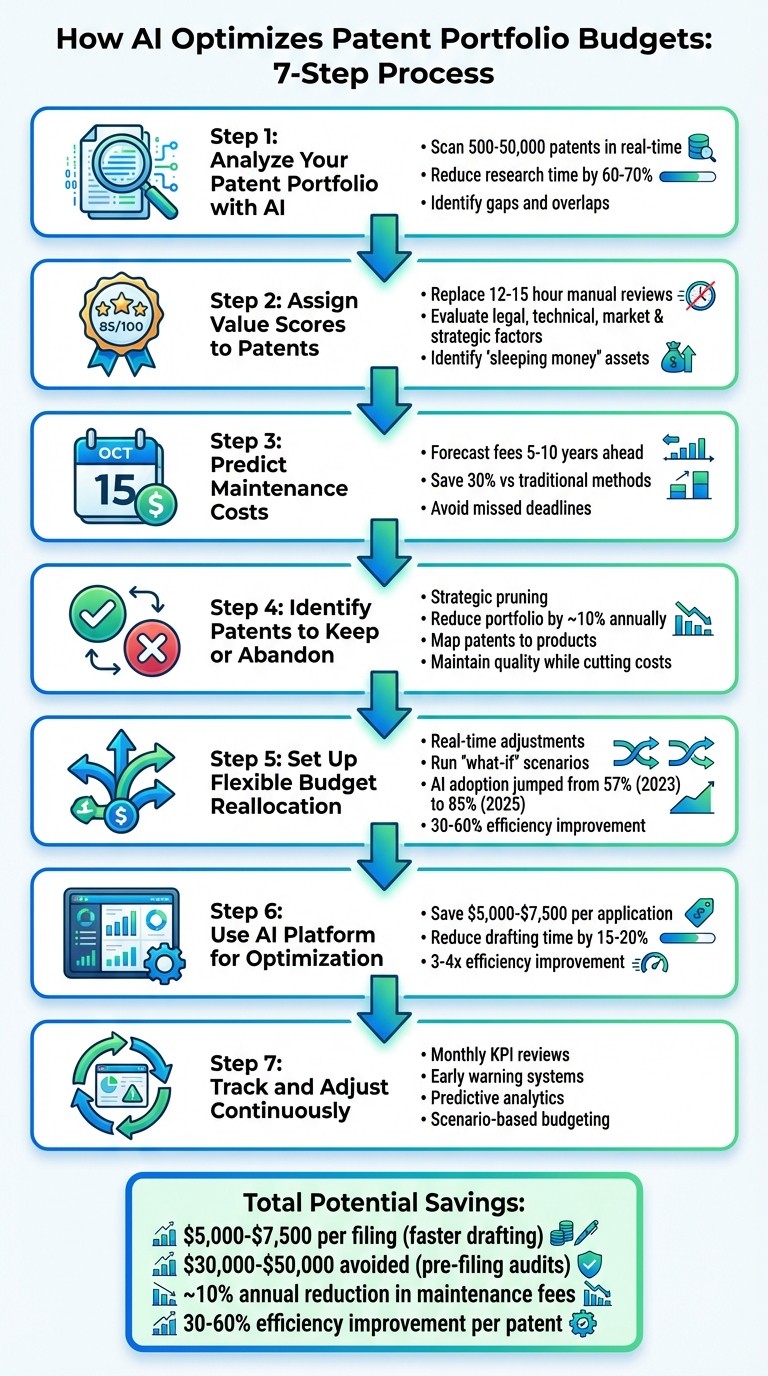
7-Step AI-Driven Patent Portfolio Budget Allocation Process
Can AI Help Manage Your Global Patent Portfolio? - Trademark and Patent Law Experts
Step 1: Analyze Your Patent Portfolio with AI
The first step in managing your patent budget effectively is knowing exactly what you own. AI platforms can scan portfolios of any size - from 500 to 50,000 patents - and deliver insights almost instantly. These tools replace outdated spreadsheets and annual reviews with a dynamic, real-time view of your assets. By identifying patterns in technology clusters, citation networks, and market relevance, AI transforms static reports into what the industry calls "living" strategies.
With continuous monitoring, AI systems can flag emerging threats, uncover new opportunities, and highlight redundant or outdated assets. This real-time insight allows you to make proactive adjustments to your budget, a process explored further in later steps.
AI doesn't just stop at categorization. Using semantic search, it can identify related patents even when different terminology is used, slashing research time by up to 60–70%. It also performs gap analyses by comparing your portfolio against global databases and competitor filings. This reveals areas where your technology may lack protection and where you're underinvesting. Additionally, AI can spot overlapping patents, a telltale sign of unnecessary spending.
Next, let’s dive into how AI can pinpoint low-value patents to streamline your portfolio.
Finding Low-Value Patents with AI
AI helps identify low-value patents by analyzing historical data, citation networks, and market relevance. These are the patents that drain resources without offering strong commercial protection or contributing to revenue. Many IP organizations have used this type of analysis to reduce their portfolios by about 10% annually, cutting costs while maintaining quality.
The system evaluates patents on multiple fronts, including claim breadth, legal validity, market relevance, and commercial impact. Patents with narrow claims, those nearing expiration, or those with few external citations often emerge as candidates for abandonment. AI can even predict the likelihood of a patent being invalidated by analyzing past legal cases, helping you decide whether to defend or let go of a challenged asset.
Organizing Patents into Categories
After identifying low-value assets, AI takes it a step further by organizing your patents. It uses global standards like the Cooperative Patent Classification (CPC) system, as well as customized categories tailored to your business needs. This process creates visual innovation maps that highlight where your portfolio is concentrated and where there are gaps. Technology clustering can expose "white space" for future investment and pinpoint redundant "thickets" that can be trimmed.
AI also facilitates patent-to-product mapping, showing which patents directly support revenue-generating products and which are redundant. This clear connection between patents and products helps identify assets that are worth keeping and those that can be safely abandoned. Citation mapping further identifies "hub" patents - those frequently cited by others - as high-value assets, while isolating low-impact patents for potential removal.
This detailed analysis lays the groundwork for assigning precise value scores to your patents, which will be explored in the next step.
Step 2: Assign Value Scores to Patents Using AI
Once your portfolio is organized, the next step is to assign AI-enabled patent analysis to assign value scores to each patent. These scores simplify budget decisions by ranking patents based on their value across several dimensions, including legal, technical, market, and strategic factors. This approach eliminates the need for subjective, labor-intensive manual reviews, which typically take 12 to 15 hours per patent and are often influenced by human bias.
AI evaluates patents by analyzing their enforceable scope, remaining term, litigation risk, and likelihood of invalidation. It also considers technical attributes like novelty, technological advancement, and how widely the knowledge is dispersed. On the market side, it assesses factors such as market size, growth potential, licensing opportunities, and the longevity of the technology.
Additionally, AI identifies patents with strong "blocking power" - those frequently cited by competitors - and Standard-Essential Patents (SEPs), which command higher licensing fees. It also flags underutilized assets, sometimes referred to as "sleeping money", which have high external citations but are rarely used internally. These could be prime candidates for licensing deals or spin-offs.
To refine the rankings, weighting methods like the Analytic Hierarchy Process (AHP) or scoring systems tailored to lifecycle stages and disciplines are applied. This ensures that patents tied to profitable, revenue-generating products are prioritized over those covering outdated or discontinued technologies. These refined scores pave the way for a deeper dive into the metrics AI uses to evaluate patent value.
Metrics AI Uses for Patent Scoring
AI uses a range of metrics to calculate a patent's value. One key factor is claim breadth, which measures how much protection a patent provides. Citation networks are another important metric, as they reveal whether competitors are building on your technology - a strong indicator of its foundational importance. Market relevance is assessed by looking at market size, growth trends, and identifying "white spaces" where few patents currently exist, signaling untapped opportunities.
Litigation history and prior art analysis are also crucial. By examining legal precedents, AI can estimate the likelihood of a patent being invalidated or successfully defended in court. Patents aligned with industry standards or directly linked to competitor products tend to score higher, as they offer clearer opportunities for enforcement or licensing.
AI also conducts evidence-of-use (EoU) analysis by scanning competitor product announcements, user manuals, and technical documents to find overlaps with your patent claims. This information is invaluable for negotiating licensing deals and identifying patents with strong enforcement potential. By combining all these metrics into a single score, AI provides a clear roadmap for deciding which patents to invest in and which to abandon, freeing up resources for more strategic uses.
Step 3: Predict Maintenance Costs and Renewal Dates
Once you’ve established patent value scores, the next step is to forecast upcoming maintenance costs. Maintenance fees tend to increase as patents age, and without proper planning, unexpected costs can lead to rushed decisions about abandoning patents. The true financial burden of a patent often becomes evident years after it’s filed, typically following a timeline of about ten years.
AI tools play a key role here by projecting expected fees over the next 5–10 years. These tools can identify peak cost periods, helping companies prepare in advance. Modern platforms break down future expenses into detailed categories, such as official fees, service charges, taxes, and even currency exchange fluctuations, providing forecasts on a monthly or yearly basis. Johanna Winter-Robl, Head of IP at Kermi, highlights this transparency:
I can see the price and what the cost will be next time. It provides complete transparency by showing all cost categories related to renewal.
This financial clarity allows businesses to explore alternative strategies for managing their patent portfolios. For instance, AI simulations can help assess the financial impact of retiring certain patents versus maintaining the entire portfolio. This is particularly useful for global portfolios, where fee structures, payment intervals, and renewal rules vary by region. Daniel Palmer, VP Technology at Biodexa Pharmaceuticals, shares:
The forecasting tool has definitely been advantageous to my colleagues in Finance. We haven't had any omissions or any errors at any point, so that obviously just means that the software works and does what it's supposed to.
AI tools also integrate these forecasts with key business events, enabling smarter decisions. For example, they help align maintenance fees with milestones like product launches or fundraising efforts. If a patent no longer supports a planned product or market strategy, you can let it expire before the next high-cost renewal period, freeing up resources for more strategic investments. Automated docketing systems further streamline this process by tracking renewal dates, reducing the risk of missed deadlines and potential IP loss - a mistake that could permanently forfeit a patent. Companies using automated renewal platforms report saving at least 30% compared to traditional methods by cutting out intermediaries and optimizing transaction costs.
Step 4: Identify Which Patents to Keep or Abandon
Once cost projections are in place, the next step is deciding which patents are worth further investment and which should be let go. This process, often referred to as strategic pruning, is essential for managing your budget effectively. By focusing on the patents that truly matter, you not only cut unnecessary expenses but also strengthen the overall value of your portfolio. AI plays a key role here, evaluating patents based on factors like scope, validity, market relevance, commercial impact, enforceability, and their position within the broader portfolio. This detailed analysis helps distinguish between patents that protect revenue-generating products and those that are simply draining resources.
AI goes even further by mapping patents to current products and competitor technologies. It identifies low-impact patents - those that may be outdated, redundant, or have minimal competitive significance. For instance, if your company moved to a new technology platform three years ago, AI can highlight patents tied to the old system that no longer contribute to your current offerings. Without AI, manually reviewing large patent portfolios would be an overwhelming task.
Another valuable tool AI provides is moat analysis, where it compares the breadth of a patent's claims against competitor products. This ensures that key defensive patents remain intact. It also uses automated Evidence-of-Use detection to uncover patents that might not be actively used within your company but could hold significant value for licensing or defense. Kent Richardson, Partner at Richardson Oliver, captures the importance of this process:
What the IP industry needs is a shorter path to our most valuable assets. More assets, fewer resources, and more pressure on patents make developing and qualifying those most valuable patents more important - and more challenging - than ever. Patlytics finds that shorter path.
AI also identifies opportunities to license or spin off patents that no longer align with your business strategy. This approach transforms what might seem like a simple cost-cutting exercise into a chance to generate revenue. The financial benefits are clear - companies with well-maintained IP portfolios have historically outperformed the US All Stocks universe, achieving a 72.5% one-year base rate on a risk-adjusted basis. By leveraging AI, this pruning process not only reduces costs but also sets the stage for smarter budget allocation in the future.
Maintaining Portfolio Quality While Cutting Costs
Strategic pruning is about more than just cutting expenses; it’s about ensuring that any budget reductions don’t compromise your competitive edge. AI assigns patents a priority level - high, medium, or low - based on their technological relevance and market presence. Geographic analysis also comes into play, as AI evaluates whether certain patents are worth maintaining in regions where your market presence is minimal or where enforcement standards are weak. These patents often become prime candidates for abandonment.
AI also identifies redundancy within your portfolio, flagging situations where multiple patents cover slight variations of the same process. Eliminating these redundancies reduces maintenance fees without sacrificing protection. This shift from focusing on quantity to emphasizing quality aligns with the preferences of investors and leadership, who now favor streamlined portfolios that tell a clear and intentional story. Regular AI-driven reviews ensure that your intellectual property stays aligned with rapidly evolving product strategies, turning portfolio management into a proactive, strategic process rather than a passive administrative task.
Step 5: Set Up Flexible Budget Reallocation
After trimming your patent portfolio, the next step is to establish a system that can adjust budgets dynamically as market conditions evolve. Traditional static reviews are becoming a thing of the past. Thanks to AI, budgets can now respond instantly to new data, eliminating the need to wait for scheduled checkpoints. This approach transforms portfolio management into what’s called Agentic Portfolio Intelligence, where AI takes the lead in monitoring and updating insights continuously.
AI doesn’t just monitor - it runs "what-if" scenarios to reassess patent values as situations change. For instance, if a competitor launches a new product that overlaps with one of your patents, the system recalculates the defensive value of that asset. It then flags it for increased focus, whether through enforcement or licensing. Similarly, if a targeted market segment experiences sudden growth - say, it doubles in size - AI can recommend reallocating R&D filing budgets to capture that opportunity. This real-time adaptability not only fine-tunes the value of your assets but also improves financial efficiency.
The numbers back this up. AI adoption in intellectual property (IP) management jumped from 57% in 2023 to 85% in 2025, with firms reporting efficiency improvements of 30% to 60% per patent draft. For example, in Q4 2025, Nielsen’s in-house IP team implemented AI-driven portfolio management. This allowed them to handle high-volume global operations while maintaining accuracy during rapid scaling. Each maintenance deadline serves as a checkpoint, where the system reassesses a patent’s revenue potential and defensive value before committing further funds.
Beyond internal data, AI also tracks external signals - like competitor announcements or funding rounds - to identify shifts in market interest. These insights allow for proactive budget adjustments, directing resources toward licensing opportunities or defensive filings. As PatentPC puts it:
If you can see risk before it becomes cost, you're already ahead of the game.
This proactive strategy ensures that your budget stays aligned with the realities of the market. Instead of locking in decisions for an entire year, you can reallocate funds based on performance metrics, competitor actions, and emerging opportunities. This not only improves ROI but also strengthens your competitive edge by focusing resources on the patents that matter most right now. This flexible budgeting system sets the stage for further portfolio optimization, which will be explored in the next section.
Step 6: Use Patently for AI-Driven Budget Optimization
Patently takes dynamic budget reallocation to the next level by combining all essential tools into a single, streamlined platform. Designed specifically for patent professionals, Patently offers a suite of features, including drafting tools, semantic search, project management, and analytics - all powered by AI. This integration simplifies workflows and enables real-time, AI-driven budget adjustments, seamlessly tying these decisions into daily portfolio management tasks.
The platform's unified approach delivers both cost savings and efficiency gains. For example, in February 2026, Bob Hansen from The Marbury Law Group adopted Patently and saw a 3x–4x improvement in efficiency. This allowed the firm to make fixed-fee projects profitable at partner rates by reducing write-off losses and cutting the drafting time for a standard 28-hour application to just 19.6 hours. Similarly, in September 2025, a biotechnology company used Patently for invention harvesting and drafting, saving 10 to 15 hours per application. These time savings translated into direct cost reductions of $5,000 to $7,500 per application, thanks to lower billable hours and reduced outside counsel fees.
Prioritizing Patents with Patently's AI Scoring
Building on insights from earlier steps, Patently provides the tools needed for real-time budget optimization. Unlike traditional scoring systems that rely on occasional manual reviews, Patently's AI continuously evaluates patents as new market data becomes available. This allows you to identify changes in patent value early, enabling proactive decisions about whether to maintain, enforce, license, or abandon specific assets.
The platform also conducts Source Material Audits on invention disclosures to ensure technical completeness before significant drafting costs are incurred. Integrated validity searches (Section 102/103) run directly within the drafting workspace, flagging high-risk applications early. By reallocating funds away from these "failed applications" before filing fees are paid, users can avoid the $30,000 to $50,000 costs often associated with rejected or invalidated patents. These real-time scoring tools feed directly into project management and budget tracking, creating a more efficient workflow.
Managing Budgets with Patently's Project Tools
Patently's project management features allow for real-time budget tracking across your entire patent portfolio. Its hierarchical project categorization and customizable fields help organize patents by business unit, technology area, or market segment - tailored to align with your specific budget strategy. Real-time "sanity checks" and Section 112 support verification catch drafting gaps early, reducing costly rework and prosecution delays.
In September 2025, Abnormal Security, under the leadership of Director of IP Kenneth Jenq, used Patently’s AI to manage its portfolio and identify potential infringements. By generating detailed claim charts in minutes rather than weeks, the company slashed investigation costs, which previously ranged from $20,000 to $50,000 per case. Patently's ability to unify drafting, search, and analysis into one workflow eliminates inefficiencies caused by disconnected tools. This streamlined process allows for more agile budget management. Users frequently report 15–20% faster drafting timelines and savings of 10–15 hours per application, freeing up resources for high-priority filings or strategic projects.
Step 7: Track and Adjust Budgets Continuously
Managing patent portfolio budgets isn’t a one-and-done task. As market conditions, enforcement cycles, and operational needs shift, budgets need to keep pace. Without regular oversight, spending can become scattered, leading to inefficiencies and fragmented budgets. This is where AI tools step in, offering real-time visibility into your entire intellectual property (IP) landscape. Instead of reacting to budget issues as they arise, AI helps transform budget management into a proactive process.
AI-driven Early Warning Systems are particularly useful for catching potential problems before they spiral out of control. These systems can flag weak signals like invoice overruns from specific law firms, unexpected spikes in provisional filings without follow-ups, or delays in inventor disclosures. By reviewing these key performance indicators monthly, you can spot and address budget challenges early, preventing them from snowballing into major issues.
Predictive analytics also play a big role in smarter budget allocation. For example, before committing funds to an expensive appeal, AI can evaluate the likelihood of success, helping you divert resources away from low-probability cases. Similarly, automated docketing systems track global renewal deadlines, ensuring you avoid costly late fees or the risk of losing valuable assets.
Top IP organizations go beyond just tracking expenses - they use AI to tie patents directly to revenue streams, market opportunities, and licensing potential. This approach not only eliminates redundant costs but also ensures that every dollar spent supports broader business goals.
AI’s capabilities extend even further with scenario-based budgeting. Imagine your R&D team grows by 30%, or a key patent family faces a legal challenge. AI can simulate the financial impact of these scenarios in real time and suggest budget adjustments. By adopting this data-driven approach, budget management becomes a flexible, ongoing process that evolves alongside your business needs. This kind of adaptability shifts budgeting from a static, annual task to a dynamic, responsive strategy.
Benefits of AI for Patent Budget Allocation
AI-powered tools are transforming how businesses manage patent budgets by driving efficiency, aligning strategies, and improving decision-making.
Lower Operating Costs
AI can cut costs by reducing inefficiencies and making better use of resources. For instance, generative AI patent drafting tools speeds up the process by 15–20%, saving companies between $5,000 and $7,500 per filing. Additionally, pre-filing AI audits can catch structural issues or prior art conflicts early, helping businesses avoid $30,000 to $50,000 in unnecessary prosecution expenses.
Another significant area of savings comes from AI-driven portfolio pruning. By analyzing patents and identifying those with limited strategic value, companies can cut back on maintenance fees for patents that no longer serve their goals. Many leading IP teams reduce their portfolios by around 10% annually. These immediate cost reductions free up resources for better long-term financial planning.
Better Long-Term Planning
AI doesn’t just save money - it provides actionable insights for smarter budget allocation. By analyzing market trends, competitor movements, and evolving technologies, AI helps align patent investments with business priorities. This ensures that resources are focused on high-value patents that protect critical technologies and strengthen market positions.
AI also excels at gap analysis, pinpointing "white spaces" - areas of innovation that competitors haven’t yet explored. Predictive lifecycle management further enhances planning by forecasting when certain technologies may become obsolete, allowing businesses to proactively adjust their maintenance budgets. These insights enable companies to reinvest savings into forward-thinking strategies, securing a stronger competitive position.
An AI-optimized patent portfolio can also enhance opportunities in mergers, acquisitions, and funding by clearly demonstrating the connection between intellectual property and potential revenue growth. As PowerPatent highlights:
AI tools can help patent attorneys improve the quality of patent applications, which can have long-term cost savings for clients.
Conclusion
Managing patent budgets effectively requires more than just static spreadsheets and last-minute cost-cutting measures. AI is reshaping this process by highlighting which assets deserve continued investment and flagging those that consume resources without delivering strategic value. Beyond just speeding up drafting, AI helps allocate legal resources more efficiently.
The financial benefits are clear. Companies leveraging AI-based methods save between $5,000 and $7,500 per filing by streamlining the drafting process. Additionally, addressing potential issues early can prevent $30,000 to $50,000 in prosecution costs. Many organizations also reduce their portfolios by about 10% annually, cutting unnecessary maintenance fees. These savings open up opportunities for reinvesting in more impactful areas.
Patently integrates AI-powered drafting, advanced semantic search, and project management tools to help maintain budget efficiency. Whether it's removing outdated patents, forecasting maintenance expenses, or shifting resources to focus on emerging technologies, AI brings clarity and precision to strategic decisions.
As DeepIP explains:
"AI-driven solutions are changing this equation, enabling a more proactive and strategic approach to portfolio management”.
The real question isn’t whether to adopt AI for patent budgeting - it’s how quickly you can implement it. Start by auditing your portfolio with AI tools, establish clear scoring systems, and ensure you have mechanisms for ongoing monitoring.
The patent landscape is changing fast, and AI ensures your budget strategies can keep pace.
FAQs
What data does AI need to score my patents accurately?
AI needs detailed information from patent documents to analyze and score them accurately. This includes semantic and conceptual data, citation networks, and related prior art. These components allow the AI to grasp both the content and the context of the patents, leading to more precise evaluations.
How do I validate AI recommendations before abandoning patents?
To make the most of AI recommendations, it’s important to evaluate a patent’s strategic value, market relevance, and potential ROI. Tools like Patently can assist with semantic searches and SEP analytics, offering insights into a patent's importance. However, the key is to blend AI-driven data with human expertise. This ensures decisions are well-informed and aligned with broader business objectives. By doing so, you can avoid discarding patents that still hold value and focus on retiring those with less strategic importance.
How often should my patent budget be reallocated using AI?
While there isn’t a fixed rule for how often you should adjust your patent budget using AI, it’s a good idea to conduct regular reviews. Incorporating data-driven forecasting, scenario planning, and strategic adjustments can help ensure your resources are being used effectively. These practices keep your budget aligned with the changing needs and priorities of your patent portfolio.