How Predictive Analytics Improves SEP Licensing
Intellectual Property Management
Apr 8, 2026
Shows how predictive analytics maps patents to standards, models FRAND rates, forecasts litigation risk, and optimizes SEP licensing strategy.

Standard Essential Patent (SEP) licensing has long been a costly and inefficient process. Predictive analytics is changing that by introducing data-driven tools that simplify complex tasks and reduce reliance on subjective judgment.
Here’s what predictive analytics brings to the table:
Accurate Patent Analysis: Top patent tools map patent claims to technical standards, cutting down on inflated metrics and manual errors.
Fairer FRAND Compliance: Data models help ensure royalty rates align with patent value, addressing royalty stacking issues.
Litigation Risk Forecasting: Historical data predicts case outcomes and identifies risks early, saving time and resources.
Smarter Licensing Strategies: Tools rank patents based on true technical contributions, helping companies focus on valuable assets.
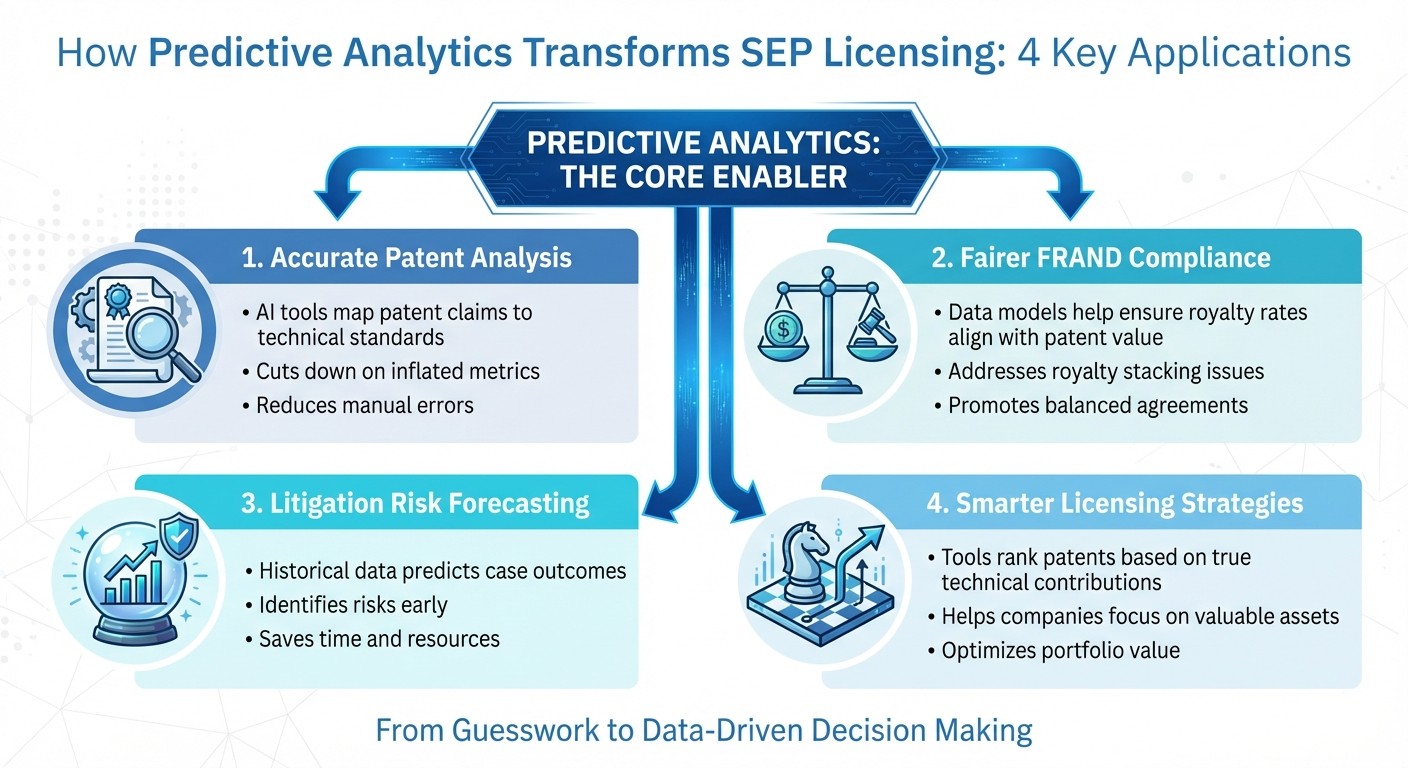
How Predictive Analytics Transforms SEP Licensing: 4 Key Applications
Agentic AI – Patent Expert Co-Pilot Framework for (SEP) Licensing & Litigation Intelligence
Using Predictive Analytics for FRAND Compliance
FRAND obligations are a cornerstone of SEP licensing, but they've often lacked clear, measurable standards. Predictive analytics is changing that by bringing transparency to compliance.
Evaluating FRAND Obligations with Data
Predictive analytics helps determine if royalty rates align with the actual value of an invention while staying within fair limits. By analyzing economic data and disclosures, these tools model FRAND rates, offering a structured approach to licensing negotiations. This is especially critical for addressing royalty stacking - where combined fees from multiple SEP holders can become unmanageable for implementers.
"A FRAND rate must take into account the overall royalty that could be reasonably charged for all SEPs." – Fair Standards Alliance
Analytics platforms go a step further by calculating a patent holder's market share. They do this by examining the numerator and denominator of a portfolio in relation to an entire standard, such as 5G or Wi-Fi 6. Additionally, semantic essentiality verification maps independent patent claims to specific standard sections, assigning essentiality scores from 1 to 100. This helps negotiators spot instances where licensors may be overstating their portfolio's value.
"Transparency should be encouraged to create greater predictability and avoid discrimination." – Fair Standards Alliance
Monitoring Licensing Agreements in Real Time
Once FRAND evaluations are data-driven, real-time monitoring ensures licensing strategies remain flexible and up-to-date. These tools track global rate-setting decisions and compliance trends as they happen. For instance, in March 2026, the UPC Court of Appeal deferred a rate-setting request, providing new data for predictive models to analyze whether UK or German practices might dominate.
The UPC's goal of delivering judgments in under 12 months underscores the need for rapid data analysis. Predictive tools also monitor jurisdictional trends, such as whether the UPC leans toward the UK's interventionist stance on FRAND rate-setting or adopts the German courts' approach. Platforms like Patently assist by tracking ownership changes, litigation trends, and behaviors like hold-up or hold-out in real time.
"The UK courts depend heavily on disclosure from the parties and detailed economic expert evidence... when determining FRAND rates." – Andrew Moir, David Webb, and Theo Pickles, Herbert Smith Freehills Kramer LLP
This level of real-time insight allows companies to adjust their licensing strategies as needed, ensuring they stay compliant with shifting FRAND standards across jurisdictions. It also helps them prepare robust economic evidence well ahead of any potential disputes or litigation.
Forecasting Litigation Risks and Outcomes in SEP Licensing
Predictive analytics is reshaping legal strategies by offering a data-driven approach to forecasting litigation risks, building on the foundation of FRAND compliance insights.
Modeling Litigation Outcomes with Historical Data
Legal teams are no longer relying solely on intuition to navigate SEP disputes. Predictive analytics leverages historical data - such as case precedents, judge rulings, and statutes - to deliver probabilistic assessments of potential litigation outcomes. This allows teams to craft strategies and present evidence based on what has worked in similar cases.
"Predictive analytics... assists lawyers, judges, and stakeholders in making informed decisions by quantifying uncertainties and highlighting critical patterns that might otherwise go unnoticed." – PowerPatent
These tools go beyond predicting case outcomes; they also help legal teams understand judicial behavior. By analyzing a judge's prior rulings and preferences, teams can adjust their arguments to align with the judge's tendencies. Similarly, insights into opposing counsel's litigation history can reveal their preferred tactics, such as a tendency to file early motions to dismiss or settle before trial. Analytics even highlight when settlements are most likely to occur - often tied to specific events like depositions or major hearings - helping teams strategically time negotiations for better results.
This level of analysis empowers legal teams to manage risks more effectively and make proactive decisions during litigation.
Reducing Risks Through Early Detection
One of the most impactful benefits of predictive analytics is early risk detection. By examining historical litigation data, companies can identify and address potential weaknesses in their legal positions before they escalate.
Real-time monitoring of court filings, motions, and rulings provides immediate insights into emerging risks, enabling legal teams to adapt their strategies on the fly. This approach also supports cost-benefit analysis for high-stakes litigation decisions, such as hiring expert witnesses, by comparing potential costs against historical success rates. Tools like Patently streamline this process by tracking trends and behaviors across SEP portfolios, helping teams identify potential disputes before they arise.
The transition from intuition-driven to data-driven decision-making marks a significant shift in managing SEP licensing disputes. Legal teams can now focus their resources on the most impactful litigation stages - such as expert depositions or in-depth technical analyses - where data shows they can make the biggest difference.
Improving SEP Licensing Strategies with Predictive Analytics
Predictive analytics is changing the game for SEP licensing negotiations and portfolio management. By leveraging data-driven insights, organizations can make strategic, well-informed decisions that go beyond traditional approaches.
Strengthening Licensing Negotiations with Data
Historically, licensing negotiations have relied on voluntarily declared SEP portfolios. Predictive analytics, however, introduces a way to objectively verify these claims. Tools like semantic essentiality scoring analyze independent patent claims and map them to specific standard sections, assigning scores (from 1 to 100) to indicate the likelihood of essentiality.
"Level the playing field using the same data and metrics in licensing negotiations as the licensors." – LexisNexis IPlytics
A fair FRAND negotiation hinges on understanding both the "numerator and denominator" - the number of essential patents a licensor holds compared to the total SEP stack for that technology. For example, if a company claims it holds key 5G patents, analytics can uncover their actual share within the total 5G SEP stack. This ensures royalty rates align with their true market contribution. Tools like Patently's SEP analytics provide ultimate owner transparency, giving negotiators a clear view of opposing portfolios.
Additionally, portfolio benchmarking helps organizations identify their strengths and weaknesses, shaping arguments for cross-licensing discussions. By monitoring competitors' investments in standards development, companies can spot early shifts in technology and maintain leadership in standard-setting organizations. This level of clarity not only strengthens negotiation positions but also informs smarter resource allocation.
Allocating Resources Efficiently
Predictive analytics doesn't just enhance negotiations - it also sharpens resource allocation strategies. By focusing on true essentiality rather than declared SEPs, organizations can avoid wasting resources on patents that lack real commercial value. Expert-verified data ensures attention is directed toward patents that are technically necessary to a standard.
"Not all of the SEPs are truly essential, affecting how much you should pay and how much you should ask." – Patently License
For licensors, predictive tools help pinpoint high-value patents to prioritize in licensing campaigns. They also assist in "keep/kill" decisions, determining which patents to maintain or abandon based on essentiality and market relevance. Licensees, on the other hand, can apply essentiality filters during due diligence to focus legal and financial resources on the most impactful patents. This targeted approach supports fair and efficient FRAND negotiations.
Predictive forecasts also help organizations prepare for future demands. By briefing executives on licensing budgets and potential challenges, businesses can reserve resources well in advance. As emerging standards like 6G evolve, analytics can predict filing trends and budget needs across sectors such as automotive, medical technology, and smart homes. This forward-looking strategy ensures companies stay ahead in a rapidly changing landscape.
Conclusion: How Predictive Analytics Transforms SEP Licensing
Predictive analytics is changing the game for SEP licensing by turning complex challenges into data-driven solutions. Instead of relying on guesswork, companies can now craft royalty frameworks that reflect actual technological contributions, align with industry benchmarks, and maintain transparency - all while meeting FRAND requirements and avoiding regulatory scrutiny from bodies like the U.S. Federal Trade Commission and the Department of Justice.
The benefits go beyond compliance. Predictive tools help identify risks early, forecast litigation outcomes, and lower legal expenses. They also ensure resources are allocated effectively, cutting down on unnecessary spending.
"A strategic approach is to develop a clear, data-driven framework for calculating royalties, ensuring that the rates are defensible and aligned with industry norms." – PatentPC
With increasing regulatory focus, objective valuation methods and AI-powered platforms like Patently are becoming essential. These tools provide in-depth SEP analytics, standardize licensing terms, and document justifications to reinforce compliance.
As standards move from 5G to the next frontier of 6G, predictive analytics will remain crucial for staying competitive. Companies that adopt these tools will be better equipped to navigate future licensing challenges with clarity, fairness, and strategic foresight.
FAQs
How do essentiality scores work in SEP licensing?
Essentiality scores play a key role in SEP licensing by indicating how crucial a patent is to a specific standard. A higher score signals greater importance, which can significantly influence licensing negotiations and rate determinations. These scores are derived from dependable data and assessments, carefully reviewed and validated by technical experts to maintain precision.
What data is required to model a defensible FRAND royalty rate?
The information provided doesn’t detail the precise data required to establish a defensible FRAND royalty rate. Generally, this type of modeling might include an examination of licensing agreements, prevailing market dynamics, and the scope of relevant patent portfolios. However, the exact requirements would vary based on the specific circumstances and objectives of the analysis.
How can predictive analytics flag SEP litigation risk early?
Predictive analytics plays a key role in spotting potential SEP litigation risks. By examining historical patent data, court decisions, and specific patent characteristics, it helps pinpoint vulnerabilities - like possible infringement - before they turn into full-blown legal conflicts. Catching these issues early enables proactive strategies and smarter decision-making.