How Startups Use SEP for Licensing Deals
Intellectual Property Management
Feb 19, 2026
Step-by-step approach for startups to find, verify, negotiate, and monitor SEP licenses using AI analytics and FRAND-aligned agreements.
Startups face high costs and complexity when licensing Standard Essential Patents (SEPs) for technologies like 5G, Wi-Fi, and Bluetooth. Here’s how they navigate the process effectively:
Identify Relevant SEPs: Use AI tools like Patently to filter through the 150,000+ declared 5G patents and focus on patents relevant to your product.
Verify Claims: Not all declared SEPs are valid. Research shows only 10-15% of 5G SEPs are authentic. Request claim charts to confirm validity.
Understand FRAND Terms: Licensing under Fair, Reasonable, and Non-Discriminatory (FRAND) terms ensures fair rates and equal treatment.
Negotiate Smart Agreements: Tailor contracts with tiered royalties, regional licenses, and flexible terms to match your startup’s growth.
Monitor Portfolios: Regularly review SEP ownership and new filings to stay ahead of market shifts.
Tools like Patently simplify SEP analysis, helping startups save time and money while avoiding overpayment. Learn how to turn SEP licensing into a business advantage.
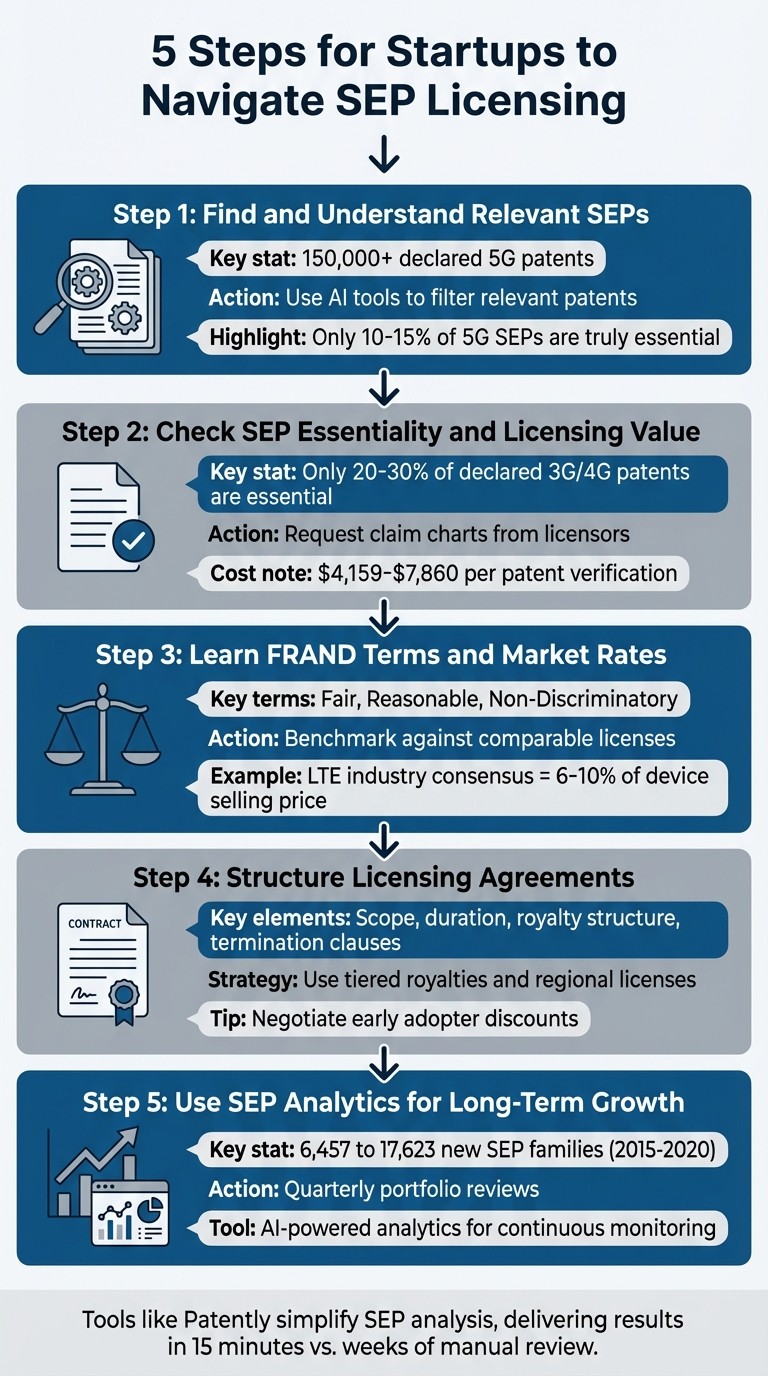
5-Step SEP Licensing Process for Startups
Step 1: Find and Understand Relevant SEPs
What SEPs Are and Why They Matter
A Standard Essential Patent (SEP) covers technologies that are critical for implementing industry standards like 5G, Wi-Fi, or Bluetooth. For startups in fields such as telecommunications, IoT, and electronics, gaining access to SEPs is a key step for entering the market and ensuring their devices work seamlessly with others. SEP holders are typically required to license these patents under Fair, Reasonable, and Non-Discriminatory (FRAND) terms. However, since terms like "fair and reasonable" can be open to interpretation, it’s crucial to confirm a patent’s essentiality before negotiating.
Use SEP Analytics to Find Licensing Opportunities
Traditional methods of researching SEPs can be both costly and time-consuming. Determining whether a single patent is truly essential might cost around $10,000, and in one case, reviewing 700 SEPs for the MPEG standard ended up costing about $5.25 million in litigation fees. For most startups, such expenses are simply out of reach.
AI-powered tools like Patently offer a more efficient solution. These platforms use semantic search and advanced AI algorithms to compare your technology against standard specifications in a matter of minutes, rather than weeks. Patently’s True Essentiality filter is particularly useful for cutting through the clutter of over-declared patents. Research shows that many patents labeled as SEPs may not actually meet the essentiality criteria.
"Not all declared patents are essential and not all essential patents are declared. Both described scenarios show that patent declaration data needs refinement, filtering, extrapolation and a neutral and objective SEP determination."
– Tim Pohlmann, Ph.D., Managing Director Americas, LexisNexis Intellectual Property Solutions
Take a 5G device as an example. Patently’s SEP analytics can narrow down over 150,000 declared 5G patents to those specifically relevant to User Equipment (UE) functionalities, such as antennas or power management. It eliminates patents tied only to network infrastructure, which may not be relevant to your product. This targeted approach helps you pinpoint the companies holding the patents you need to license, while steering clear of irrelevant portfolios. This process sets the stage for assessing the essentiality and licensing value of these patents in the next phase.
Step 2: Check SEP Essentiality and Licensing Value
How to Verify Patent Essentiality
Once you've identified relevant SEPs, the next step is confirming their essentiality. Organizations like ETSI and IEEE provide databases of declared patents, but they don't verify these claims - patent holders themselves declare their patents as potentially essential. Interestingly, research indicates that only 20% to 30% of declared 3G and 4G patents qualify as essential, and this figure drops to just 10% to 15% for 5G.
Why does this matter? Because essentiality directly impacts licensing costs. To avoid overpaying, request claim charts from licensors during technical discussions. These charts link specific patent claims to sections of the technical standard, proving that each claim is necessary for compliance. While creating these charts can cost between $4,159 and $7,860 per patent and take 14–27 hours, the investment ensures you’re not paying royalties on nonessential patents.
"SEP determination is complex and too often subject to systematic bias."
– Tim Pohlmann, Ph.D., Managing Director Americas, LexisNexis Intellectual Property Solutions
Once essentiality is verified, focus on aligning the SEP portfolio with your technology and market needs. Tools like Patently’s True Essentiality filter, which combines AI and expert reviews, can help weed out over-declared patents. A strong indicator of essentiality is whether the patent’s inventors were involved in standard-setting groups - studies show that patents are 2.6 times more likely to be essential when inventors participate in these groups. Additionally, it's crucial to differentiate between User Equipment (UE) and non-UE claims to confirm the patent applies to your specific product type.
Analyze Licensing Opportunities
With essentiality confirmed, the next step is evaluating how the SEP portfolio aligns with your product’s standards and market strategy. Start by mapping the technical standards your product uses, the related features, and the countries where you operate. This is key since patents are enforceable only in jurisdictions where they’re granted.
Portfolio ownership is another factor to review. If subsidiaries or affiliates are controlled by a single parent company, this could impact negotiation dynamics. For large portfolios, statistical sampling is a practical approach. Reviewing at least 100 patent families or 10% of the portfolio can give you a reliable estimate of the true essentiality rate, without the need to verify every patent individually.
Take the TCL v. Ericsson case from December 2017 as an example. Ericsson claimed it held 112 SEPs out of 1,796 (7.5%), while TCL argued Ericsson’s share was only 70 SEPs out of 1,673 (4.7%). The U.S. District Court for the Central District of California ultimately determined Ericsson’s share to be 5% of the aggregate royalty rate. This case highlights the importance of understanding the licensor’s actual share of the overall SEP stack - often referred to as the "denominator." Knowing this helps calculate fair rates and avoid "royalty stacking", where inflated portfolios lead to excessive cumulative royalties.
Step 3: Learn FRAND Terms and Market Rates
Understanding FRAND Terms
FRAND stands for Fair, Reasonable, and Non-Discriminatory - a promise made by SEP (Standard-Essential Patent) holders to Standards-Setting Organizations (SSOs). This commitment ensures that once their patents are essential to a standard, they can’t exploit their position unfairly. For startups, understanding FRAND is crucial because it protects you from being held hostage by patent holders after you've committed to using their technology.
Here’s what FRAND means in practice:
Fair: No forced bundling of patents or exclusivity requirements.
Reasonable: Royalties that reflect the value of the technology without stifling competition.
Non-Discriminatory: Equal treatment for companies in similar situations.
Why does this matter? The stakes are huge. By 2013, FRAND commitments were referenced in legal cases and academic discussions 10 times more often than in 2003. And with patent litigation costs ranging from $1 million to $6 million, knowing your rights under FRAND can save your startup from overpaying or getting dragged into costly disputes. In the U.S., FRAND commitments are often treated as legally binding contracts, giving your startup enforceable rights as a third-party beneficiary.
Understanding these licensing terms is key to negotiating agreements that are both fair and cost-effective. It’s also why benchmarking against market data is so important.
Use Market Data for Negotiations
Once you’ve grasped FRAND principles, the next step is to use market data to benchmark licensing rates. The best way to do this? Analyze comparable licenses - agreements made by companies in similar situations. This helps you identify the "going rate" for licenses in your industry.
There are two main approaches to establishing fair rates:
Top-down approach: Start with the total royalty for an entire standard (e.g., the industry consensus for LTE is 6% to less than 10% of a device’s selling price). Then, allocate a portion to the licensor based on their share of essential patents.
Comparable asset transaction method: Look at past deals involving similar patents. For instance, in the 2017 TCL v. Ericsson case, the court determined Ericsson’s share of the LTE royalty rate was 5%, which translated to 0.02% to 0.5% of a handset’s average selling price.
Market data often appears in different forms like lump sums, cross-licenses, or balancing payments. Break these down to find the effective rate. For example, in InterDigital v. Lenovo, the court awarded a royalty of $0.175 per phone. You can also validate rates using a "price premium" analysis. When Samsung launched the Galaxy A51 with 5G, it was priced at $500 - $101 (or 25%) more than the identical 4G version at $399. That $101 difference highlights the added value of 5G technology.
"Analysing comparable contracts should reveal the 'going rate' that market participants agreed was reasonable for licences in their specific circumstances."
– Pekka Sääskilahti and Andrew Tuffin, Compass Lexecon
If your startup operates in specific regions, consider negotiating a regional license instead of a global one. This is especially useful if the licensor has limited active patents in your target markets. Tools like Patently's SEP analytics can help you dig deeper, showing the total number of declared SEPs for a standard, the licensor’s proportional share, and which patents are enforceable in your region. Also, keep an eye out for "early adopter" discounts - licensors often offer lower rates to early signers to create positive momentum in the market.
Step 4: Structure Licensing Agreements
Main Parts of a Licensing Agreement
Creating a licensing agreement that safeguards your startup and keeps costs manageable is crucial. This isn't just about negotiating royalty rates - it’s about building flexibility into the agreement so it evolves alongside your business.
Start by clearly defining the scope of use. This includes specifying the territories where the license applies, the products or services it covers, and any restrictions on how it can be used. For instance, if your startup operates only in the U.S. and Europe, negotiate a regional license instead of paying for worldwide rights. This simple adjustment can save you a significant amount of money. Additionally, the agreement should outline the financial structure, including royalty rates, payment schedules, upfront fees (if applicable), and audit rights to ensure transparency as your business grows.
Another critical component is the duration and renewal clauses. These should include triggers for renegotiation, allowing you to adjust terms if the value of the intellectual property changes or as your company crosses key milestones. Consider incorporating reopener clauses, which let you revisit terms mid-contract if your market share expands or the technology evolves. For example, if your sales triple in the second year, a reopener clause ensures you're not stuck overpaying based on outdated forecasts.
Don’t forget to address termination and exit paths. These clauses, along with dispute resolution methods like mediation or arbitration, give you an escape route if the technology doesn’t meet expectations or if the licensor fails to deliver on their obligations. This is especially vital when dealing with untested or high-risk technology. And since you’re working with SEPs (Standard Essential Patents), make sure all terms comply with FRAND (Fair, Reasonable, and Non-Discriminatory) commitments.
Once you’ve structured the agreement, the next step is negotiating terms that align with your startup’s growth and cash flow.
Negotiate Terms That Work for Startups
A well-structured agreement is just the starting point. To truly support your startup’s financial health, tailor the licensing terms to fit your growth strategy and cash flow.
One effective approach is using tiered royalty structures. Start with lower rates that increase as you hit specific revenue milestones. This approach protects your margins during the early stages when funds are tight, while rewarding licensors as your business scales. Another option is usage-based pricing, where payments are tied to performance or sales volume. This reduces upfront financial pressure and ensures you only pay as your revenue grows. For instance, instead of a fixed annual fee, negotiate a per-unit royalty that activates only after you begin shipping products.
"Usage-based pricing... reduces your upfront risk and aligns cost with return."
– PatentPC
Minimizing upfront fees is another way to preserve cash flow. While licensors often favor these payments as a sign of commitment, they can strain your resources early on. Instead, negotiate for smaller upfront fees paired with higher running royalties. If the licensor insists on an upfront payment, you might propose a minimum royalty guarantee - a baseline payment that ensures they’re compensated without depleting your reserves.
You can also request early adopter discounts. SEP owners are often willing to offer lower rates to companies that finalize agreements quickly, as it reduces their own litigation and transaction costs. Lastly, include "use-it-or-lose-it" terms. These allow you to cancel or renegotiate the agreement if your sales don’t meet certain benchmarks. This ensures you’re not locked into a costly contract for technology that doesn’t deliver the expected results.
Step 5: Use SEP Analytics for Long-Term Growth
Monitor SEP Portfolios Regularly
After finalizing your licensing agreement, the journey doesn’t end there. Keeping a close eye on SEP portfolios is essential to remain aligned with the ever-changing market. The SEP landscape is dynamic - new patents are filed, ownerships shift, and litigation trends evolve. For example, between 2015 and 2020, the number of new SEP families in telecommunications skyrocketed from 6,457 to 17,623. Since 2015, over 150,000 patents have been declared for the 5G standard. Monitoring these developments allows you to proactively manage risks and adjust royalty budgets before challenges arise.
Establish a quarterly review process to stay on top of critical changes. Pay particular attention to ownership transitions, especially when Patent Assertion Entities (PAEs) acquire portfolios, as this often signals potential litigation risks. Analytics can also help you identify "subsequent art" - instances where other companies build on your existing portfolio - which could open up new licensing opportunities. Additionally, conducting regular audits ensures you focus on high-value assets while removing outdated patents, streamlining your monetization and cross-licensing efforts.
Since not all declared patents are essential, it’s vital to apply rigorous filters for accurate assessments. Keep an eye out for "undeclared patents" - those that are technically essential but haven’t been officially declared to standards bodies. These can present both risks and opportunities, depending on your position in negotiations. By combining regular reviews with AI-driven analytics, you can simplify long-term monitoring and make more informed decisions.
Use Patently for Continuous Analytics
With billions of patent claims and standard section combinations in ETSI data, manually analyzing SEP portfolios is nearly impossible. That’s where Patently License with Questel comes into play, offering access to "true essentiality" data that has been manually verified by technical experts. This process eliminates non-essential patents, giving you a clearer understanding of your exposure and its impact on your bottom line.
"Get your forecasts right today by accessing SEP true essentiality on Patently License with Questel."
– Patently
Patently’s AI-powered tools, like Patently Know, help uncover relationships within patent families and assess the complete "SEP stack" for specific technologies. This insight clarifies your market share and exposure, particularly as the industry begins its shift toward 6G. Early planning with these tools can position you to manage future budgets and adapt to upcoming standards. By integrating continuous analytics into your processes, you can turn SEP data into a powerful, long-term strategic resource.
How to Use Standard Essential Patent Data for a FRAND Defense Strategy
Conclusion
Startups need to dig deeper than surface-level SEP declarations and focus on what truly drives success. By applying the five steps outlined here - identifying relevant SEPs, verifying essentiality, understanding FRAND terms, structuring agreements, and maintaining continuous monitoring - you can turn a complex licensing process into a strategic advantage. These steps lay the groundwork for transforming a challenging legal landscape into a competitive tool.
In practical terms, Patently License with Questel simplifies the licensing process by offering manually verified "true essentiality" data. This eliminates much of the guesswork and helps reduce costs. Thanks to AI-driven tools that deliver detailed SEP analyses in just 15 minutes, startups no longer need sprawling legal teams to stay competitive during licensing negotiations.
"Patently License with Questel provides a complete understanding of who owns what and where, so you can get to the right answers... not all of the SEPs are truly essential, affecting how much you should pay and how much you should ask." – Patently
With over 150,000 declared 5G patents since 2015 and ongoing progress toward 6G, strategies must evolve alongside these market shifts. Regular portfolio monitoring and data-driven decisions are key to staying ahead. By following these targeted steps, startups can better manage risks, uncover new licensing opportunities, and align royalty budgets with real-world market conditions.
With expert-reviewed data and AI insights at your disposal, you can make confident, financially sound decisions - whether you're negotiating your first licensing deal or optimizing an established portfolio.
FAQs
How do I know which SEPs my product actually needs?
To figure out which Standard Essential Patents (SEPs) your product requires, start by performing an essentiality assessment. This process ensures that the patents claimed as essential are genuinely necessary for the technical standards your product adheres to. Over-declaring patents can inflate costs unnecessarily.
SEP analytics tools, such as Patently, can be a game-changer here. These tools help you zero in on the patents that truly matter, cutting down risks and ensuring your licensing efforts are directed at genuinely essential patents. This approach not only saves resources but also strengthens your position during licensing negotiations.
What should I ask for to prove a patent is truly essential?
To verify if a patent is essential, you can request an essentiality check or certification. This process involves analyzing the patent's claims to determine if they are necessary for implementing a specific standard. The evaluation may be conducted through objective methods or AI-driven analysis, ensuring the patent is truly integral to the standard's implementation.
How can I estimate a fair FRAND royalty before negotiating?
To estimate a fair FRAND royalty, start by examining comparable license agreements. Look at existing deals within the same industry to understand typical terms and rates. Next, delve into industry benchmarks to identify standard practices and prevailing royalty rates for similar technologies. Finally, perform region-specific essentiality assessments to account for variations in market dynamics, legal frameworks, and patent portfolios in different areas. Together, these steps provide a solid foundation for negotiating equitable licensing terms.