Ultimate Guide to Startup Patent Portfolio Management
Intellectual Property Management
Feb 20, 2026
Guide for startups to build, file, and manage patent portfolios—prioritize inventions, use provisional filings and AI tools, prune assets, and plan global protection.

Your patent portfolio is more than just legal paperwork - it’s a tool for growth. Patents can protect your innovations, attract investors, and even generate revenue. But managing them poorly can lead to costly mistakes. This guide breaks down how to build, file, and maintain patents effectively, with practical tips for startups:
Set clear goals: Align patents with business objectives like funding, market entry, or licensing.
Prioritize key inventions: Protect innovations with commercial impact and long-term relevance.
Use provisional patents: Secure early filing dates with lower upfront costs.
Leverage AI patent tools: Save time and money on drafting and prior art searches.
Conduct regular reviews using AI-enabled patent analysis: Prune outdated patents to cut costs and focus on high-value assets.
Plan international filings wisely: Focus on high-revenue markets and manage maintenance fees.
With proper management, patents can shield your innovations and drive your startup’s success.
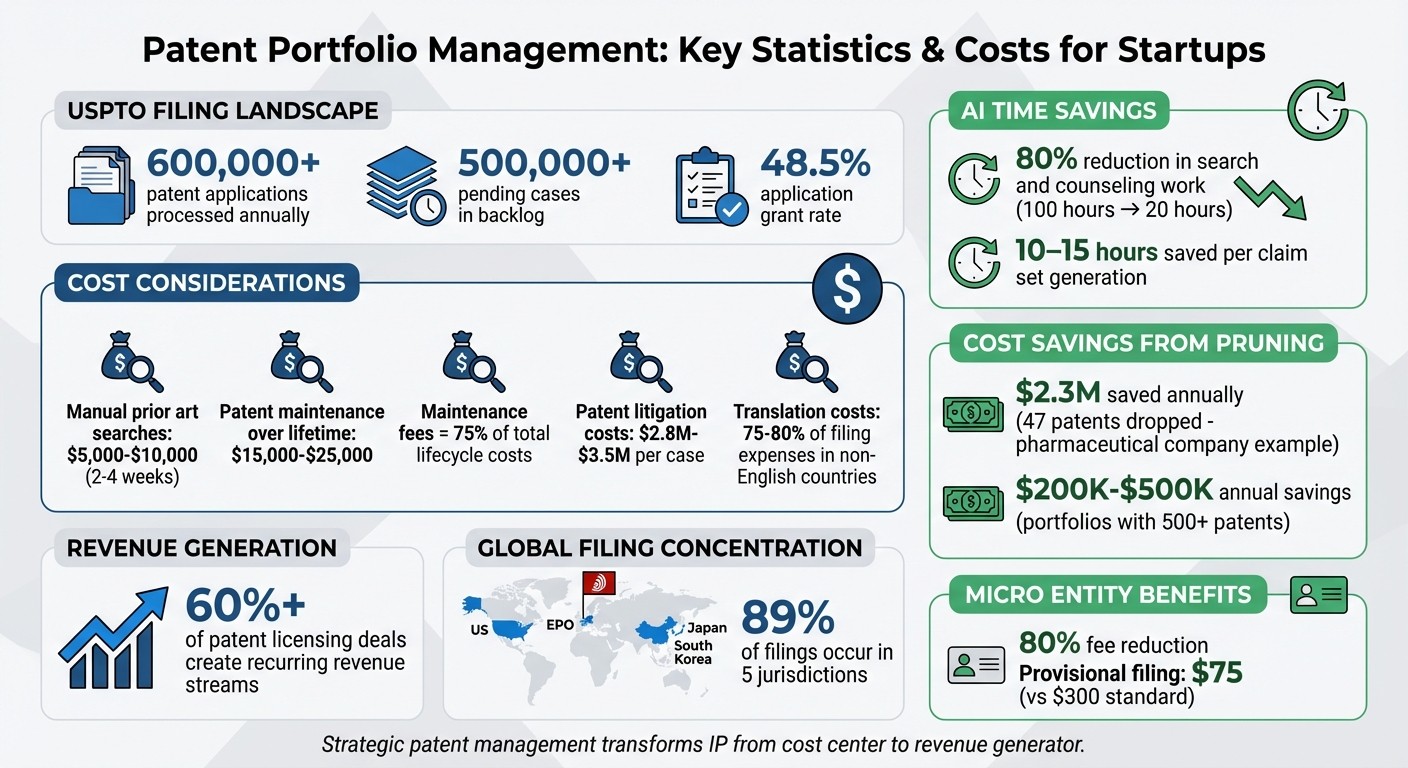
Patent Portfolio Management: Key Statistics and Cost Savings for Startups
Startup Secrets: Insider Guide to Patents
Building a Patent Portfolio That Supports Your Business
Think of your patent portfolio as a financial asset - every patent should earn its keep by contributing to revenue, strengthening your market position, or helping you achieve funding goals.
Setting Patent Goals That Match Your Business
Start by defining how patents fit into your overall business strategy. A well-planned portfolio can serve three main purposes: offensive (generating licensing income or blocking competitors), defensive (ensuring your freedom to operate), or marketing (showcasing innovation to attract investors and partners). For example, a biotech startup might focus on defensive patents around its core compound to reassure investors, while a SaaS company could prioritize offensive patents for customer-visible features.
Your patent strategy will shift as your business grows. Early-stage startups often focus on securing priority dates while their products are still evolving. As you move into the growth stage, expanding internationally and protecting brand assets become key priorities. Later-stage companies may streamline their portfolios, dropping patents that no longer align with revenue goals and ensuring clear IP ownership for M&A due diligence. To keep your approach relevant, conduct biannual reviews to align your IP strategy with business changes.
Build a dedicated patent team that includes a business leader, legal counsel, and technical experts. This team should tie patent filings to specific milestones, such as achieving product-market fit, raising funds, or entering new markets. Additionally, make sure all co-founders, employees, and contractors have signed agreements assigning their inventions to the company. Ownership gaps discovered during fundraising can derail potential deals.
Once you’ve defined your patent goals, the next step is deciding which inventions to prioritize.
Choosing Which Inventions to Patent First
With your strategic goals in place, focus on selecting inventions that provide real value. These should align with the offensive, defensive, or marketing roles you’ve identified earlier.
Avoid filing patents for inventions without clear commercial impact, novelty, or enforceability. Prioritize inventions based on detectability - can you spot infringement by examining a competitor’s product? External-facing features, like user interfaces or hardware designs, are often easier to enforce than internal algorithms. Target inventions that leave competitors with few viable workarounds, ideally addressing broader industry challenges rather than niche product-specific issues.
Protect features tied to customer-visible benefits, especially those that offer measurable improvements in speed, cost, or efficiency. For instance, if your machine learning model improves inference times by 40% compared to industry benchmarks, and that performance matters to customers, it’s worth protecting. Such patents can also force competitors to replicate your approach.
Consider the long-term relevance of an invention. If the technology will likely become obsolete within 18 months, it might not justify the cost of filing. Align your filing schedule with key product development phases - such as prototyping, launch, and feature updates - so you have protection in place before public disclosure.
For international filings, use a simple 2×2 matrix to weigh revenue potential against enforceability. Focus on high-revenue markets with strong legal systems, like the U.S., EU, and Japan. Lower-priority regions may only warrant filings if they’re manufacturing hubs for competitors or essential for strategic partnerships.
How to File Patents as a Startup
Once you've identified your key inventions, the next step is figuring out how to file patents effectively. This process is crucial, especially when you consider that the USPTO processes over 600,000 patent applications annually and is currently dealing with a backlog of more than 500,000 pending cases. A well-thought-out filing strategy can save you both time and money.
Before filing, conduct a prior art search. Use databases like USPTO, Google Patents, and Espacenet to ensure your invention is both new and non-obvious. This step helps you avoid costly rejections. Additionally, clearly define the technical problem your invention solves and document its "best mode", or the best way to implement your solution.
Starting January 17, 2024, the USPTO will require non-provisional utility applications to be submitted in DOCX format. Filing in other formats will incur a $400 surcharge ($160 for small entities and $80 for micro entities). To avoid another $400 fee, file electronically through the USPTO Patent Center. If eligible for micro entity status, you can benefit from an 80% fee reduction, bringing the cost of a provisional filing down to $75.
Using Provisional Applications for Early Protection
Provisional applications are a great way to secure your filing date under the U.S. first-inventor-to-file system. They don’t require formal claims, oaths, or prior art statements, giving you a 12-month window to refine your product, test the market, and secure funding before committing to the higher costs of a non-provisional application.
"A provisional patent application allows you to file without a formal patent claim, oath or declaration, or any information disclosure (prior art) statement." - USPTO
Provisional filing fees range from $75 to $300, depending on your entity size, while non-provisional applications can cost thousands in legal and prosecution fees. Filing a provisional also lets you use "Patent Pending" status immediately, which can help build credibility with investors and partners.
File your provisional application before any public disclosure - such as demos, sales, or presentations. While the U.S. allows a one-year grace period, many other countries require absolute novelty, meaning public disclosure before filing could void your international patent rights. Ensure your provisional is detailed; a vague description could jeopardize your priority date when transitioning to a non-provisional application.
"It is important to think of a provisional application as a method to postpone the major costs of patent prosecution, not the costs of writing the patent application itself." - Neil P. Ferraro, Shareholder, Wolf Greenfield
While drawings aren’t mandatory for provisional applications, including them is highly recommended. They help clarify your invention and cannot be added later if they introduce new material. Plan to review your application 90 days after filing to assess any product changes and decide if additional filings are needed before the 12-month window closes. When upgrading to a non-provisional application, claim the benefit of the provisional rather than converting it. Conversion starts the 20-year patent term from the provisional date, effectively shortening your patent's lifespan by a year.
Once your filing date is secure, your next challenge is drafting claims that effectively protect your invention.
Writing Claims That Are Both Broad and Specific
Claims are the backbone of your patent - they define the legal boundaries of what is protected. Courts enforce the specific language of claims, not the general idea of your invention. To maximize protection, use a layered claim structure: broad independent claims to cover the core innovation and narrower dependent claims for specific features or details. This strategy ensures that even if a broad claim is invalidated, narrower claims may still hold up.
Focus your independent claims on functional interactions rather than specific components. For instance, say "a wireless communication interface" instead of "a Bluetooth 5.0 module." Your claims must be backed by enough detail in your written description to avoid invalidation under Section 112. Before finalizing, think about three potential ways competitors might work around your invention and ensure your claims address those scenarios.
Use positive language to describe what your invention includes, avoiding negative limitations that specify what it is not. Clearly define any specialized terms either within the claims or in the detailed description to prevent ambiguity during enforcement.
To spread risk, include "bridge" claims - those that are more detailed than your broadest independent claim but less specific than your narrowest dependent claim. These claims provide fallback options during prosecution if an examiner challenges your broader claims using prior art.
While utility patents focus on function, design patents protect a product’s appearance.
When to Use Design Patents
Design patents safeguard the ornamental aspects of a product - how it looks, not how it works. They’re particularly useful for startups where visual design plays a key role in customer appeal and brand identity.
Consider filing for a design patent if your product's appearance sets it apart in the market. For example, a uniquely shaped hardware device or a software interface with distinctive visual elements could benefit from design protection. Design patents can complement utility patents by covering different aspects of the same product.
Keep in mind that provisional applications are not an option for design patents. You must file a non-provisional design application, which requires formal drawings showing the design from multiple perspectives. Design patents last 15 years from the grant date and don’t require maintenance fees, making them easier to manage than utility patents.
Using AI Tools for Patent Drafting and Research
Patent drafting and prior art searches are often time-consuming and expensive. On average, manual prior art searches cost between $5,000 and $10,000 and take two to four weeks for a single report. For startups with limited resources and tight schedules, these costs can be a major obstacle. AI-powered platforms are changing the game by acting as a "co-pilot", transforming unstructured inputs like technical notes, code snippets, and sketches into polished, professional patent documents.
The time savings are impressive. For instance, an Am Law 100 firm reported cutting the time required for complex patent search and counseling work by 80%, reducing 100 billable hours to just 20 - while maintaining the same quality of output. Similarly, a biotech company's Chief IP Counsel shared: "Right off the bat, we're saving at least 10 to 15 hours by generating high quality claim sets, and that translates directly into financial savings". By automating time-intensive tasks like formatting, initial drafting, and prior art discovery, these tools allow legal teams to focus on strategic decisions. For startups, this means staying on budget and meeting deadlines without sacrificing the quality of their patents.
Drafting Patents with Patently's AI Assistant
Patently's AI assistant, Onardo, streamlines the patent application process by turning unstructured inputs - like Slack conversations, code snippets, or short technical videos - into formal patent language. This is especially useful when engineering teams discover innovations during development sprints but lack the time or expertise to document them properly. Instead of waiting for a lengthy invention disclosure process, you can immediately capture the idea and let the AI organize it into a patent-ready format.
Onardo features a block-based Claims Composer that helps draft complex claim sets with proper hierarchical structures and antecedent bases. It ensures that independent claims are broad enough to protect the core innovation, while dependent claims cover specific implementations. The AI can also simulate a patent examiner's perspective, flagging vague language and suggesting more precise terms to lower the risk of office actions. For startups filing provisional applications, this approach generates documents that are 80% ready for non-provisional filings - saving time and preserving early filing dates at a fraction of the cost. Real-time collaboration features allow teams to review and refine drafts together, cutting down on delays.
Finding Prior Art with Semantic Search
AI-driven semantic search tools complement the drafting process by making prior art discovery more efficient. Traditional keyword searches often struggle with non-standard technical language or when similar concepts are described using different terminology. Patently's Vector AI semantic search solves this by analyzing the purpose and technical relationships of inventions, going beyond exact word matches. This conceptual approach uncovers related ideas even when described differently, reducing the chance of missing critical prior art.
The tool also identifies synonyms and related terms across multiple languages, eliminating the need to manually input every variation. For example, a search for "adaptive control systems" might also reveal patents discussing "real-time decision systems" or "dynamic optimization algorithms". This is particularly helpful for startups in emerging fields where terminology is still evolving.
"If I can give the executive team an answer in a few minutes, that's priceless. Patently makes me look good to my boss, which is always a sound investment".
A Director of IP & Litigation at a leading cybersecurity company reported using AI semantic search and claim mapping features to assess infringement risks internally, saving between $20,000 and $50,000 per case by avoiding external search vendors. Beyond patent databases, AI tools can explore non-patent literature like academic papers, GitHub repositories, conference slides, and technical blogs, offering a broader view of the prior art landscape.
When conducting searches, start with your core independent claims and run a calibration round to refine your wording based on initial results. Always manually review promising hits, as critical threats are often buried in dependent claims rather than abstracts, and AI summaries can sometimes be misleading. Use the AI's relevance scoring to prioritize high-risk references and maintain a search journal documenting dates, tools, queries, and results to demonstrate due diligence to investors and partners.
Managing Your Patent Portfolio Over Time
Once your portfolio is established, the next step is ensuring it keeps pace with your business as it grows. Early on, startups often aim to file as many patents as possible. But as your company scales, the focus needs to shift toward active management - tracking deadlines, keeping up with maintenance fees, and confirming that every patent serves a clear purpose. Without this oversight, you risk wasting money on outdated patents or missing critical renewal dates. Consistent management ensures your patent portfolio stays aligned with your evolving business goals.
Reviewing and Pruning Your Portfolio
As your business priorities shift and technologies evolve, it’s important to regularly review your portfolio to pinpoint patents that no longer serve their purpose. Considering that maintaining a patent can cost between $15,000 and $25,000 over its lifetime, cutting unnecessary patents can lead to major savings.
Start by categorizing patents into high-, medium-, and low-priority tiers based on their role in your strategy - whether they’re used for protection, generating revenue, or blocking competitors. High-priority patents often cover core technologies, bring in licensing revenue, or create barriers for competitors in key markets. On the other hand, low-priority patents might cover outdated technologies, minor innovations, or features tied to discontinued products [44,45].
Pruning decisions shouldn’t be left solely to legal teams. Bring in stakeholders from Product, R&D, Marketing, and Finance to assess the relevance of each patent against your current goals, tech lifecycle, and budget. For example, in November 2025, a major pharmaceutical company cut 47 low-value patents and saved $2.3 million annually in maintenance fees. Companies with portfolios exceeding 500 patents can save between $200,000 and $500,000 each year by adopting a similar approach.
"Pruning is not simply about reducing the number of patents; it's about selectively identifying and removing patents that no longer support the company's goals, freeing up resources to invest in high-impact IP."
Start your review process at least 18 months before renewal deadlines to allow time for thorough evaluation and stakeholder input. Use objective metrics - like forward citations, competitive blocking potential, and alignment with your roadmap - to guide decisions and reduce bias [45,48]. Document the reasoning behind any abandonment, whether due to redundancy or obsolescence, to maintain transparency for investors and auditors [47,48]. Geographic pruning is another key consideration: focus on protecting patents in high-growth or competitive regions while letting them lapse in less critical markets [44,45,48].
While streamlining your domestic portfolio, don’t overlook the importance of a well-thought-out international strategy.
Planning International Filings and Maintenance Fees
Protecting patents internationally is costly, and those expenses can add up quickly over time. The Paris Convention gives you a 12-month window from your initial U.S. filing to decide between direct national filings or the cost-deferring PCT (Patent Cooperation Treaty) route [52,54].
The majority of global patent filings - 89% - occur in just five jurisdictions: the U.S., European Patent Office (EPO), Japan, South Korea, and China. Prioritize these core markets if they align with where you sell, manufacture, or compete. The PCT route can help manage costs by deferring the high expenses of national phase entry for up to 30 months, giving you more time to secure funding or gauge market potential [52,54].
Maintenance fees represent a large share - up to 75% - of a patent’s total lifecycle costs, and they increase as the patent ages. For U.S. patents, fees are due at 3.5, 7.5, and 11.5 years after issuance. In Europe, annual renewal fees begin as early as the third year after filing. Translation costs can also be a burden, often making up 75% to 80% of initial filing expenses in non-English-speaking countries like China, Japan, and South Korea [53,54].
"Maintaining a patent can be expensive: maintenance fees account for up to 75 percent of the total estimated costs of a patent across its 20-year lifecycle."
Anthony de Andrade, President and CEO, Quantify IP
To manage these expenses, conduct regular portfolio audits - either annually or biannually - to identify patents that can be dropped in regions with low market demand or outdated technology [51,54]. In some countries, like Germany and the UK, declaring a willingness to license a patent through a "Licensing of Right" program can lead to reduced maintenance fees. Use tools like translation memory to cut costs by reusing technical terms across filings, and focus on English-speaking jurisdictions to minimize translation needs [53,54]. For routine tasks, negotiate fixed-fee arrangements with patent attorneys and renewal service providers to keep costs predictable [50,53]. Many jurisdictions also offer a six-month grace period for late maintenance payments, though this typically involves a surcharge [50,53].
Enforcement, Competitor Analysis, and Team Collaboration
Creating a patent portfolio is just the beginning - protecting and leveraging those rights is where the real work begins. This involves having a solid enforcement plan, keeping an eye on competitors, and fostering collaboration across teams. Startups often begin by defending their innovations, but as they grow, enforcement and licensing become tools to strengthen their market position. Enforcement doesn’t always mean lawsuits; often, a clear warning or reminder of licensing terms can resolve disputes quickly.
Creating Enforcement and Licensing Plans
When you suspect someone is infringing on your patent, acting quickly is crucial. Within 24–72 hours, gather evidence like screenshots, URLs, and timestamps, confirm your ownership rights, and evaluate the potential impact on your business before reaching out to the infringer. For digital startups, platform-based tools like DMCA takedowns or App Store reporting can offer fast and cost-effective solutions.
A well-written cease and desist (C&D) letter should strike the right tone - firm but professional. Clearly outline your rights and include specific examples of infringement to strengthen your position for negotiation. Litigation can be expensive, so many startups turn to licensing as a way to generate income. In fact, over 60% of patent licensing deals in the U.S. create recurring revenue streams, allowing startups to retain ownership while building a steady income.
From the start, keep an "evidence box" ready for enforcement. This should include lab notebooks, testing records, source code escrow, and claim charts that link your patent elements to industry standards. This preparation ensures you're ready for litigation if negotiations fail. Effective enforcement also requires a team with expertise spanning legal, technical, and business domains to identify risks early and execute licensing strategies effectively. Beyond enforcement, keeping tabs on competitors’ actions can further strengthen your position.
Analyzing Competitor Patents to Find Opportunities
As your patent portfolio grows, analyzing competitors’ patents can guide both enforcement and R&D efforts. This analysis can give you a strategic edge of 18 to 24 months by revealing competitors' R&D priorities and potential product launches well before they’re announced publicly. Look for key indicators like detailed implementation specs, manufacturing processes, or UI designs that often signal upcoming releases.
"The question isn't whether you can afford to invest in competitor patent analysis. It's whether you can afford not to, when your competitors are already revealing their next two years of innovation strategy in public patent databases."
Focus on pioneering patents with numerous forward citations, as they often highlight foundational technologies and influential players in your industry. Use citation network analysis to track who is referencing your patents and identify the prior art your competitors are building upon. This approach can help you uncover white space - areas of innovation with less competition and fewer risks of litigation.
To avoid costly infringement disputes, implement a phased Freedom-to-Operate (FTO) program. Start with broad scans during early R&D stages and follow up with targeted legal opinions before launching a product. Additionally, consider a 90-day plan: spend the first 30 days identifying top competitors, the next 30 analyzing filing trends, and the final 30 adjusting your R&D roadmap based on your findings. These insights not only shape enforcement strategies but also guide future patent filings, ensuring your portfolio remains a valuable business tool.
Working Across Teams to Manage Your Portfolio
A well-coordinated internal approach ensures that enforcement, competitor insights, and portfolio management work together seamlessly. Assign a specific role - like General Counsel, COO, or founder - to oversee your IP strategy and align it with your broader business goals. Centralized visibility is crucial: use a single, searchable dashboard to connect legal, R&D, and business teams, allowing them to track filing statuses, renewal deadlines, and market readiness in real time.
Integrate IP management into your existing workflows. Legal teams should participate in product roadmap discussions to identify patentable features early, while marketing teams should consult legal before launching new brands to avoid trademark conflicts. Simplify the process for engineers by using a short-form Invention Disclosure System (IDS) template to report new methods, processes, or systems. To encourage innovation, consider a balanced incentive program that rewards inventors at both the filing stage and when the patent generates revenue.
Establish a triage board for reviewing invention disclosures, with representatives from legal, R&D, and business teams. This ensures that decisions to file patents consider both technical novelty and commercial potential. Training is another key element: engineers should learn to identify patentable ideas, while commercial teams need to understand how to avoid unintentional rights loss through public disclosures.
Conclusion
Building and managing a patent portfolio is an ongoing process that starts at the moment of invention and continues until your patents expire or are abandoned. The difference between startups that thrive and those that falter often lies in how actively they manage their intellectual property - treating patents as tools for growth rather than just legal protections.
Every decision about filing should tie directly to your business goals, whether it's securing funding, launching a product, or entering a new market. Regular audits are key to ensuring your portfolio stays aligned with market demands. As Ellyar Barazesh from Baker Botts aptly states:
"Patent portfolio management starts at the inventive stage and doesn't end until a patent is no longer active".
The data backs up the importance of strategic management. In the U.S., patent litigation costs range between $2.8 million and $3.5 million per case, and only about 48.5% of USPTO applications result in granted patents. On the flip side, over 60% of patent licensing deals generate recurring revenue streams, turning intellectual property into a potential profit center.
Modern tools are changing the game for startups navigating this complexity. Platforms like Patently simplify the process with features like AI-assisted drafting via Onardo, semantic search using Vector AI, and centralized dashboards that keep legal, R&D, and business teams aligned. These tools replace outdated spreadsheets and help startups move from reactive to predictive portfolio management.
But tools are just one piece of the puzzle. Startups that succeed take a multi-layered approach, combining utility patents, design patents, trademarks, and trade secrets to build a strong competitive moat. They strategically prune their portfolios at renewal milestones, maintain evidence boxes from the beginning, and use data-driven insights to outpace competitors. By treating your patent portfolio as a strategic asset, you can safeguard your innovations and open the door to future growth opportunities.
FAQs
How many patents should a startup file in year one?
The number of patents a startup should file in its first year varies based on its industry, the technology it’s working on, and its long-term goals. The key is to prioritize quality over quantity. Typically, filing between 1 to 5 patents for your most important innovations is a good starting point, especially if they align with major business milestones.
Begin with provisional applications to lock in early filing dates, giving you time to refine your ideas. Then, within 12 months, transition to non-provisional applications to secure full protection. This strategic approach helps safeguard your critical assets without overspending on unnecessary filings.
When should I file a PCT instead of filing directly abroad?
Filing a PCT application can be a smart move if your startup needs extra time to explore international markets and fine-tune its global approach. The PCT process secures your priority date and gives you up to 30 months to choose the specific countries where you want protection. This extended timeline allows you to delay significant expenses, evaluate market opportunities, and adjust your plans during critical stages like product development or fundraising.
What documents should I keep for patent enforcement later?
To gear up for patent enforcement, maintain thorough, organized records that establish ownership and document the invention's development process. Key paperwork to keep includes signed agreements, date-stamped drafts, filing certificates, ownership contracts, and usage rights documentation. These records play a crucial role in safeguarding your rights and bolstering your case during audits, legal disputes, or enforcement efforts.