Contextual Relevance in Semantic Patent Search
Intellectual Property Management
Feb 21, 2026
How contextual relevance and vector-based semantic search improve patent prior art retrieval, boost precision, and cut research time dramatically.
Patent searches are evolving. Traditional keyword searches miss critical results due to language variability and ambiguity. Here's the solution: contextual relevance. By focusing on meaning rather than words, semantic search improves accuracy, saves time, and bridges gaps in terminology.
Key Takeaways:
Keyword searches fall short: Only 29% of results are relevant, with drastic variations (87% for solid-state batteries vs. 11% for eVTOL aircraft).
Context matters: Semantic systems understand intent, identifying similar concepts like "autonomous vehicle" and "self-driving car."
AI-powered patent tools save time: Search durations drop from 10–15 hours to 2–4 hours.
Improved precision: Semantic search ranks results by relevance, reducing irrelevant matches.
Semantic patent search combines natural language processing and vector AI to deliver more precise and efficient results, transforming how professionals handle patent research.
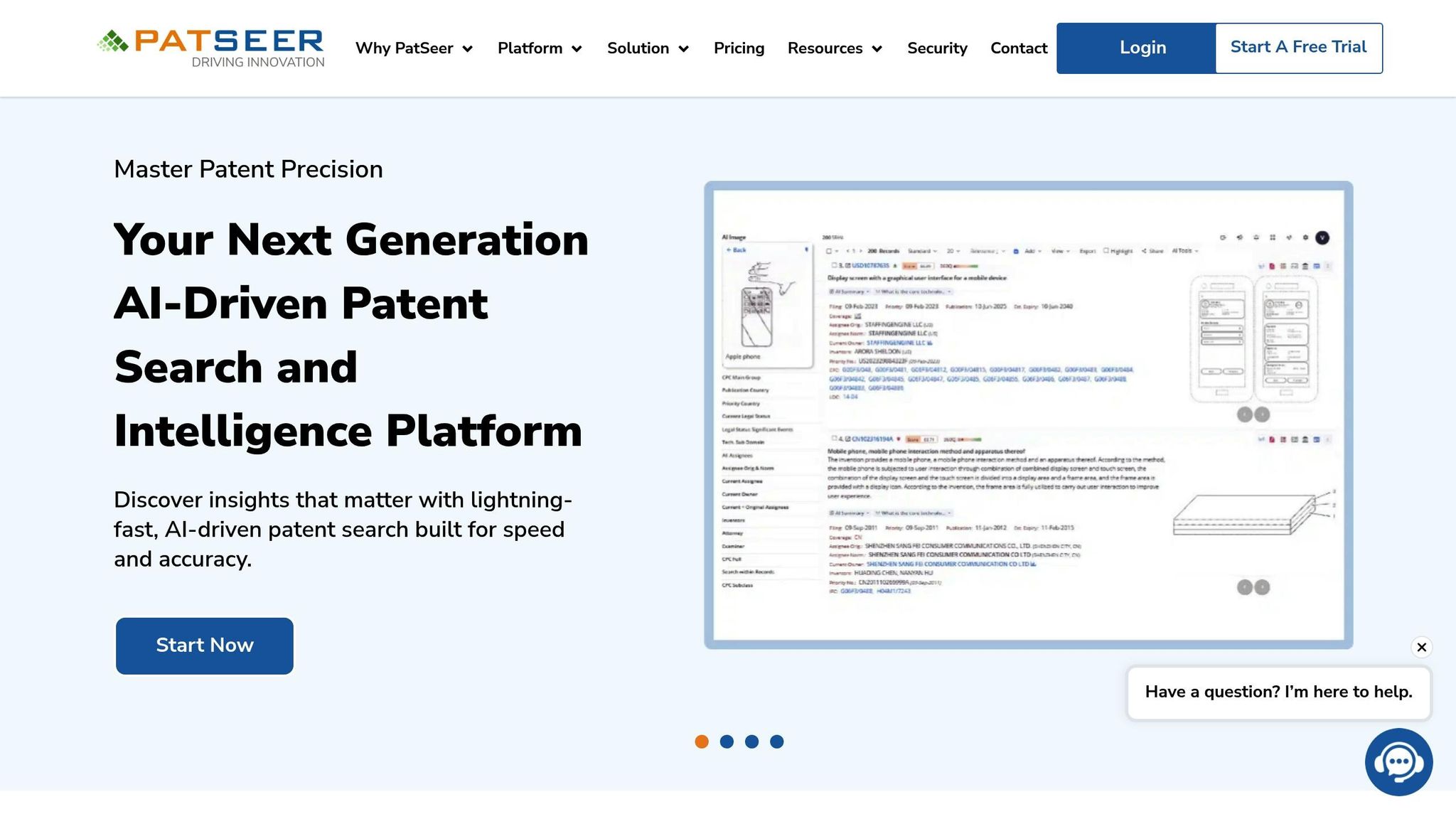
Understanding PatSeer's AI Patent Search: A Guide to LLM-Driven Technology
Limitations of Keyword-Based Patent Search
Grasping these limitations highlights why contextual relevance is crucial in semantic patent searches. Traditional keyword-based methods often fall short, creating hurdles that semantic approaches aim to address.
Missing Context and Semantic Understanding
Keyword searches treat terms as isolated units, ignoring how words relate to each other or the intent behind a query. This makes it difficult for the system to differentiate between multiple meanings of the same word in different technical fields. As INTERGATOR points out, "Keywords are analyzed in isolation without considering their meaning or relationships".
Take the word "mold", for instance. In microbiology patents, it might refer to fungal growth, while in manufacturing, it describes a tool used in processes like 3D printing. A keyword search lumps both contexts together, leaving researchers to sift through irrelevant results. The USPTO Patent Public Search system further illustrates this issue - it won’t process a query if a single term generates more than 20,000 matches.
Adding to the challenge, patent drafters using AI patent drafting tools often use varied phrasing to set their inventions apart from prior art. For example, a search for "battery-driven car" might miss patents describing the same concept as "autonomous vehicle". Beyond context, keyword searches also struggle with synonyms and language barriers.
Overlooked Synonyms and Cross-Language Issues
Keyword searches demand that researchers predict every possible synonym, technical variation, or related term. This is not only time-consuming but often leads to incomplete results. For example, searching for "wireless data transmission" might fail to retrieve patents that refer to the same idea as "radio frequency communication methods".
Using wildcards to account for variations, such as "compUsing wildcards to account for variations, such as "comp$", can flood the results with irrelevant matches like "compost", "complex", or "composition" [13]. Additionally, the USPTO system has limits on numeric modifiers, refusing to process queries if they exceed 125 combinations [13].quot;, can flood the results with irrelevant matches like "compost", "complex", or "composition". Additionally, the USPTO system has limits on numeric modifiers, refusing to process queries if they exceed 125 combinations.
Language is another major roadblock. Keyword searches are inherently language-specific, meaning patents in other languages might be overlooked unless researchers manually include translated terms. While semantic AI can bridge this gap by recognizing concepts across languages, traditional keyword systems lack this capability. Modern platforms now offer AI-enabled patent analysis to overcome these traditional search hurdles.
How Contextual Relevance Improves Semantic Patent Search
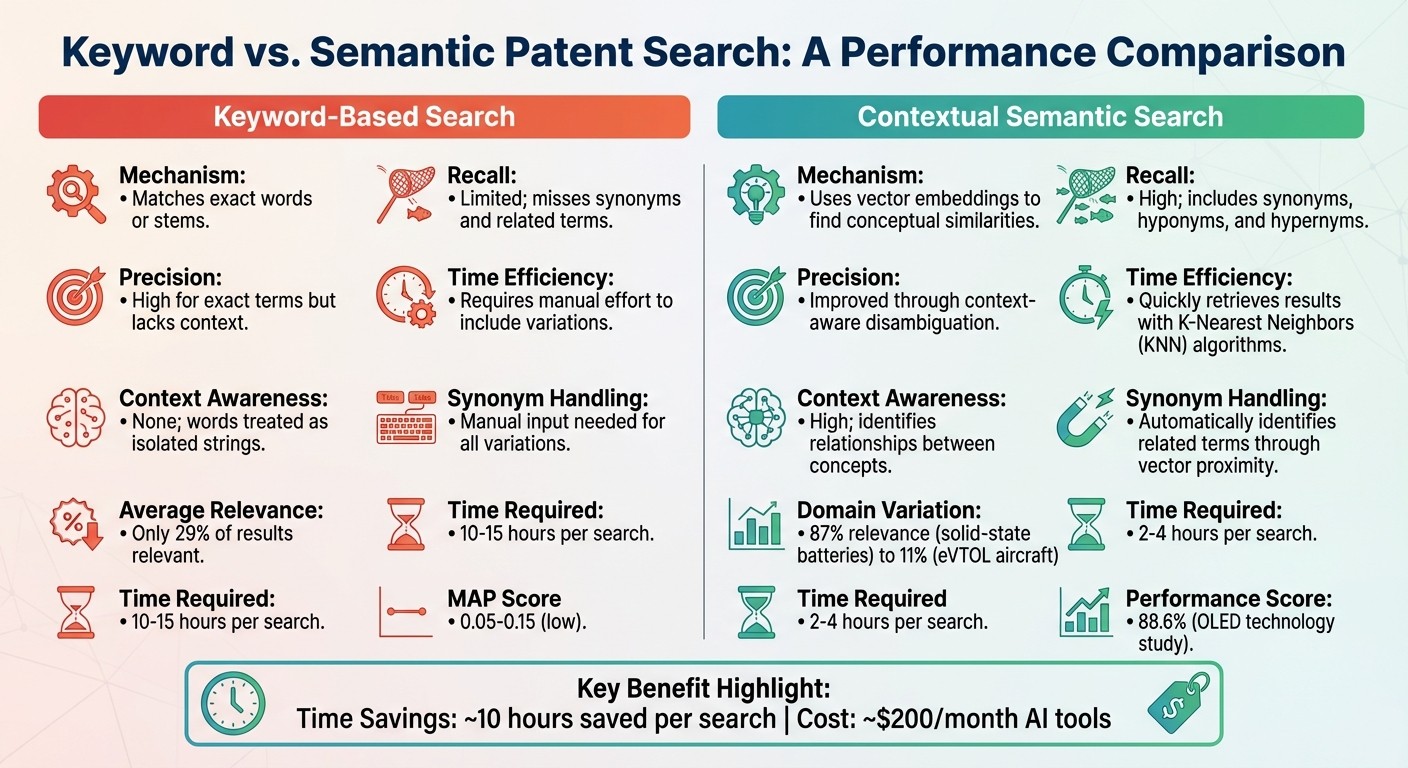
Keyword vs Semantic Patent Search: Performance Comparison
Semantic search transforms patent text into vectors that focus on meaning rather than just matching characters. By using domain-specific training, such as models like fastText and word2vec applied to technology-specific datasets, synonym recognition improves dramatically. For instance, in the optics field, integrating a crowdsourced feedback loop boosted the F1 score for suggested terms from 0.08 to 0.609.
Semantic Entity Analysis and Vector Embeddings
Domain-specific training is just the start - vector embeddings take precision a step further by breaking down patents into technical entities. These entities are then mapped into a conceptual space where related ideas naturally cluster. This approach helps differentiate identical terms used in different contexts. For example, "mold" in microbiology has a completely different meaning from "mold" in 3D printing. Using technology-specific datasets, like those categorized by Cooperative Patent Classification (CPC) codes, ensures that the context is preserved .
Advanced systems can even calculate a centroid from multiple vectors. For example, when terms like "lens", "optic", and "microlens" are combined, the AI identifies a central point in the vector space. This centroid then helps pinpoint related terms and concepts. A USPTO pilot study demonstrated the effectiveness of this method, allowing patent examiners to refine AI suggestions by up-voting or down-voting them, enhancing the semantic accuracy of searches.
"Patent terminology is often domain specific. By curating technology-specific corpora and training word embedding models based on these corpora, we are able to automatically identify the most relevant expansions of a given word or phrase."
– Arthi Krishna, Patent Examiner, USPTO
This refined precision directly benefits patent professionals, making tasks like prior art searches and invalidity studies more efficient and accurate.
Query Expansion and Conceptual Matching
Query expansion helps tackle vocabulary mismatches by automatically including synonyms, hyponyms (e.g., "sodium chloride" as a narrower term), and hypernyms (e.g., "salt" as a broader term). For example, a patent application claiming a broad category like "salt" might be invalidated by prior art that discloses a specific type, such as "sodium chloride".
By measuring distances in vector space, semantic search retrieves related documents even when they lack shared keywords. This is especially useful for identifying emerging technical terms - those "bleeding edge" phrases that haven't yet been standardized in dictionaries or thesauri. This conceptual matching overcomes the limitations of traditional keyword searches, offering a more precise and comprehensive way to retrieve relevant patents.
Keyword Search vs. Semantic Search Comparison
The differences between traditional keyword-based search and semantic search are striking:
Metric | Keyword-Based Search | Contextual Semantic Search |
|---|---|---|
Mechanism | Matches exact words or stems | Uses vector embeddings to find conceptual similarities |
Recall | Limited; misses synonyms and related terms | High; includes synonyms, hyponyms, and hypernyms |
Precision | High for exact terms but lacks context | Improved through context-aware disambiguation |
Time Efficiency | Requires manual effort to include variations | Quickly retrieves results with K-Nearest Neighbors (KNN) algorithms |
Context Awareness | None; words treated as isolated strings | High; identifies relationships between concepts |
Synonym Handling | Manual input needed for all variations | Automatically identifies related terms through vector proximity |
Traditional information retrieval methods for prior art searches often report low Mean Average Precision (MAP) scores, typically between 0.05 and 0.15. Semantic search significantly improves these metrics by analyzing the relationships between concepts, rather than treating words as disconnected strings.
Technologies Behind Contextual Relevance
This section dives into how natural language processing (NLP) and vector-based AI systems address the limitations of traditional keyword matching in patent searches. These technologies enable a deeper semantic understanding by converting patent text into vectors that represent meaning, rather than relying solely on matching strings of characters.
Natural Language Processing and Word Embeddings
NLP allows search systems to assign multi-dimensional vector values to patent text, enabling a shift from basic word matching to a more nuanced semantic interpretation. However, general-purpose NLP models often falter when dealing with the highly specialized and legal language used in patents. To overcome this, domain-specific models like PatentSBERTa are fine-tuned with patent claims and abstracts. This tuning is essential because patents often use broad, unconventional terminology to maximize claim scope, making exact keyword matches unreliable.
In February 2025, researchers at North Dakota State University's Department of Transportation and Supply Chain conducted a study evaluating 10 machine learning and NLP models. Their goal was to filter a database of 9.6 million patents, focusing on 4,214 patents across five domains: solid-state batteries, EV chargers, connected vehicles, eVTOL aircraft, and LiDAR sensors. The study applied techniques such as lemmatization and t-SNE dimensionality reduction. Results showed that supervised models outperformed unsupervised clustering, effectively handling the 71% average "noise" present in traditional keyword searches.
The reliability of keyword searches varies significantly by domain. For example, in the solid-state battery sector, 87% of keyword matches were relevant, while in the eVTOL aircraft domain, only 11% were accurate. This stark difference underscores the importance of domain-adapted NLP systems, which can grasp that "mold" in microbiology has a completely different meaning than "mold" in 3D printing.
Advanced NLP systems also incorporate global context by linking patents to their citation networks and technical classification hierarchies. This approach captures the broader relationships within patent data, avoiding the pitfalls of focusing solely on local context. For example, PatentSBERTa achieved an F1 score of 66% in predicting Cooperative Patent Classification (CPC) subclasses, outperforming earlier text-based models.
These advances in NLP are further enhanced by vector AI, which takes semantic understanding to the next level by representing entire documents as mathematical vectors.
Vector AI and Thematic Relevance
Vector AI translates patent documents into numerical vectors that exist in multi-dimensional space. The similarity between two patents is determined by the distance between their vectors, eliminating the need for shared keywords. Algorithms like K-Nearest Neighbors (KNN) then identify the most relevant documents by locating the closest vectors.
Google’s context vector system exemplifies this approach. It uses domain-specific term lists, typically containing 40 to 50 terms, to identify subject matter. In more complex fields, these lists can expand to as many as 300 terms. The vocabularies used in these models are massive, ranging from 300,000 to 800,000 entries - on par with comprehensive dictionaries or encyclopedias.
"RankBrain uses artificial intelligence to embed vast amounts of written language into mathematical entities - called vectors - that the computer can understand."
– Bloomberg
Thematic relevance is further enhanced through phrase graphs, which map patents to their citation networks. This method provides a broader "global context", enabling AI systems to understand a technology’s place within the larger patent ecosystem rather than just analyzing isolated terms. By combining traditional keyword indexing for speed with AI embeddings for semantic depth, these systems deliver search results that are both quick and intelligent.
Benefits of Contextual Relevance for Patent Professionals
When it comes to patent searches, contextual relevance powered by AI isn't just a technical upgrade - it's a game-changer. Here's how it directly improves the work of patent professionals.
Improved Accuracy in Patent Searches
Contextual relevance bridges vocabulary gaps that often complicate patent searches. AI-driven semantic search relies on vector embeddings to find documents with similar meanings, even if the keywords are entirely different. This kind of conceptual matching sharpens the precision of novelty and freedom-to-operate searches. It also breaks down language barriers, retrieving relevant patents from around the globe.
A standout feature is its ability to distinguish between multiple meanings of the same word based on context. For example, it can tell whether "horse" refers to an animal, a carpenter's tool, or gymnastic equipment. In one study focused on OLED technology, AI semantic search delivered an 88.6% performance score for the top 10 results, aligning closely with key invention elements. By ranking results based on conceptual similarity, these tools ensure the most relevant references are prioritized.
With training on massive patent datasets - spanning over 134 million patent documents - AI systems can identify conceptual matches at an unprecedented scale. Modern tools even include "Relevance Analysis" features, which explain why a document was retrieved. These insights, which highlight specific similarities and differences, help professionals validate results rather than leaving them to trust a "black box" process.
And it's not just about precision. These advancements also deliver a major boost in efficiency.
Time Savings and Efficiency Gains
By leveraging contextual relevance, patent professionals can cut search times drastically - from 10–15 hours down to just 2–4 hours. That’s a savings of about 10 hours of attorney time per search. AI handles the heavy lifting, automatically identifying synonyms and related concepts, so there’s no need for manual keyword brainstorming.
"Spending less time creating a result set and more time reviewing relevant results aids in faster and more effective decision making." – Brad Buehler, Chief Operating Officer/Founder, Ensemble IP
Search results are ranked by relevance, reducing the time spent sifting through irrelevant hits. Automated tools also highlight key passages, claim numbers, and quotes, making it easier to zero in on critical information. What’s more, the top 20 results from a semantic search often reveal technical synonyms and CPC classes that might have been overlooked. These can then be used to refine a hybrid search.
The real power of AI lies in its ability to act as a "drafting accelerator." It quickly generates an initial result set, allowing professionals to focus their efforts on high-level legal judgment. By combining speed with accuracy, these tools are transforming how patent professionals approach their work.
Patently's AI-Powered Semantic Search with Vector AI
Patently takes patent searching to a whole new level with its Vector AI technology, which focuses on understanding the semantic meaning behind entire sentences rather than just matching isolated keywords. This means patent professionals can use natural language queries to quickly find relevant results, all while retaining the option to apply Boolean filters and exact match criteria for added precision. It's a clear shift from traditional keyword-based searches to a more intent-driven, context-aware approach to patent discovery.
What truly sets Patently apart is its proprietary "Genetic families" structure. Developed over more than a decade and updated monthly with data from leading patent offices, this system groups related patents instantly. This makes it easier for users to pinpoint core patents and uncover insights faster than ever.
"In the cutting-edge world of electrical testing, staying ahead of the curve is essential. Patently has become an indispensable tool for us, integral to our research and innovation."
– Stan Zurek, Head of Research and Innovation, Megger Instruments
Patently doesn’t just consolidate search results from multiple sources; it also flags ambiguities and prioritizes results based on factors like family size, the number of active patents in the family, and forward citation counts. Let’s take a closer look at two standout features: AI-assisted conceptual matching and intuitive citation browsing.
AI-Assisted Conceptual Matching
Patently's AI transforms search queries into mathematical vectors, enabling it to find results that are conceptually similar, even when the exact wording differs. For example, a query for "drone" might surface patents related to unmanned aerial rotocraft. This capability bridges the "vocabulary gap" that often limits traditional keyword searches, ensuring that the system captures the intent behind the query rather than being restricted by specific terminology.
This feature is particularly useful in today’s hybrid search workflows. In fact, under the USPTO's Artificial Intelligence Search Automated Pilot (ASAP) program, which runs from 2025 to 2026, patent examiners are already using AI to identify prior art before issuing their first office actions.
Citation Browsing and Project Filtering
In addition to finding conceptually similar patents, Patently simplifies citation analysis for more thorough patent reviews. The Forward & Backward (FAB) browser is a prime example of this. It lets users navigate through citation generations while automatically removing duplicates within patent families. This streamlines the process of tracking citations across multiple documents, saving time and improving accuracy.
For a more visual approach, the C-Tree tool maps out priority claims and relationships within a patent family. This ensures that no important family members or related events are overlooked during landscape analysis. For larger projects, Patently’s collaborative tools allow teams to tag key assets, flag items for further review, and add project-specific notes. This helps organize search results in a way that aligns with each team’s unique workflow, making the entire process more efficient and manageable.
Applications of Contextual Relevance in Patent Management
AI's ability to interpret context has transformed essential patent workflows like prior art searches and landscape analysis. By focusing on the meaning behind technical language, AI-powered tools uncover patents that traditional keyword searches often miss. This saves time, reduces manual effort, and minimizes the chances of overlooking critical prior art.
Prior Art Retrieval and Invalidity Searches
Locating valid prior art is a cornerstone of challenging patents. However, keyword searches frequently fall short due to variations in terminology. For instance, a 2014 study on adaptive pattern optimization could be pertinent to a 2026 patent describing "machine learning-driven dynamic model tuning" - but traditional searches might miss the connection.
Contextual relevance solves this by aligning technical concepts rather than relying on exact wording. A 2026 case study on OLED flexible screens demonstrated this capability, achieving an impressive 88.6% performance score in matching key elements through semantic analysis. Manual checks confirmed that all four claim elements were perfectly aligned.
"Hidden prior art detection software relies on semantic understanding, not vocabulary matching." – Golam Rabiul Alam, PhD, Patent AI Lab
This technology also extends to non-patent literature, such as GitHub repositories, arXiv preprints, and technical manuals, where terminology often deviates from formal patent language. Tasks like landscape searches, which traditionally take weeks, can now be completed in just one or two days with AI-powered semantic tools.
Beyond individual prior art searches, semantic tools are redefining how broad patent landscape analyses are conducted.
Patent Landscape Analysis
Competitive landscape analysis requires more than identifying specific patents - it involves spotting patterns, clusters, and trends across vast datasets. Semantic search tools excel at this by grouping documents based on shared concepts rather than surface-level keywords. These tools prioritize results by similarity and identify the "relevance drop-off" point, where documents start to lose alignment with the query.
This approach significantly reduces the time spent reviewing marginally relevant documents. It’s especially beneficial during R&D planning, helping teams uncover white space opportunities and monitor emerging technical areas. With natural language queries, professionals can describe technical challenges, allowing AI to surface conceptually similar solutions - even when different terminology is used. This often leads to the discovery of unexpected prior art or new licensing opportunities that traditional search methods might miss.
Conclusion: The Future of Contextual Relevance in Patent Search
By 2026, patent searches have moved beyond basic keyword matching to embrace semantic, vector-based discovery. This shift tackles long-standing issues like missed synonyms, overlooked cross-language prior art, and shallow semantic understanding. The result? A blend of semantic search's expansive recall and Boolean search's pinpoint precision.
The debate between vector and Boolean search methods has reached a clear resolution. As Golam Rabiul Alam, PhD, from Patent AI Lab, put it:
In 2026, the Vector vs. Boolean patent search debate is finally over. The answer is Both.
This hybrid approach has drastically reduced search times - from 10–15 hours down to just 2–4 hours - saving attorneys approximately 10 hours per search. With AI tools priced at around $200 per month, the cost is easily offset by the time savings they deliver.
Modern NLP engines have also stepped up, leveraging millions of semantic rules and continuously learning from new data sources like patent filings, scientific papers, and clinical research. Meanwhile, new Relevance Analysis features are addressing the "black box" issue by clearly explaining why specific patents are included in search results and highlighting where relevance begins to drop off. This transparency is critical, especially with the USPTO's ASAP program (2025–2026), which uses AI to identify prior art before the first office action, ensuring alignment between examiners and practitioners.
Patently's AI-powered semantic search with Vector AI is a prime example of this progress, combining conceptual matching, citation browsing, and project filtering to uncover hidden prior art while maintaining legal precision. For patent professionals grappling with increasingly complex and cross-disciplinary innovations, contextual relevance has become the cornerstone of effective search strategies.
Challenges like semantic drift - where AI might confuse functional similarities across unrelated fields, such as medical and automotive sensors - remain a concern. The solution lies in balancing AI's capabilities with human oversight, particularly through Boolean constraints. This approach is especially crucial for high-stakes tasks like Freedom-to-Operate or novelty searches, reaffirming that AI is a tool to enhance, not replace, professional expertise.
FAQs
How does semantic search understand intent beyond keywords?
Semantic search takes things a step further than just matching exact words - it focuses on the context and intent behind a query. Using natural language processing (NLP), it can interpret what someone truly means, recognize synonyms, and connect related ideas. For instance, instead of just looking for keywords, semantic search digs into the broader purpose of a query. This approach ensures results are based on relevance to the concept, not just how often a keyword appears, making it especially effective for precise tasks like patent research.
When should I combine vector search with Boolean filters?
To get more precise results, combine vector search with Boolean filters. This method lets you refine your search based on specific criteria like task type, publication date, or jurisdiction. By doing so, you can narrow down results to better match your exact needs, improving both relevance and accuracy.
How can I verify why a patent result is considered relevant?
When evaluating a patent result's relevance, it's helpful to use tools that break down factors like similarities and differences in relation to your query. These tools go beyond simple keyword matching - they focus on conceptual relevance, showing how AI determines rankings. By reviewing these insights, you can get a clearer picture of why certain results align with your search.