AI in Scenario-Based Patent Forecasting
Intellectual Property Management
Feb 23, 2026
AI-led scenario forecasting transforms patent management—identifying drivers, cleaning multimodal data, building explainable models, and turning forecasts into strategic IP actions.
AI is transforming patent forecasting, making it faster, more precise, and better equipped to handle complex data. By using AI for scenario-based forecasting, businesses can evaluate how patents perform under different conditions, saving time, reducing costs, and improving decision-making.
Here’s what you need to know:
Scenario-based forecasting creates multiple models to predict patent value and risks under changing factors like market trends or regulations.
AI tools analyze vast datasets (e.g., patents, market signals) in seconds, replacing manual processes that take hours.
Key benefits include faster prior-art searches (20 hours to <2 hours), reduced false negatives (from 15% to <5%), and better resource allocation.
Applications span resource allocation, risk management, and identifying innovation opportunities through patent analysis.
AI combines speed and data analysis with human expertise for smarter patent management. Companies can now simulate future scenarios, pinpoint high-value patents, and manage portfolios with real-time insights.
The bottom line: AI is no longer optional for managing complex patent portfolios in 2026.
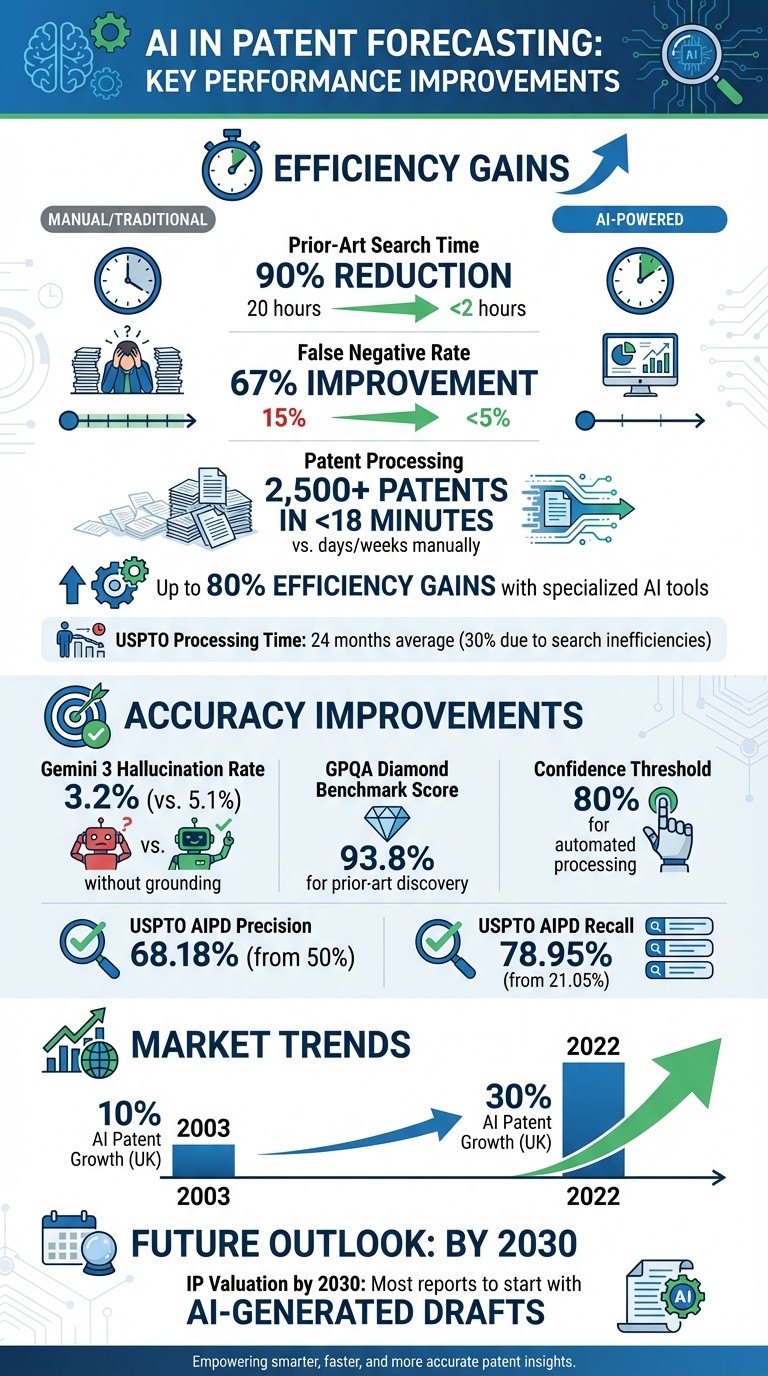
AI Impact on Patent Forecasting: Key Performance Metrics and Benefits
Identifying Key Drivers for Patent Forecasting
To sharpen patent forecasting and build effective AI models, it's essential to pinpoint the key factors driving patent trends. These trends are influenced by both demand-side forces - such as technological advancements and competitive filings - and supply-side constraints like examiner capacity and processing backlogs. By analyzing massive datasets, AI can identify the most impactful drivers, turning assumptions into actionable, data-supported insights. Let’s dive into the primary demand-side forces shaping patent activity.
Understanding Patent Demand Drivers
Demand drivers are the factors that motivate companies to file, maintain, or even abandon patents. For example, technological progress and the discovery of unexplored opportunities, often referred to as "white spaces", fuel new patent filings. A telling example is the growth in AI-related patents in the UK, which surged from about 10% of all filings in 2003 to nearly 30% by 2022. This shift highlights how innovation priorities evolve over time.
Competitive pressures also play a big role. When competitors file patents in a particular technology area or announce partnerships, it signals where the market is heading and where research and development investments are ramping up. AI tools can analyze various metrics - like licensing volumes, royalty trends, product performance, and even user reviews - to predict which patents are likely to generate revenue. Companies’ decisions to maintain or let patents lapse provide further clues about which technologies they consider worth protecting.
While demand-side factors drive patent filings, supply-side constraints significantly influence how these filings progress.
Addressing Supply-Side Constraints
Even when patent demand is high, supply-side limitations can slow the process. Examiner behavior is one such factor and varies widely across jurisdictions and individuals. AI tools can analyze historical data on examiner trends - approval rates, common objections, and average processing times - to better predict grant outcomes.
Processing timelines also create bottlenecks. For instance, the USPTO averages 24 months from application to grant, with inefficiencies in the search process accounting for about 30% of that time. To tackle these delays, major patent offices like the USPTO, EPO, and WIPO have adopted AI tools to handle large-scale data and improve examination quality. Understanding these constraints helps forecast not just when patents are filed, but when they might actually be granted.
Legal and ethical considerations further shape the supply landscape. For example, evolving regulations on AI inventorship and data compliance affect what can be patented. China’s CNIPA, for instance, mandates that inventors must be natural persons, which limits protections for AI-generated inventions. With these supply and demand factors in mind, the next step is leveraging AI to pinpoint the most influential drivers.
Using AI to Identify Influential Drivers
AI excels at identifying the drivers that truly impact patent outcomes. Using semantic search, AI can find conceptually similar patents, even when different terms are used, uncovering trends that traditional keyword searches might miss. Predictive analytics further enhances this by assigning probabilities to legal risks and grant outcomes, based on historical litigation, settlements, and examiner behavior. Machine learning models can also cluster similar patents, revealing redundancies or high-value groups.
AI-powered platforms can process millions of patent records and related documents in mere seconds, a task that would take human analysts days or weeks. Some specialized AI tools for drafting patent applications report efficiency gains of up to 80%.
"The future is not one of AI replacing human experts, but of a powerful symbiosis. AI will manage the scale and speed of data, while humans provide the indispensable strategic oversight, ethical judgment, and nuanced interpretation." - DrugPatentWatch
When choosing AI tools for driver identification, look for platforms that offer explainability - features that highlight the key influencers and their percentage impact on forecasts. This transparency helps clarify why certain drivers matter more than others. Additionally, configure AI tools to flag analyses with confidence scores below 80% for manual review. This ensures that human expertise remains central when uncertainty is higher than acceptable thresholds.
Setting Up AI-Powered Data Collection and Analysis
To turn raw data into actionable patent insights, using the top patent tools for AI-powered data collection is key. Once you've pinpointed the main drivers, configure AI systems to gather and process data into meaningful forecasts. This involves pulling information from various sources, cleaning it for consistency, and letting AI identify critical patterns. The goal? Skip the manual grind and let AI transform raw data into insights that matter. A solid foundation like this sets the stage for building and testing AI-driven scenario models.
Setting Up Data Inputs
AI systems thrive on diverse data sources to produce accurate forecasts. These sources include patent office databases like USPTO, EPO, and CNIPA, alongside external signals such as financial platforms, CRM dashboards, scientific papers from sites like arXiv, and even GitHub repositories. Automated pipelines can be configured to continuously feed this data.
A modular system works best, with specialized agents handling specific tasks such as extracting claims from USPTO or monitoring filings at EPO. Advanced AI models can process text, diagrams, and claims simultaneously with high precision, achieving a 93.8% score on the GPQA Diamond benchmark for prior-art discovery. This multimodal processing ensures that technical drawings and figures, often loaded with critical details, are not overlooked.
To minimize errors, use Retrieval-Augmented Generation (RAG), which grounds AI outputs in reliable sources like USPTO bulk data instead of relying solely on training data. This approach reduces hallucination risks - when AI generates incorrect but plausible-sounding information. For instance, Gemini 3's hallucination rate was just 3.2%, compared to 5.1% for models without grounding. Always archive raw data in an unedited _raw format before processing. This ensures you can trace back to the original data if issues arise during cleaning or analysis.
Ensuring Data Quality and Consistency
Patent data often comes with inconsistencies that need cleaning. While AI can automate much of this, it requires proper configuration to handle common issues effectively.
One recurring challenge involves "splits" and "lumps." Splits occur when a single entity appears under multiple names, such as "Google Inc.", "Google LLC", and "Google." Lumps happen when different entities share the same name, like multiple inventors named "Wang Wei". AI clustering algorithms can group variations into a single canonical name, but resolving lumps often requires cross-referencing additional data like institution names or co-inventors. Another common issue is concatenated fields, where multiple applicants, inventors, or IPC codes are crammed into one cell. These need to be separated into distinct rows while keeping the unique document identifier.
"One very common error is to imagine that data downloaded from a search of a patent database is ready to present to an audience. It is merely the start of the patent analytics process." - Paul Oldham, Author, The WIPO Manual on Open Source Patent Analytics
AI can also align different classification systems, such as the USPTO's Cooperative Patent Classification (CPC) and the older International Patent Classification (IPC). It can even translate multilingual content into a uniform format, helping create global patent landscapes. To maintain accuracy, use uncertainty scoring to flag outputs with less than 80% confidence for human review. This ensures that expert oversight remains part of the process when AI lacks certainty, directly supporting reliable scenario-based forecasting.
Using AI for Advanced Analysis
Once the data is clean and structured, AI can uncover patterns and insights essential for scenario-based forecasting. Natural Language Processing (NLP) and Large Language Models (LLMs) like BERT for Patents are particularly effective at interpreting the technical intent behind patent claims, even when different terminology is used. This goes beyond basic keyword searches, capturing conceptually similar patents that might otherwise be missed.
Clustering algorithms can highlight emerging technology areas and identify whitespace opportunities. For instance, classification tools group patents by technology domain, while clustering methods reveal trends that might not be evident in individual filings. In 2023, the USPTO improved its Artificial Intelligence Patent Dataset (AIPD) by replacing Word2Vec embeddings with BERT for Patents and using active learning to refine decision boundaries. This upgrade boosted precision to 68.18% and recall to 78.95%, compared to the previous method's 50% precision and 21.05% recall.
AI can also analyze multimodal data - combining text, images, and external signals to create a complete view of innovation. For example, computer vision techniques can interpret patent drawings, while knowledge graphs map relationships between patents, technologies, and inventors. This approach reduces false negatives in prior-art discovery from 15% to under 5%. For ongoing insights, set up "living dashboards" that update automatically as new patents are filed, keeping your forecasts current in a constantly shifting landscape.
When analyzing patents, focus on the claims section, as it defines the enforceable boundaries of the invention. Use the abstract and specifications for context, but let the claims guide your core analysis. To streamline data management, adopt standardized file naming conventions like source_topic_type_date_raw. This simple practice makes it easier to trace data origins and troubleshoot issues, ensuring a smoother analysis process. With these advanced techniques in place, AI-driven insights can be seamlessly integrated into scenario modeling and forecasting.
Building and Testing AI-Driven Scenario Models
Once you've cleaned your data and pinpointed key drivers, the next step is to create AI-driven scenario models. These models simulate various future possibilities, allowing you to test how factors like market changes, regional dynamics, or new competitors might impact patent value. The idea is to replace static forecasts with adaptable, dynamic models that respond to evolving conditions. This process connects AI-enabled patent platforms with strategic planning, paving the way for testing and refining these models.
Creating Scenario Models with AI
After cleaning and analyzing your data, AI takes over to break down patents and align them with potential market applications. It achieves this by dissecting patent claims into their functional components - essentially identifying what an invention does and how it operates - and then mapping these functions to industries and product designs. For example, a haptic engine patent could be linked to gaming controllers, medical devices, or even automotive systems. AI then simulates how each of these application scenarios could influence the patent portfolio's value.
The process relies on a modular framework. AI begins by analyzing patent claims, abstracts, and legal status from databases like USPTO or EPO. It then extracts the "core functionality" of the invention and maps these components to commercial categories. This mapping is enhanced by tools like Technology Identifiers (Tech_IDs), which classify patents for cross-industry applications. AI continuously updates these models by scanning new filings and market signals, ensuring relevance over time. Remarkably, AI can categorize over 2,500 patents in under 18 minutes - a task that would take humans days or even weeks. By 2030, most IP valuation reports are expected to start with AI-generated drafts that include projected income and benchmarking data.
These models also integrate predictive analytics to assess legal risks. By analyzing historical data on lawsuits, settlements, and examiner behavior, AI assigns probabilities to potential challenges like litigation or patent invalidation. This makes the models not just market-focused but also legally robust.
Testing and Refining Models
Once your models are built, it's time to test them thoroughly to ensure reliability. Metrics like Root Mean Square Error (RMSE), the determination coefficient (R²), and Mean Absolute Percentage Error (MAPE) help measure accuracy and variability. For time-series data, techniques like the "rolling origin" or expanding window ensure that the models perform well across different historical periods.
To fine-tune these models, Bayesian hyperparameter optimization is often used. This method speeds up the process by leveraging a surrogate model for quicker convergence. Complex models like LSTMs or transfer function models can be benchmarked against traditional approaches like ARIMA to identify weaknesses, especially during market volatility. Residual plots are another useful tool for spotting patterns the model might have missed. Additionally, active learning can enhance performance by focusing on data near critical decision boundaries.
"ARIMA provides more stable performance across multiple scenarios, highlighting a trade-off between short-term accuracy and long-term reliability." - MDPI Inventions Journal
Incorporating Expert Knowledge
While AI offers speed and scale, expert judgment is essential for refining these models. AI-driven outputs reach their peak potential when paired with human expertise. IP professionals can review AI-generated drafts, adjust assumptions, and customize models to fit specific business needs. Experts also define the variables for "what-if" simulations, such as the impact of a new competitor or changes in regional demand.
Training AI on a company's specific taxonomy ensures that patent data aligns with the business's unique way of categorizing technologies. Providing natural language definitions for these categories helps the AI understand the nuances of the field.
Explainable AI (XAI) plays a critical role here. For effective modeling, AI must provide clear explanations for its decisions. For example, it should clarify why a patent is valued a certain way, allowing experts to verify that the logic aligns with legal and technical standards. Experts also contribute by updating Technology-to-Application Mapping Tables, ensuring that models stay relevant as industries evolve.
"AI doesn't replace expert judgment. It enhances it. The most effective implementations treat AI as a partner - accelerating the classification process, surfacing insights faster, and freeing up human experts to focus on higher-value analysis and decision-making." - Clarivate
Interpreting and Acting on Forecasting Outputs
With AI-driven models in place, the challenge now lies in making sense of the outputs and turning them into strategic decisions. By 2030, the role of AI will shift from simply generating data to helping refine and customize it. The focus will be on identifying which scenarios matter most, using them for planning, and presenting the insights in a way that stakeholders can quickly act upon.
Comparing and Evaluating Scenarios
The first step is evaluating the probability and impact of each scenario. AI tools excel at running "what if" simulations - such as market shifts, new competitors, or regional challenges - to show how these variables influence patent value and resilience. For instance, when analyzing a haptic engine patent, AI might connect it to B2C fitness trackers, B2B AR/VR headsets, or automotive systems. Each option comes with its own risks and rewards. Scenarios with confidence scores above 80% should be prioritized, while those below should be flagged for review to catch potential issues, like "hallucinated" prior art.
Sensitivity analysis is a critical tool here. It allows you to test how licensing a patent to one partner in a specific region might affect your leverage with others. By using Technology Identifiers (Tech_IDs), you can compare how a single patented function performs across different industries, such as B2B versus B2C markets. AI can also predict legal risks by analyzing historical lawsuit data, settlement trends, and examiner behaviors.
Using Scenarios for Planning
The value of scenario data goes beyond analysis - it's a planning resource. It helps optimize resources, manage risks, and refine strategies. For example, mapping patent functions to "Service Models" like Licensing, SaaS, or Subscription can reveal the most profitable commercial paths. If a scenario highlights weak assets or "noise" patents, you can phase them out to avoid unnecessary maintenance costs. AI-powered analytics make it easier to identify these underperformers early, freeing up resources for higher-value patents.
Real-time dashboards now offer dynamic updates on patent valuations. Unlike static annual reports, these dashboards monitor live signals - such as revenue, app downloads, and competitor activity - to automatically adjust IP valuations. This "always-on" approach allows you to adapt strategies as conditions evolve. The ultimate goal is to shift IP management from being a reactive legal function to a proactive business tool, integrating patent data with CRM systems, product roadmaps, and R&D plans.
Communicating Insights to Stakeholders
Clear communication is essential for turning analysis into action. Stakeholders need concise, actionable insights. Tools like visual dashboards, executive slide decks, and function-to-market mapping matrices can bridge the gap between technical data and business strategy. For example, a "Claim-to-Feature Matrix" can help legal teams identify product elements that meet specific claim limitations, simplifying infringement risk and novelty assessments. Meanwhile, "investor-ready one-pagers" can summarize valuation and risk for investors in a single, digestible format.
Communication Format | Target Stakeholder | Primary Purpose |
|---|---|---|
Investor-Ready One-Pagers | Investors / VCs | Quick valuation and due diligence |
Function-to-Market Matrices | R&D / Product Managers | Identifying licensing opportunities and product-market fit |
Claim-to-Feature Matrices | Legal Counsel | Infringement detection and FTO analysis |
Live Dashboards | Executive Leadership | Continuous monitoring of portfolio health and risks |
Transparency is key to building trust. Addressing concerns about AI's "black box" nature requires explainable models that clarify how classifications and risk scores are determined. Allow stakeholders to customize or train the AI using your company's specific taxonomy to ensure outputs align with internal priorities. Presenting "what-if" models can also demonstrate how value or risk changes under different market conditions. This type of contextual storytelling ties AI insights to real-world business goals, enabling executives to make well-informed decisions.
"The edge won't come from assembling numbers. It'll come from knowing what numbers to trust, what assumptions to tweak, and how to connect the model to real business goals." - PatentPC
Conclusion and Key Takeaways
AI-driven scenario forecasting is changing how patent management works, swapping out static reviews for dynamic, real-time intelligence. Patent professionals now have tools to simulate various scenarios, assign accurate probabilities to legal risks, and identify hidden innovation opportunities. This evolution shifts IP management from routine tracking to a more strategic role in decision-making.
The implementation process builds on earlier discussions of key drivers and model-building. It involves consolidating data, running AI analyses on patent claims, mapping functions to markets, and conducting sensitivity tests. AI serves as a "first draft" tool, with human expertise fine-tuning the insights. This marks a shift in focus - from creating models to refining AI-generated outputs with expert oversight.
"The role of the analyst will shift - from 'builder' to 'editor.'" - PatentPC
Patently simplifies this workflow by combining claim-level analysis with market insights. Its tools - AI-assisted drafting, advanced semantic search, and collaborative project management - streamline forecasting while ensuring transparency and accountability. With features like customizable fields and robust claim-level analysis, Patently supports a more explainable and auditable approach to managing modern patent portfolios.
The benefits are clear: AI-powered platforms process vast amounts of data, accelerating innovation while cutting costs. Additionally, with the USPTO's updated fee rules taking effect on January 19, 2025, continuous AI-driven portfolio reassessment becomes crucial for managing expenses effectively.
These advancements enable organizations to make smarter, data-driven decisions. As patent portfolios grow more complex, adopting AI is no longer optional - it’s essential.
"In 2026, the question is no longer whether AI belongs in portfolio management. It is whether organizations can afford to manage increasingly complex patent portfolios without it." - DeepIP
The real competitive edge lies in deciding which AI insights to trust, challenging assumptions, and connecting predictive models directly to business objectives.
FAQs
What data do I need to start AI scenario-based patent forecasting?
To kick off AI-driven scenario-based patent forecasting, start by gathering multimodal patent data. This means collecting a mix of information like text, images, historical patent trends, and insights into technological advancements. The key datasets you'll need should include patent landscapes, filing patterns, innovation activities, and shifts in the market.
In addition, having access to patent portfolios, prior art, and classification data is crucial. These resources help machine learning models pinpoint trends and make accurate predictions about future technologies.
How do I validate AI patent forecasts and confidence scores?
To ensure the reliability of AI patent forecasts and their confidence scores, AI tools can be employed to analyze patent databases and legal documents for potential challenges. These tools excel at quickly evaluating prior art and legal data, helping maintain accuracy. Beyond this, methods like cross-validation, time series modeling, and semantic similarity checks add another layer of verification. Together, these approaches ensure that the forecasts are grounded in solid data and thorough analysis.
How should humans review and approve AI forecasting outputs?
When reviewing AI forecasting outputs, it's crucial to ensure they meet transparency and disclosure standards. This involves checking for accuracy, completeness, and proper documentation. For example, the USPTO requires that any AI involvement be disclosed if it impacts patentability. Reviewers need to carefully evaluate whether the outputs are correct, relevant, and aligned with both legal and technical guidelines. Throughout the process, maintaining a commitment to candor and good faith is essential before giving final approval.