Vector AI and Semantic Search Accuracy in Patents
Intellectual Property Management
Apr 18, 2026
Explains how Vector AI semantic search improves patent prior-art discovery, making searches faster, multilingual, and higher recall than keywords.
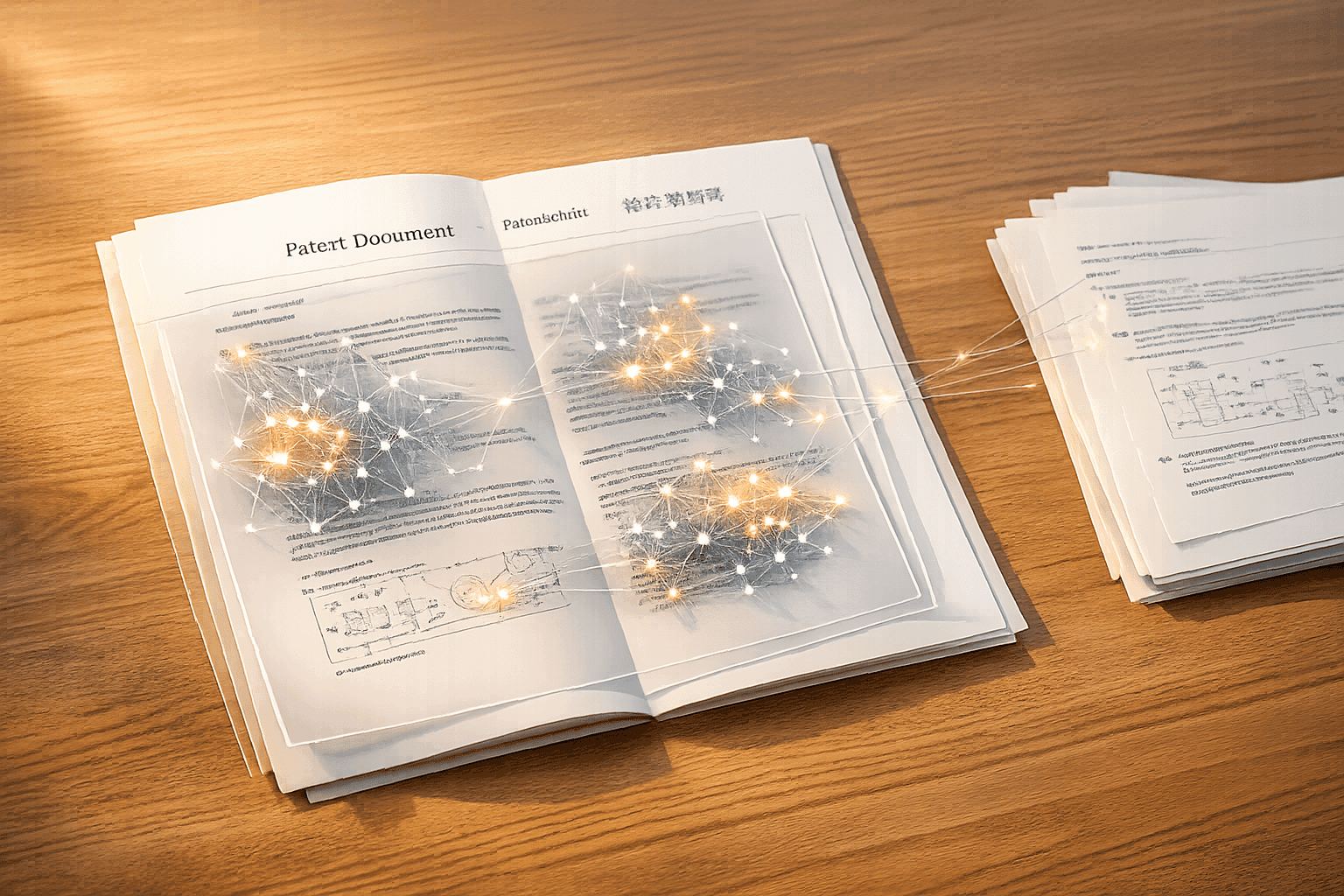
Patent searches are evolving - and fast. Traditional keyword searches often miss 20-40% of relevant prior art due to vocabulary mismatches. Enter Vector AI semantic search, a method that focuses on conceptual meaning rather than exact word matches. This approach reduces false negatives by 30-60%, handles multilingual patents seamlessly, and delivers results in seconds instead of hours.
Key Takeaways:
Semantic Search Benefits: Finds related concepts even with different terminology (e.g., "autonomous vehicle" = "self-driving car").
Multilingual Capability: Bridges language gaps across global patents without manual translations.
Speed Advantage: Results in seconds, saving hours of manual query refinement.
Precision & Recall: Improves recall significantly, retrieving up to 98.3% of unique patents missed by keyword searches.
In this article, we’ll compare Vector AI to keyword-based methods, highlighting why it’s becoming the go-to tool for patent professionals.
Dr. Lucas Sheneman: Using AI to Enable Modern Semantic Search in a Data Portal
1. Vector AI Semantic Search (e.g., Patently)
Vector AI semantic search is reshaping how patent professionals locate prior art by focusing on the meaning behind concepts rather than relying on exact word matches. Platforms like Patently make this process user-friendly by allowing searches in plain English, eliminating the need for complex Boolean syntax. The system works by converting patent text into high-dimensional vectors, which measure the "distance" between concepts. This approach identifies related inventions - even if they use entirely different terminology - making searches far more effective.
The benefits of this technology can be seen across four key areas. Semantic accuracy tackles the challenge of vocabulary mismatches. For example, where one patent might mention "autonomous vehicle" and another says "self-driving car", Vector AI links these as related ideas. This capability significantly reduces false negatives, a finding supported by the World Intellectual Property Organization (WIPO).
Multilingual capability is another game-changer, especially since over 70% of patent filings are in non-English languages. Around 25% of Chinese patents, for instance, contain technical details not available in English. Vector AI bridges this gap by matching concepts across languages, even when translations are imperfect. It also handles non-Latin scripts, such as those in Chinese, Japanese, and Korean patents, ensuring consistent terminology across global jurisdictions.
Speed is another area where Vector AI shines. In October 2024, IP professional Laurence Brown used Patently's Vector AI to search for "In-ear headphones with noise isolating tips", applying a priority date filter before 2000. The tool returned 300 results, allowing Brown to pinpoint the relevant Sony patents in under five minutes. Similarly, in September 2025, researcher Sundeep L reduced embedding generation time from 15 days to just 6.5 hours - a 56× improvement - while achieving sub-4-second query times for a database of 2.9 million English-language patents.
Finally, recall and precision metrics highlight how well Vector AI balances its performance. A PatentBench study from December 2025 tested 340 samples and found that specialized patent AI agents achieved 100% recall in retrieving all four relevant patent families in one test case, far surpassing general-purpose models. Additionally, the system uncovered 98.3% unique patents compared to traditional keyword searches, proving its ability to identify prior art that often goes unnoticed with conventional methods.
With its unmatched accuracy, multilingual capabilities, speed, and balanced performance, Vector AI sets a new standard for patent searches. Next, we’ll explore how these benefits compare to traditional keyword-based methods.
2. Traditional Keyword Search
Traditional keyword search operates by matching exact words, without accounting for context or synonyms. For example, if you search for "wireless charging", the system will only look for those exact terms in patent documents. But if a patent describes the same concept using phrases like "contactless energy transfer" or "electromagnetic coupling", it won’t appear in the results. As PatentScan explains:
Traditional keyword searches focus on terms like 'wireless,' 'inductive,' and 'charging.' However, the most relevant prior art used terminology like 'contactless energy transfer' and 'electromagnetic coupling' - terms that wouldn't surface in keyword-based queries.
This approach struggles with semantic accuracy. Keywords are treated as isolated entities, which means the system fails to understand relationships between terms in technical contexts. For instance, keyword indexing breaks words into their "stems" (e.g., "driving" becomes "driv"), which helps find variations of the same word but doesn’t connect terms with similar meanings, like "autonomous." As Sundeep L observed:
Traditional keyword matching often misses relevant patents due to technical jargon variations.
Another challenge is multilingual capability. These systems rely on exact matches or manual translations, which often fail to capture the nuanced meanings of technical terms, such as chemical formulas or engineering concepts. To compensate, users must create extensive bilingual glossaries and list every possible synonym across languages. This process is labor-intensive and still prone to gaps in coverage.
Speed is another drawback. Refining searches to ensure completeness takes significant time. For example, comprehensive searches often require 7–13 hours, costing around $7,800 in attorney fees. Much of this time is spent crafting complex Boolean queries like (wireless OR contactless) AND (power OR energy) and repeatedly refining them when results fail to capture relevant patents.
When it comes to recall and precision, traditional keyword search achieves high precision for exact matches but suffers from low recall - missing between 20% and 40% of relevant prior art. A comparative study even found that semantic search uncovered substantial prior art that keyword methods completely overlooked. Worse, traditional systems offer no feedback when relevant documents are missed; if the terms in your query don’t align with those in the patent, you simply get no results.
These limitations underscore why semantic search methods and top patent tools are increasingly seen as a game-changer for patent research.
Advantages and Disadvantages
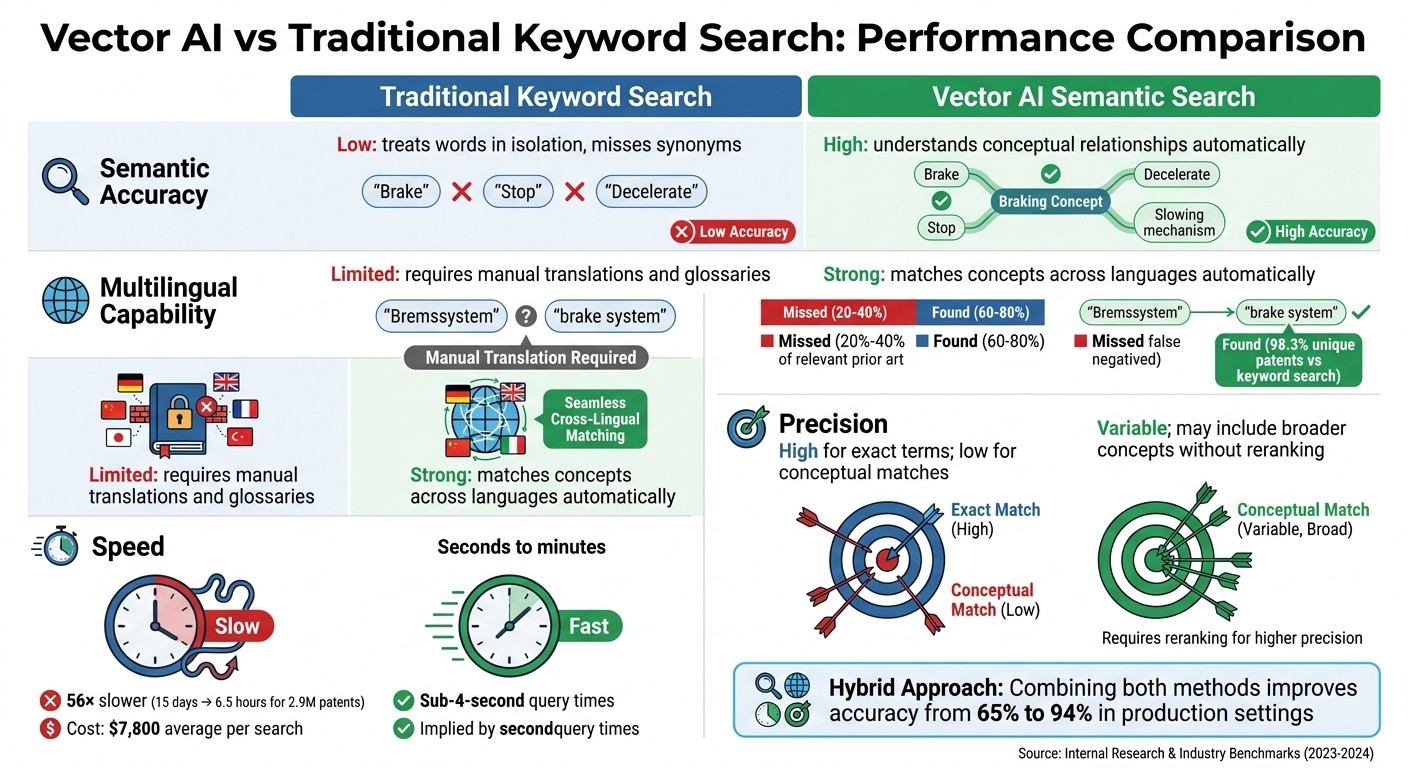
Vector AI vs Traditional Keyword Search: Patent Search Performance Comparison
When comparing Vector AI with traditional keyword search, the strengths and weaknesses of each approach become evident. Here's how they stack up:
Semantic accuracy and multilingual capability are major advantages of Vector AI. It automatically connects related terms and bridges language barriers. For example, it can equate the German term "Bremssystem" with the English "brake system" without requiring manual translations or lengthy synonym lists. Traditional systems, on the other hand, lack this level of automation and rely heavily on manual input.
Speed is another area where Vector AI shines. It processes and delivers results within seconds or minutes. Compare that to traditional keyword search, which can take 7–13 hours of attorney time and cost as much as $7,800 per search.
Recall and precision show a clear divergence between the two. Traditional keyword search is precise when dealing with exact terms but struggles with recall, often missing 20% to 40% of relevant prior art. Vector AI improves recall significantly, though it may occasionally return broadly related results if reranking isn’t applied. To address this, many industries now use hybrid approaches that combine both methods, improving answer accuracy from 65% to 94% in production settings. This hybrid model balances precision and recall, making it essential for effective patent research.
Comparative Summary of Key Metrics
Criterion | Traditional Keyword Search | Vector AI (Semantic Search) |
|---|---|---|
Semantic Accuracy | Low; treats words in isolation, misses synonyms | High; understands conceptual relationships automatically |
Multilingual Capability | Limited; requires manual translations and glossaries | Strong; matches concepts across languages automatically |
Speed | Slow; takes 7–13 hours for comprehensive searches | Fast; delivers results in seconds to minutes |
Recall | Low; misses 20%–40% of relevant prior art | High; reduces false negatives by 30%–60% |
Precision | High for exact terms; low for conceptual matches | Variable; may include broader concepts without reranking |
Conclusion
When comparing performance and efficiency, the benefits of Vector AI stand out clearly. It redefines the precision of patent searches. Traditional keyword-based methods often stumble over vocabulary mismatches, missing between 20% and 40% of relevant prior art. In contrast, Vector AI reduces false negatives by an impressive 30% to 60% and delivers results in seconds rather than the hours required by conventional searches.
Speed isn't the only advantage. Vector AI also handles multilingual matching and processes natural language queries, removing the need for complicated Boolean logic. This is a game-changer for patent professionals who face the daunting task of navigating 3.6 million global applications annually. Platforms like Patently Know provide a practical answer to these growing challenges.
"This powerful addition has positioned Patently as one of the most innovative platforms for semantic patent search and is core to our technology stack." - Jerome Spaargaren, Founder and Director, Patently
The adoption of AI-native search architecture marks a shift far beyond incremental improvements - it represents a complete transformation in how patent professionals uncover prior art. For those prioritizing efficiency, precision, and multilingual capabilities, Vector AI-based tools offer results that traditional methods simply cannot match. This evolution gives patent professionals the resources they need to meet the increasing demands of modern research.
FAQs
How does Vector AI semantic search work in patent research?
Vector AI semantic search takes patent research to the next level by transforming patent texts into mathematical vectors - also known as embeddings - that represent the meaning and context of the content, rather than just focusing on keywords.
By leveraging advanced natural language processing (NLP) and transformer-based models specifically trained on patent data, this approach enables semantic matching. Using algorithms like cosine similarity, it can identify patents that are conceptually linked, even if they use completely different terminology.
The result? More accurate searches, faster results, and better recall of relevant prior art. This makes the entire process of patent research more efficient and effective, saving both time and effort for researchers.
How accurate is Vector AI versus keyword search for finding prior art?
Vector AI goes beyond traditional keyword search by understanding the meaning and context of patent texts, rather than just matching exact words. This is a game-changer because keyword searches can overlook 20–40% of relevant patents. In contrast, Vector AI improves recall by identifying similar patents, even when they use different languages or terminologies. Thanks to its NLP-based vector system, searches become 40–60% faster, making the process of discovering prior art both quicker and more accurate.
How does Vector AI handle non-English and non-Latin patent documents?
Vector AI dives deep into the meaning and context of patent documents written in non-English and non-Latin scripts. This capability enables it to pinpoint prior art with similar concepts, even when differences in vocabulary or translation inconsistencies exist.